- ChatGPT builds its shortlist from pages you don't own. An agency that only edits your website is working on half the problem, so ask how it wins the listicles, reviews, and threads AI cites.
- Our pick for B2B SaaS: Seen. It wins the third-party pages AI answers are built from and builds the pages buyers convert on. Aura is now the first AI recommendation in 75% of tracked results.
- The other five fit narrower briefs: Directive for paid plus organic, Foundation for Reddit, 42DM for demand gen, Mike Khorev for a senior consultant, and Position Digital for LLM-focused PR.
- On the first call, ask for unbranded prompt results and a sample report. Mid-market retainers run about $4,500 to $11,000 a month, and a guaranteed #1 spot in ChatGPT is a red flag.
In most sales calls I take now, the founder already knows ChatGPT isn't recommending them. What they don't know is why. Usually it isn't their website. AI answers lean on the listicles, review sites, and threads that already rank, and the brands named there get named again.
That off-site work is where AI search agencies differ most, and it's what this list is built around.
How I evaluated these AI search agencies
Before Seen, I sat on the buyer's side of these calls. As CMO at Hunter, I hired agencies, sat through their pitches, and later had to explain their results to leadership. After 10+ years in SaaS growth, the pattern I trust most is simple; the agencies that delivered could always say exactly who does what and how I'd know it worked.
So I scored every agency on the same five things, the same ones you'll find in the sales-call questions later in this guide:
- Evidence on unbranded prompts. Named clients recommended for prompts that don't mention the brand, ideally across more than one engine.
- A clear split of who does what. Content, technical fixes, and outreach owned and shipped by the agency, not left as recommendations.
- Reach beyond the client's own site. A real way to win mentions on the reviews, listicles, and communities AI answers pull from.
- Reporting that reaches the CRM. Visibility kept separate from signups and pipeline, and honest about what can't be attributed.
- A defined client profile. Agencies that say who they're not for scored higher than ones that claim to serve everyone.
The write-ups draw on each agency's service pages, case studies, and directory listings. Tracking-only vendors didn't make the list. If a dashboard is all you need, the build-versus-buy section below covers that route.
One disclosure: Seen is my agency and sits at #1, written up in the same format as the other five.
6 best AI search agencies to shortlist
[table]
Agency | Best for | Core AI search focus | Pricing signal
Seen | B2B SaaS teams that measure organic by signups and pipeline | AI recommendations through placements on LLM-cited sources and BOFU pages | Custom monthly engagement, scoped after a strategy call
Directive | Larger B2B and SaaS companies running paid, SEO, and AI search together | AI citations connected to CRM outcomes | Not published; Clutch reviewers report $10,000 to $100,000+ a year
Foundation | B2B brands whose buyers research in Reddit and communities | Content distribution across Reddit, communities, search, and LLMs | Not published; Clutch lists $200 to $300 an hour
42DM | B2B tech companies wanting AI search inside demand generation | AEO within a wider demand gen program | Not published; Clutch reviewers report $40,000 to $50,000 projects
Mike Khorev | Founders who want to work directly with a senior consultant | AI-optimized content, technical SEO, backlinks, and citations | From $3,500/month for ongoing SEO and inbound consulting
Position Digital | Brands wanting prompt research and LLM-focused digital PR | Prompt research, content optimization, and digital PR for LLMs | From about $2,000/month
[/table]
1. Seen
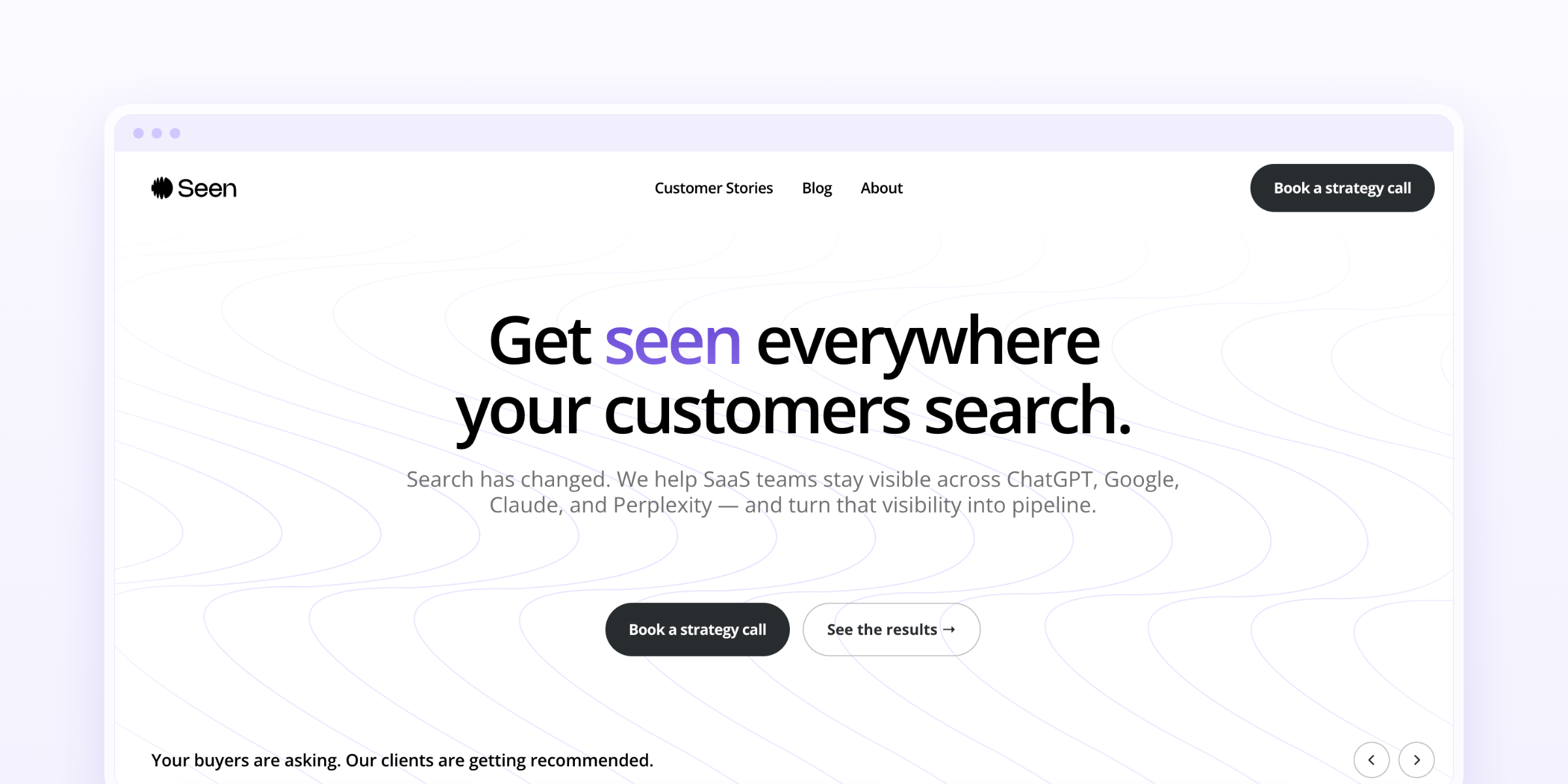
Seen treats AI search as a sourcing problem. ChatGPT, Gemini, Claude, and Google's AI Overviews build their recommendations from pages the web already trusts, like listicles, review sites, comparison articles, and communities, plus product pages that state the facts clearly. So Seen works on both sides at once: winning a place on the sources those answers cite, and building the client's own GEO- and AEO-ready pages that buyers land on and sign up from.
It works only with B2B SaaS, and it measures everything against signups and pipeline rather than traffic. The founder sets each strategy, and the same senior team that plans the work ships it.
Standout capabilities:
- Citation-source mapping turned into a plan. For each priority buyer prompt, Seen finds the pages AI answers draw on and where the client is missing, then decides which sources to win, which pages to build, and in what order.
- Owned pages buyers convert on. Comparison, alternatives, and product pages that state what a model needs to know (who the product is for, integrations, pricing model) and give a buyer a reason to sign up.
- Placements on the pages AI already cites. Listicle inclusions, editorial mentions, backlinks, and review profiles, pitched one publisher at a time rather than sold in bulk.
- The founder on every account. Irina Maltseva, former CMO at Hunter, sets and reviews each client's strategy, while Seen's team handles execution.
What makes Seen different
- The first line of every report is signups. Pipeline from Google and AI search comes first. Mentions and citations follow as leading indicators, not as the result.
- The brand comes before the keywords. Aura's name is a common word, so before chasing rankings Seen built consistent third-party mentions that taught search engines and LLMs that "Aura" means identity theft protection.
- Authority is earned, not bought in bulk. Some of Riverside's and Nextiva's best placements took months of outreach and negotiation. Seen would rather win the five pages ChatGPT actually cites than fifty it ignores.
- Every category gets its own experiments. What moves recommendations in tax compliance isn't what moves them in podcasting, so Seen tests per client and scales what works.
- In-house thinking, agency execution. Irina spent 10+ years growing SaaS companies from the inside, so the plan is built around the numbers a leadership team reports on.
Where Seen's clients started and where they are now
[table]
Client | Starting point | Result in AI search
Aura (online security) | A new domain competing with security brands that had decades of authority | #1 recommendation in 75% of tracked AI results, and featured in 10.8K AI answers and about 5K Google AI Overviews
Sphere (YC- and a16z-backed tax compliance) | A brand-new website getting about five organic clicks a day in spring 2025 | #1 across LLMs for AI-powered global tax compliance, with 40% of SQLs now coming from Google and LLMs
Riverside (podcast software) | A crowded category, plus a migration from riverside.fm to riverside.com | #1 on ChatGPT for "best podcasting software" and present in 4.3K AI answers, after 500+ earned mentions
Nextiva (business communications) | A strong content team with little capacity for off-site work | #1 on ChatGPT for "best business VoIP" and featured in 7.8K Google AI Overviews
[/table]

Curious how these brands got there? See the full customer stories →
What clients say about Seen
"It's rare to find a partner like this—any team that needs help with visibility and pipeline will genuinely benefit from working with Seen."
Gaetano DiNardi, ex-VP of Growth at Aura
"Highly recommend Seen for all things search. Their expertise spans both traditional SEO and the new world of LLM-based search, which has been incredibly valuable for us as a fast-growing global business. Also, just an absolute pleasure to work with."
Nicholas Rudder, CEO at Sphere
Clients include: Sphere, Aura, Nextiva, Riverside, Artisan.
Limitations: Seen works only with B2B SaaS companies. It's also not the right partner if you need results within 30 days or aren't ready to invest in content.
Pricing: Custom monthly engagements. Seen scopes each one after a strategy call, based on how much content needs to be built and how many third-party placements the category calls for.
Best for: B2B SaaS companies that need someone to both plan and ship their AI search work, and want to see it in signups and pipeline.
[cta]
Wondering why ChatGPT recommends your competitors and not you?
See which buyer prompts you're missing, which sources AI cites instead of you, and whether Seen is the right partner to change that.
[/cta]
2. Directive
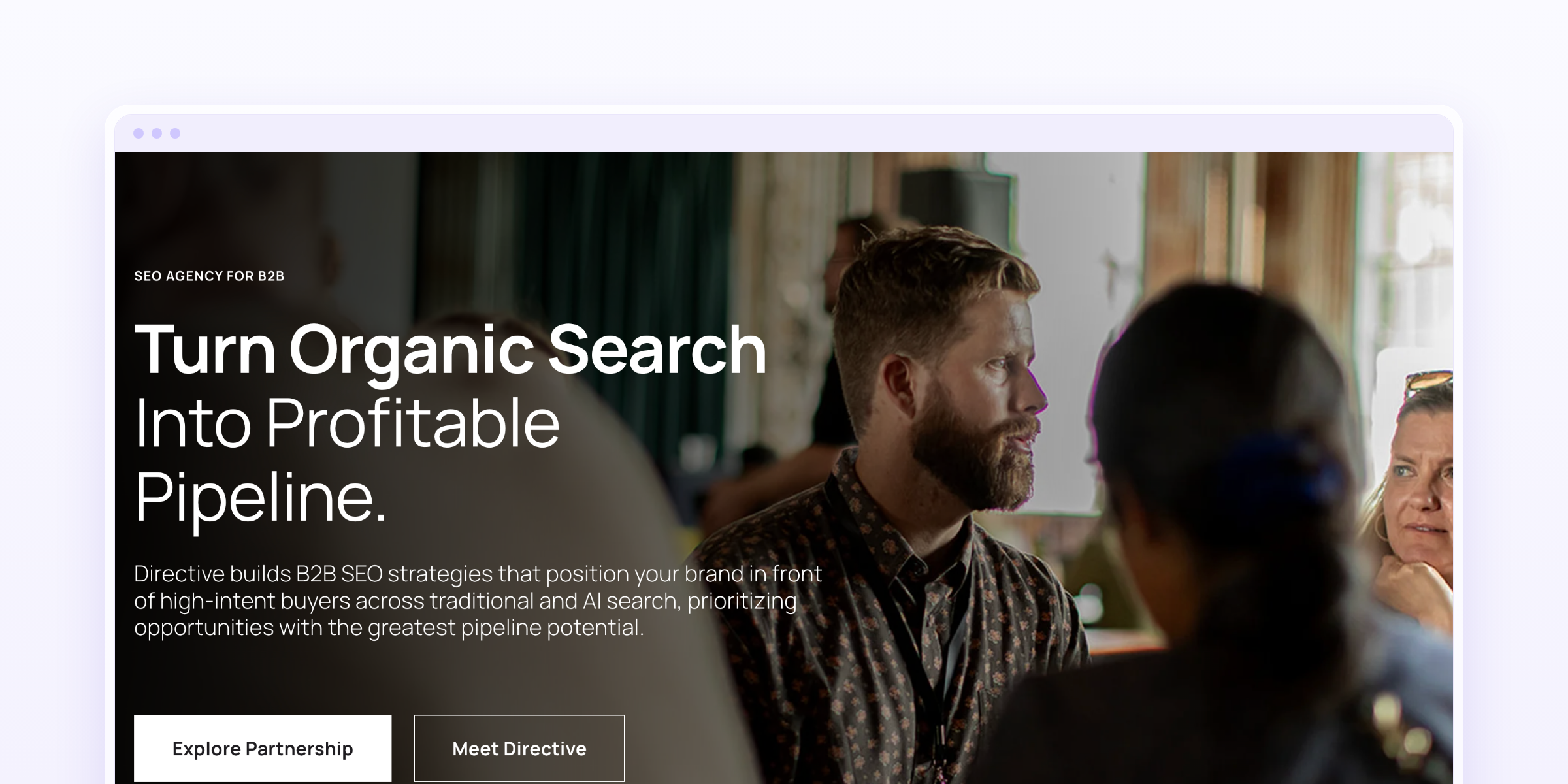
Directive is a B2B and SaaS performance marketing agency that runs paid media, SEO, and AI search visibility as one integrated program. Its DiscoverabilityOS methodology is built for complex B2B buying cycles with multiple stakeholders, long sales timelines, and AI-powered discovery.
That suits a larger marketing team that wants one partner accountable across channels rather than three vendors reporting separately. Its Clutch profile puts its client base at roughly 60% mid-market and 40% enterprise.
Standout capabilities:
- DiscoverabilityOS, which connects organic visibility and AI citations to CRM outcomes
- Custom Stratos dashboards that connect content performance with pipeline and closed revenue
- Paid media, SEO, and AI search run by one team under one plan
- Customer Generation, its pipeline-focused methodology, which it says 250+ B2B companies have used
Notable result: Directive reports that AxisCare achieved 70% traffic growth, 200% demo growth, and net-new SQLs from AI-driven search.
Clients include: AxisCare and Case Status, among the companies featured in its published case studies.
Limitations: Directive's value comes from integration. A team with an established paid media partner may prefer a narrower AI search brief.
Pricing: Directive doesn't publish rates. Clutch reviewers report spending from $10,000 to more than $100,000 a year. Ask for a proposal that separates AI search deliverables from the wider paid media and SEO program.
Best for: Larger B2B and SaaS marketing teams consolidating paid and organic under one partner.
3. Foundation
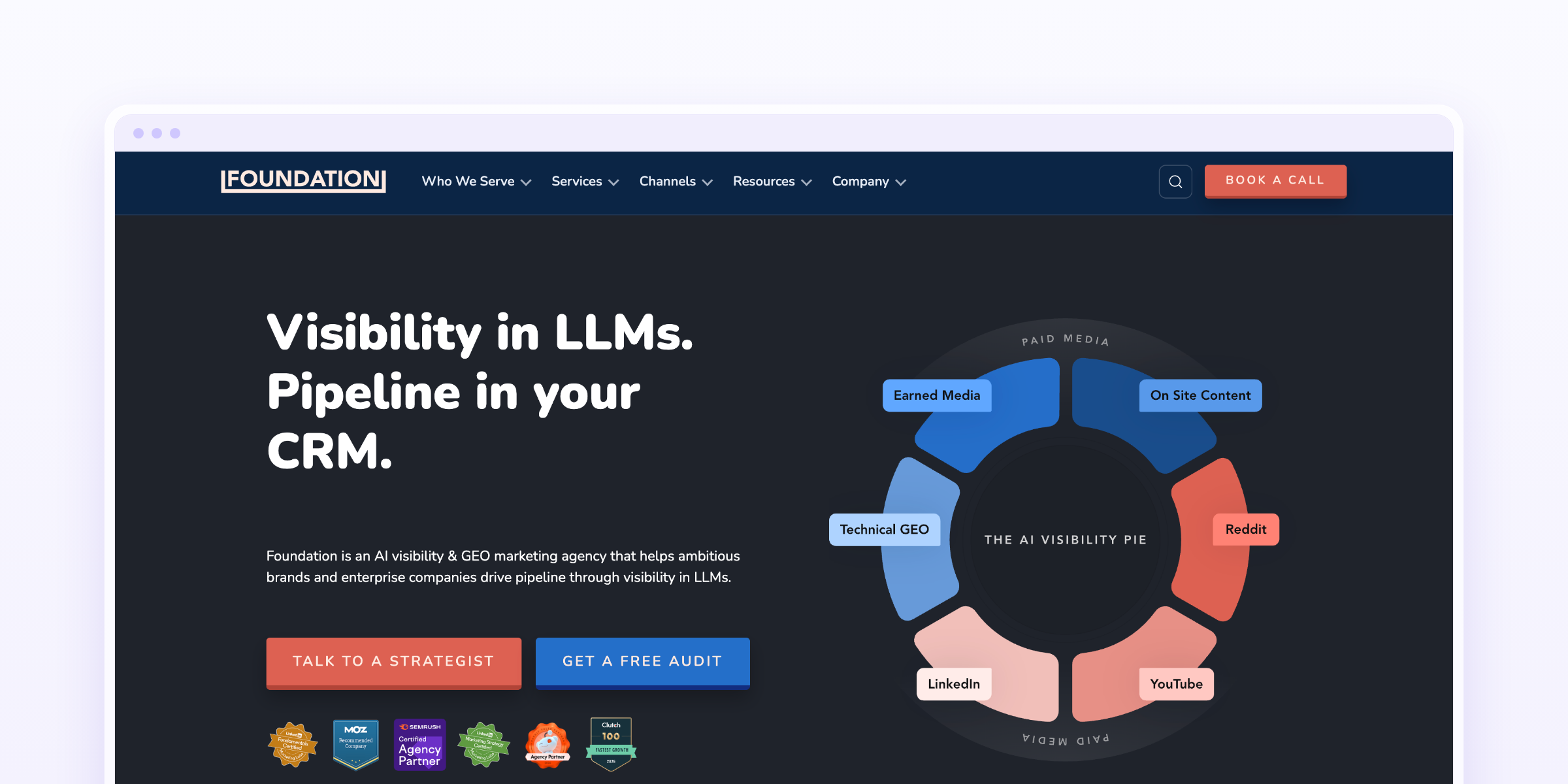
Foundation is a B2B content marketing and distribution agency founded by Ross Simmonds, headquartered in Philadelphia with offices in Canada. Its guiding idea is "create once, distribute forever," and it now describes itself as an AI visibility marketing agency for mid-market and enterprise B2B tech and SaaS companies.
It's the distribution-led option on this list, best known for organic and paid Reddit marketing. That makes it a natural fit for brands whose buyers compare tools in communities, where threads often rank on Google and feed AI answers.
Standout capabilities:
- Reddit research into top-performing posts, community rules, and moderator activity before any participation plan
- Community content such as AMAs, shared original research, and participation in trending discussions
- Organic and paid Reddit distribution managed together
- Technical SEO and content strategy available alongside distribution
Notable result: Foundation says it has generated over 220 million organic visits for its clients.
Clients include: Webex, Mailchimp, Snowflake, Canva, Procore, Bitly, and Paychex.
Limitations: Distribution is a weaker fit if your buyers spend little time in communities. Ask for evidence of AI mentions or citations rather than treating Reddit participation as the result.
Pricing: Foundation doesn't publish package prices. Its Clutch profile lists an hourly rate of $200 to $300. Ask for a proposal that separates research, content, participation, and paid distribution.
Best for: B2B brands whose buyers research in Reddit threads and online communities.
4. 42DM
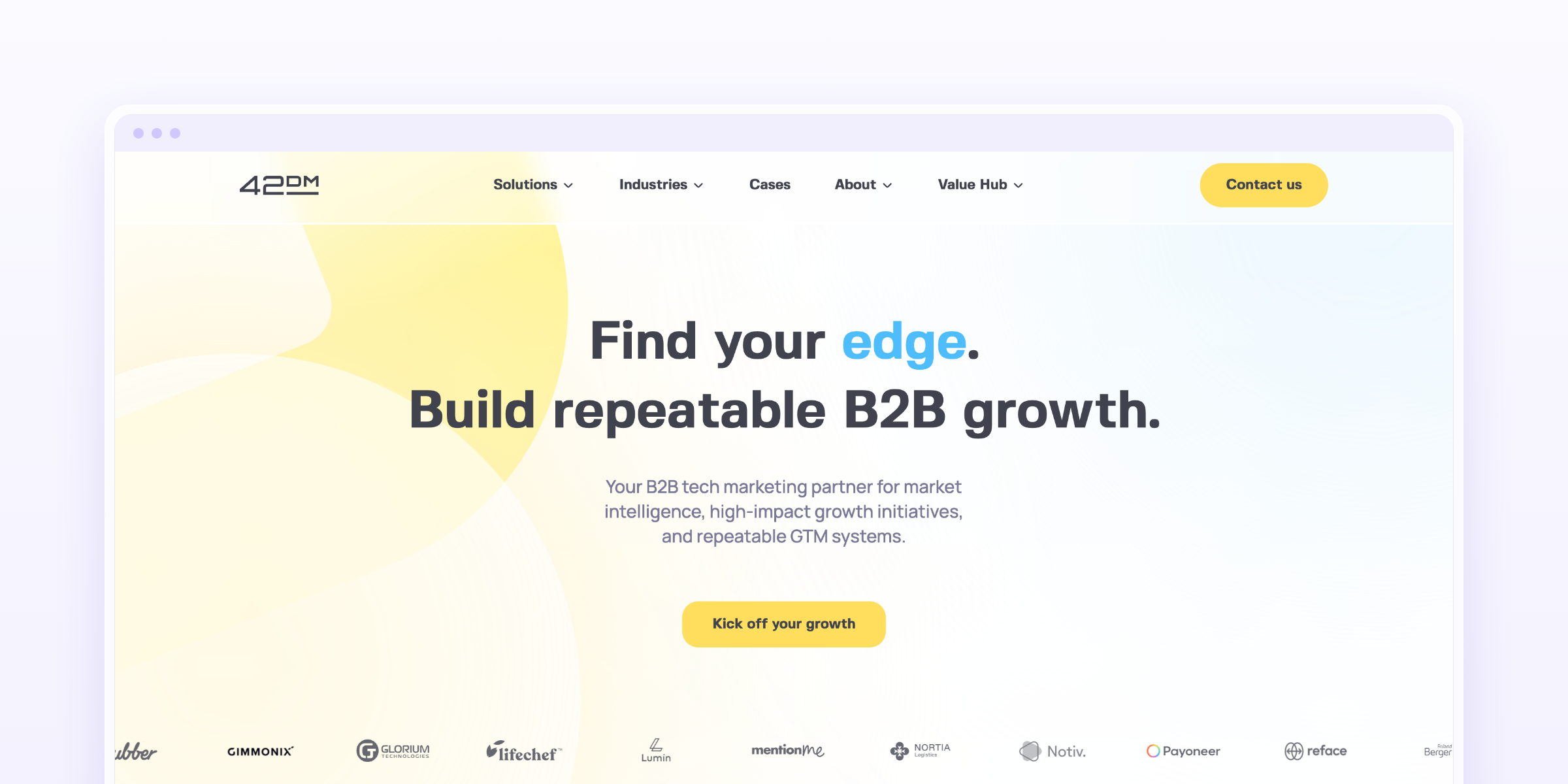
42DM is a full-service B2B marketing agency for tech companies, founded in 2016 and led by CEO Kate Vasylenko. It works across inbound, demand generation, account-based marketing, and MarTech, with HubSpot and Salesforce expertise.
It positions AI search as one channel inside that demand gen program. That suits teams that already plan around demand gen and want AI visibility handled by the same partner as the rest of their acquisition work.
Standout capabilities:
- AEO inside demand generation, planned alongside paid, email, and ABM
- Account-based marketing for B2B tech target accounts
- MarTech and CRM operations, including HubSpot and Salesforce work
- SEO and content marketing for organic growth
Notable result: 42DM's Lumin case study reports a 491% increase in monthly organic clicks, plus new traffic streams from ChatGPT and Perplexity.
Clients include: Lumin, featured in its published case study. Most of its Clutch reviews describe clients by category, such as a retail execution platform, so ask for named references on the sales call.
Limitations: If you want only AI search, ask whether 42DM sells it as a standalone engagement, and request a sample report that connects visibility to demand gen pipeline.
Pricing: 42DM doesn't publish rates. Clutch reviewers most often report projects of $40,000 to $50,000.
Best for: B2B tech companies that want AI visibility tied directly to demand generation.
5. Mike Khorev
Mike Khorev is the only independent consultant on this list. He has more than a decade of experience in SEO, content marketing, and web development, with a focus on B2B, tech, and SaaS companies, and he also works as lead SEO expert at Nine Peaks Media.
Founders and marketing leads work directly with the person setting strategy, and his service page presents this as direct access to a senior-level expert rather than an account manager. This model suits a team that has writers and needs direction more than extra hands.
Standout capabilities:
- AI SEO consulting positioned for B2B, tech, and SaaS companies
- One plan combining AI-optimized content, technical SEO, backlinks, citations, and a targeted publishing roadmap
- Fractional AI SEO director support for teams without a senior SEO lead
- Strategy set and explained by the consultant himself
Notable result: Mike Khorev reports that Time Doctor reached 20,000 monthly trials after targeted SEO campaigns.
Clients include: Time Doctor and BuildFire.
Limitations: A consultant-led model raises a capacity question. Ask how much content production and outreach is included, who carries it out, and whether that volume matches your plan. His published results are mostly Google-focused, so ask for AI search examples too.
Pricing: His January 2026 agency comparison article gives a starting price of $3,500 per month for ongoing SEO and inbound marketing consulting, rather than an AI-search-only package.
Best for: Founder-led B2B and SaaS teams that want senior strategy without an agency layer.
6. Position Digital
Position Digital is a London-based SEO and GEO agency founded in 2019 by Sean Begg Flint, who spent ten years at SEO agencies before starting it. It works mainly with B2B, SaaS, and professional services companies.
It sells AI search optimization as a dedicated service with three parts: prompt research, content optimization, and digital PR built for LLMs. It promises detailed reporting across different LLMs, which suits brands that want to see their standing in each engine rather than one blended score.
Standout capabilities:
- Prompt research and competitor analysis for AI visibility
- Content optimization tailored to how each LLM retrieves and cites sources
- Digital PR and listicle outreach through an established journalist and publisher network
- Per-engine reporting, plus an ROI guide that separates analytics-tracked AI revenue from customer-reported AI discovery
Notable result: Position Digital reports a 435% increase in LLM citations for Decentriq.
Clients include: Resource Guru, Decentriq, HR Datahub, and Data Poem.
Limitations: For a single-market SaaS brief, the proposal should name the market and language tested and specify whether reporting connects LLM visibility to signups or pipeline.
Pricing: Its own agency roundup lists a starting point of $2,000 per month, and its inquiry form uses the same figure as a budget qualifier. Treat it as a floor, not a package price.
Best for: Brands that want prompt research and LLM-focused digital PR with reporting broken out by engine.
Should you hire an agency, build in-house, or use a tracking tool?
An agency earns its retainer when it supplies execution your team can't staff. Three setups cover most teams:
- Build in-house if you already have an SEO team with content capacity and access to PR channels. Google says its generative search features use its core ranking and quality systems, so existing SEO skills remain relevant.
- Buy a tracking platform if your team can interpret mention and citation data and act on it. The tool shows where you appear and which sources models cite. Rewriting pages, correcting entity data, and earning mentions remain your job.
- Hire an agency when the gap is off-site authority or cross-functional execution: listicle placements, editorial mentions, review generation, and coordinated content, technical, and outreach work that nobody internally owns.
Whichever route you choose, prepare four things before anyone starts:
- Clear positioning: who the product is for and why it wins against named competitors.
- Customer proof: case studies, quotes, and outcome data.
- Review profiles: current listings on the review sites your buyers check.
- Consistent entity facts: the same company name, category, and core product details on your site, directories, and profiles.
You own product truth and access to customers, so positioning and proof are internal work. Profile corrections, technical implementation, content, and outreach can all sit inside an agency's scope.
Match the agency to your bottleneck
Three questions narrow the shortlist faster than comparing service menus.
1. What's actually blocking you?
- Crawl or entity problems: if crawlers can't reach key pages or entity data is inconsistent, you need technical work. Foundation and Mike Khorev both list technical SEO; ask finalists for a past fix list.
- Pages a model can't use: if your pages don't answer buying questions in a form a model can extract, you need content restructuring. Seen's comparison and alternatives pages and Position Digital's content optimization target that gap.
- Missing third-party authority: that calls for outreach and distribution. Seen earns listicle placements and mentions on the sources LLMs cite, Foundation works on Reddit, and Position Digital offers digital PR.
2. What must the engagement prove? Mentions and citations show progress, but most teams also need to connect those gains to signups and pipeline. Seen's signup-and-pipeline focus and Directive's CRM-linked dashboards suit teams that report against revenue. With 42DM and Position Digital, ask to see the report your account would receive.
3. Do you need strategy, implementation, or coordination? If your team executes and wants a senior plan, Mike Khorev's consultant model fits. If you need implementation, Seen handles strategy and execution end to end, while Foundation and Position Digital are options for distribution and PR work. If AI search has to slot in with existing paid and demand gen teams, Directive and 42DM are built for that coordination.
Questions to ask an AI search agency, and red flags to avoid
Take these into the sales call.
"Show me results on unbranded prompts." Ask for buyer recommendation prompts that don't name your brand. A credible agency should be able to show:
- a dated baseline
- the recommendation prompts it tracked ("best payroll software for startups," not "is Acme good")
- the named competitors in the set
- the engines tested
- reruns of the same prompt set over a defined comparison period
Ask for the full underlying answers, and whether the examples represent the whole prompt set or just its best screenshots.
"Who implements what?" Get a written split covering technical fixes, content, third-party authority work, and reporting. The answer should also say what you must supply, such as access, subject-matter experts, and customer proof, and what the quoted scope excludes.
"Where will the mentions come from?" A strong answer names the roundups, review sites, and communities already cited for your prompts. A weak one offers a fixed package of mentions with no named targets.
"Can I see a sample report?" A good report separates visibility gains from signups or pipeline and states openly what it can't attribute.
Red flags:
- Guaranteed #1 AI rankings or guaranteed ChatGPT recommendations. Repeated responses to the same query can produce different brands and rankings, according to research by Malthouse and colleagues. A promise to fix a position the model itself doesn't hold fixed can't be kept.
- Tracking sold as the service. A dashboard tells you where you stand; it doesn't change the answer.
- Blog volume or AI content tools sold as a complete AI search service. Without a diagnosis, an implementation plan, and repeated measurement, this is content production with a new label.
How much an AI search agency costs
For dedicated GEO and AEO work, First Page Sage's October 2026 pricing study gives monthly retainers of $1,800 to $4,200 for local and small businesses and $22,000 to $60,000+ for large enterprises.
[table]
Billing model | What you buy | Range
One-time audit | Diagnosis, unless implementation is written in | $1,500 to $12,000 per audit
Project or sprint | A bounded scope of work | $5,000 to $40,000 per project
Starter retainer | Local and small businesses | $1,800 to $4,200 per month
Growth retainer | Mid-market companies | $4,500 to $11,000 per month
Enterprise retainer | Large enterprises | $22,000 to $60,000+ per month
[/table]
A paid media or demand gen contract buys additional channels, so compare its AI search scope separately rather than treating the whole retainer as a GEO fee.
Compare four parts of the scope:
- Measurement: the engines, prompt set, and rerun frequency included.
- Off-site scope: the volume of placements, mentions, and PR.
- Content volume: pages produced or restructured each month.
- Implementation: whether the agency makes changes or only advises.
A lower fee may buy diagnosis or advice rather than implementation. The proposal should assign owners for fixes, writing, publishing, and outreach, and an ongoing retainer should also define continuing delivery and measurement.
How long AI search results take
Visibility can improve over a few months, and business results lag behind it. In Seen's experience, more consistent, compounding visibility typically develops after three months, depending on a site's maturity, authority, and existing footprint. Position Digital's ROI guide warns that the gap between leading visibility indicators and revenue runs months, not weeks.
There are three separate milestones: work completed, changes in mentions or citations, and changes in signups or pipeline. Your starting gaps set the order in which they arrive. A site with crawl problems and no third-party coverage starts further back than one with a clean technical base and an existing review footprint. Judge each milestone against the baseline and business goals agreed at the start.
Key takeaways
The founders who got the most out of agencies when I was in-house weren't the ones with the biggest budgets. They were the ones who knew exactly what they were buying before the first call.
- Decide whether to build, buy, or hire first. An agency only makes sense for work your team can't staff. Otherwise, a tracking tool and a clear plan may do.
- Name your bottleneck. Technical access, pages a model can't use, and missing third-party authority each call for a different kind of partner.
- Ask for proof you can check. Unbranded prompt results, a written split of who does what, and a sample report that separates visibility from pipeline.
- Shortlist by fit. Seen for B2B SaaS teams that want one partner to plan and ship the work and report it in signups. Directive for paid plus organic, Foundation for communities, 42DM for demand gen, Mike Khorev for senior advice, and Position Digital for LLM-focused PR.
[cta]
Want buyers to hear your name before they ever visit your site?
Seen gets B2B SaaS brands recommended in ChatGPT, Gemini, Claude, and Google's AI answers, then shows the result in signups and pipeline.
[/cta]
FAQs
What's the best AI search agency for B2B SaaS?
For B2B SaaS companies, Seen is our top pick, because it runs SEO, GEO, and AEO as one strategy and measures it by signups and pipeline. Whoever you choose, look for named results on unbranded buyer prompts and a plan built around your product.
Should one agency handle both SEO and AI search?
Usually, yes. Google says its generative features use its core ranking and quality systems, while GEO and AEO focus specifically on AI search visibility. Splitting the work across vendors can create duplicated audits and conflicting content plans.
Which AI engines should a company track first?
Start with the engines customers name when you ask how they researched. Choose a manageable prompt-and-engine set you can rerun consistently rather than assuming one engine represents every buyer.
Is GEO a one-time project or an ongoing service?
A one-time audit can diagnose problems. Visibility depends on authority that compounds and on answers that keep changing, though, so most of the value comes from continuing delivery and repeated measurement.
Do local businesses need an AI search agency?
Not always. For a business with a handful of services and steady referrals, accurate listings and reviews may matter more than a retainer.