- An AI SEO company gets your brand recommended in AI answers, not just ranked on Google. That means ChatGPT, Claude, Gemini and Google AI Overviews.
- Best for B2B SaaS: Seen. It runs SEO, GEO and AEO as one strategy, measured by signups and pipeline instead of traffic.
- Other options: Quoleady for content-led SaaS growth, Digital Hitmen for broader search marketing, Petra Labs for AI search analytics, Driven Metrics for SEO plus agentic search.
- Budget $3,000–$7,500/month for a focused retainer, and skip anyone who guarantees AI placement.
An AI SEO company helps your brand show up in AI-generated answers. That means getting mentioned, cited, and accurately described in tools like ChatGPT, Gemini, Perplexity, Claude, and Google's AI search features.
But there's no single agency that's right for every business. Some focus on getting your brand cited in AI answers, others work on the technical side, and some build visibility through content and digital PR. The right choice depends on what's holding your visibility back and what kind of support you need.
AI is also becoming part of how people research products and services. Invoca's B2C Buyer Experience Report found that 58% of U.S. consumers used generative AI to research a high-stakes purchase, up from 41% in 2025.
So, choosing an agency isn't just about finding one with "GEO" or "AI SEO" on its website. You need to understand what it actually does, how it measures progress, and whether its approach fits your business. Let's look at five AI SEO companies worth considering, what they cost, and how to compare them before signing a contract.
How we ranked these AI SEO companies
A quick note before the list. I'm Irina Maltseva, founder of Seen, so yes, my agency is on this list, and it's in first place. You should know that going in.
I've worked in SEO for more than 10 years. Before Seen, I was CMO at Hunter, where I hired, briefed and managed agencies from the in-house side. So I've sat through plenty of pitches that sounded great and reports that didn't move the business. For this list, I asked myself one question about every company: would I sign with them if I were back in-house?
Every company on this list was evaluated on the same criteria:
- AI search execution, not just tracking: A documented process for changing what ChatGPT, Claude, Gemini and Google AI Overviews say about a brand. Any $50/month tool can show whether you're mentioned. The agency has to change the answer.
- Named, verifiable results: Case studies with named clients, a clear starting point and AI-specific outcomes, not only traffic growth.
- Business outcomes: Whether the agency connects visibility to signups, qualified leads and pipeline.
- Third-party authority: The ability to earn mentions in the listicles, reviews and publications that LLMs actually cite.
- SEO and AI search together: Whether GEO is treated as part of a search strategy, rather than sold as a replacement for SEO.
- Fit by company type and stage: Whether the agency's model matches the businesses it says it serves.
For the other four companies, I based the reviews on their public service pages and published case studies. Where a result is agency-reported, the write-up says so.
5 AI SEO companies worth considering
The five companies below take slightly different approaches to SEO and AI search, so they're worth looking at depending on what your business needs.
[table]
Company | Best for | Main focus
Seen | B2B SaaS companies, Seed to Series B | SEO, GEO and AEO strategy and implementation, product-led content, and third-party authority
Quoleady | SaaS content-led growth | SEO content, link building, digital PR, and AI visibility
Digital Hitmen | Broader search marketing | SEO, GEO, PPC, and website optimization
Petra Labs | AI search analytics and attribution | AEO software, managed optimization, and revenue measurement
Driven Metrics | Businesses exploring SEO and GEO together | SEO, GEO, and agentic search optimization
[/table]
1. Seen — Best for B2B SaaS companies combining SEO and AI visibility
Seen is a founder-led AI SEO and GEO agency that works only with B2B SaaS companies, from early-stage teams at Seed and Series B to established SaaS companies. It helps them get discovered and recommended across Google, ChatGPT, Claude, Gemini, and Google AI Overviews, and it measures the work by qualified signups and pipeline, not traffic.
Rather than treating GEO as a separate add-on, Seen brings SEO, AEO, and GEO together in one strategy. In practice, the work looks like this:
- Research: Keyword and prompt research to understand how buyers search for, compare and evaluate your product across Google and AI assistants.
- Strategy: Turning that research into a plan: which buyer searches and prompts to win first, which pages to build, and which third-party sources need to mention your brand.
- Product-led content: Comparison pages, alternatives pages and high-intent articles written to rank, get cited by LLMs and convert.
- Third-party authority: Listicle placements, editorial mentions and relevant backlinks on the sources AI platforms rely on when they recommend tools.
- Experiments: Testing what actually moves recommendations in your category, then scaling what drives signups.
- Founder-led strategy: Irina Maltseva works on the strategy for each account day to day, with Seen's team handling execution end to end.
Knowing whether a brand shows up in AI answers is the easy part. Any GEO tool can do that. Seen's job is to change the answer: it builds and implements the strategy that makes clients visible wherever their buyers search, then connects that visibility to signups and qualified conversions.
Why B2B SaaS teams choose Seen
- Signups are the main KPI. Seen prioritizes the searches and prompts that influence buying decisions. A #1 spot for a prompt nobody buys from isn't worth reporting.
- Bottom of the funnel comes first. Strategies start with the comparison, alternatives, and "best tool" searches where buyers are closest to choosing, then expand from there.
- The product comes before the content. Seen learns how a client's product works, who buys it, and why it wins. With Sphere, that meant analyzing demo calls before writing a single article.
- Experiments instead of one playbook. AI search changes too fast for a fixed template. Seen tests, measures what moves recommendations in each category, and doubles down on what works.
- In-house SaaS experience. Irina spent years running growth inside SaaS companies. At Hunter, organic search grew to bring in 90% of leads, and her listicle outreach approach became an Ahrefs case study.
What Seen's clients achieved
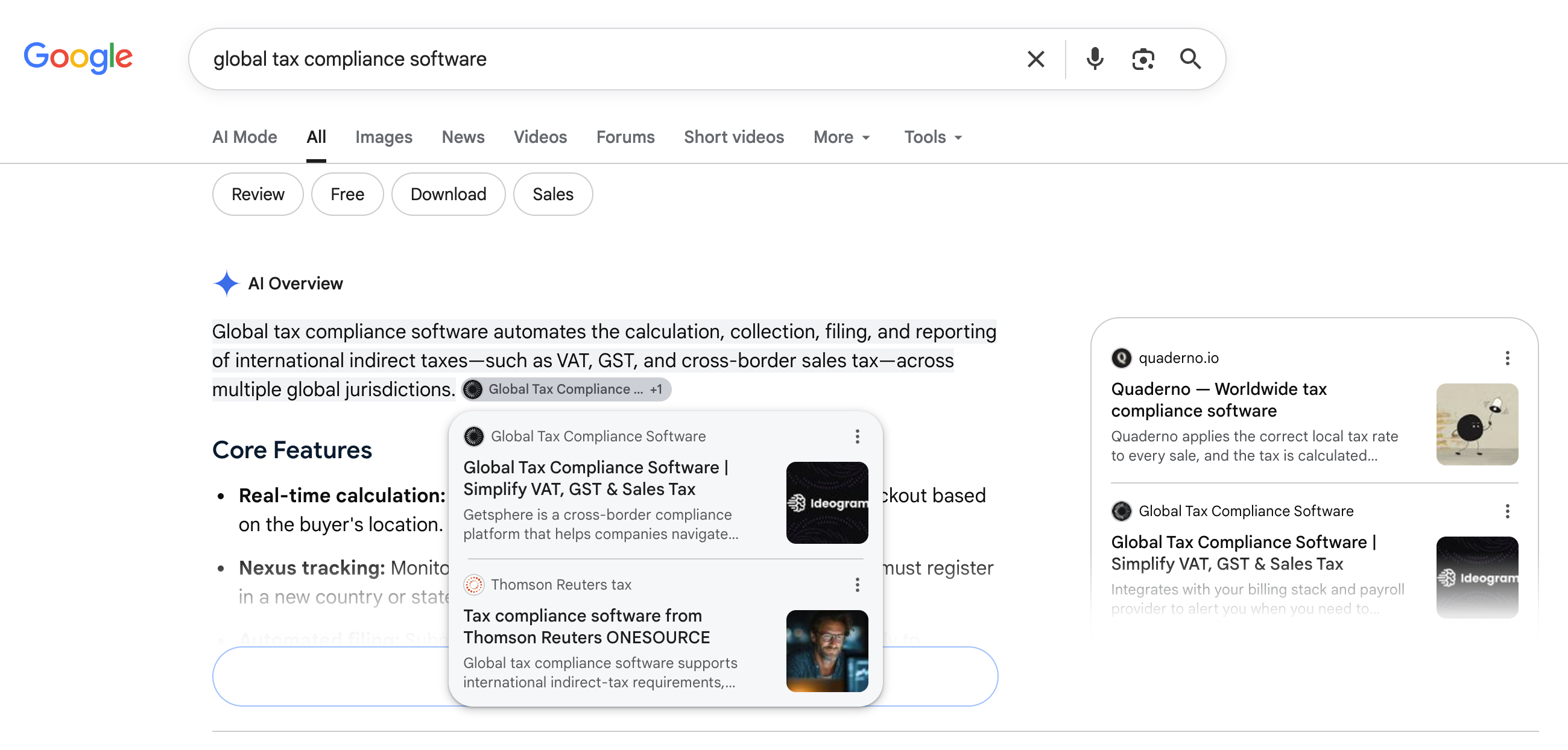
One example is Sphere, a Y Combinator and a16z-backed global tax compliance platform. When its new website launched, it was getting around five organic clicks a day, while a main competitor had more than 400K monthly organic sessions. Seen built its search presence from scratch: long-tail problems first, then bigger commercial terms and third-party mentions as authority grew.
- #1 on Google for "global tax compliance software" and 143 core business keywords.
- #1 recommendation across LLMs for AI-powered global tax compliance searches, ahead of competitors with 20+ years in the market.
- The most-cited domain across every LLM Seen tracks for the category.
- 40% of sales-qualified leads now come from Google and LLMs.
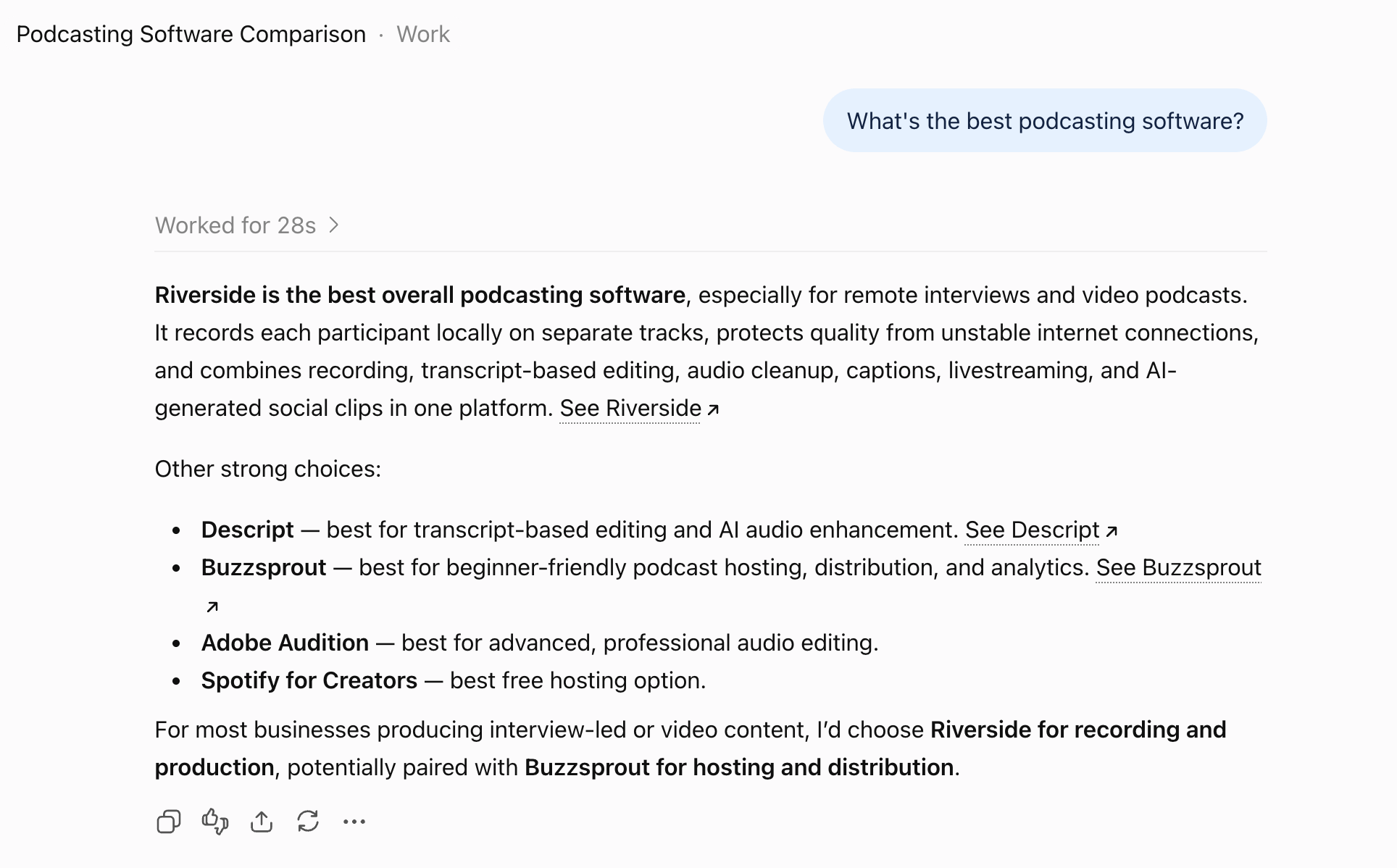
For Riverside, Seen focused on building authority through relevant publications and backlinks, supporting its migration from riverside.fm to riverside.com, and getting the brand into the listicles LLMs cite most. The campaign earned over 500 mentions and backlinks, and here's what they led to:
- #1 recommendation on ChatGPT for "best podcasting software."
- #1 in Google's AI Overviews for "podcast recording software."
- Featured in 4.3K AI-generated answers across platforms.
- 113K+ monthly organic visits from Google.
Read the Riverside case study →
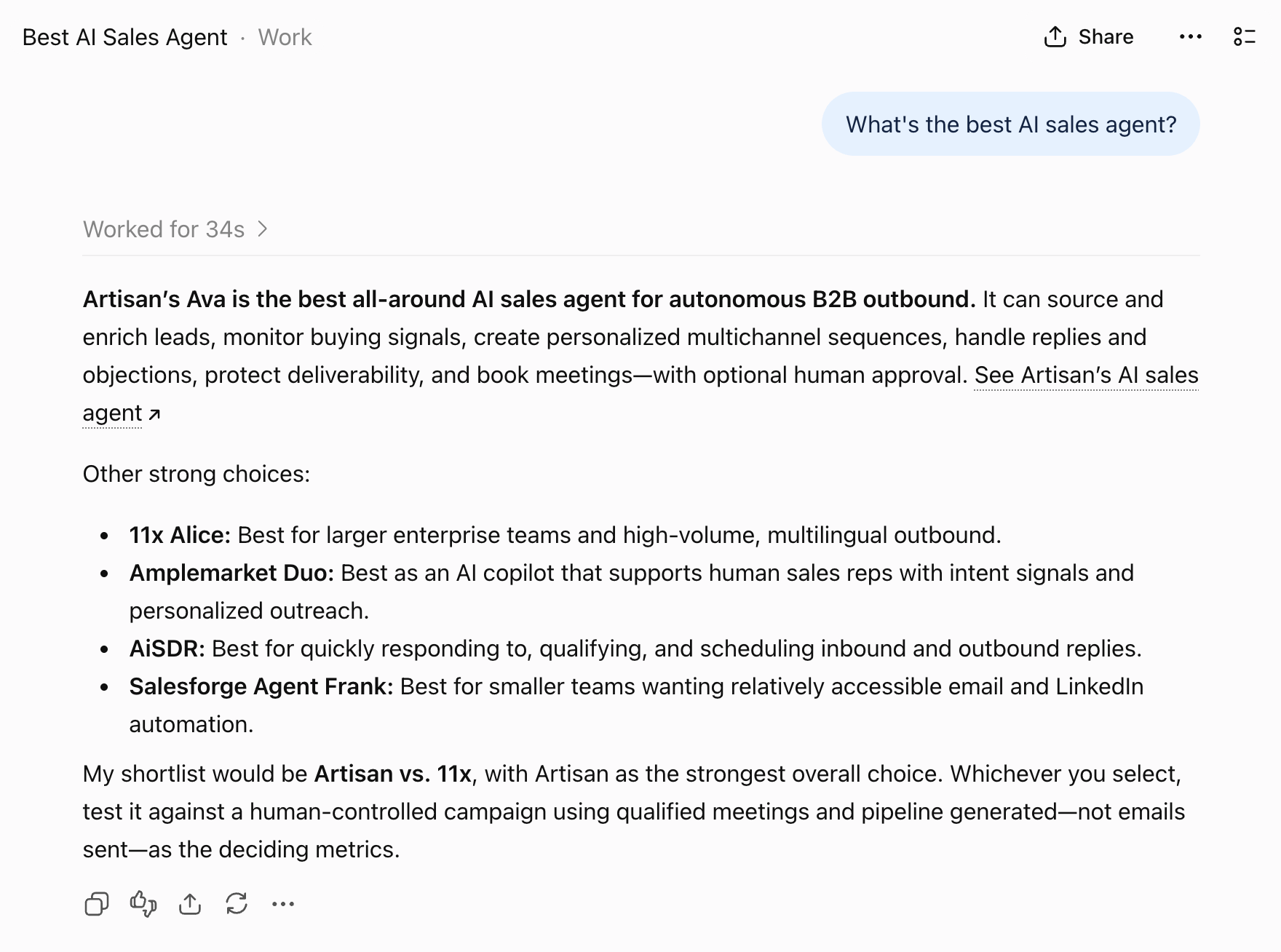
And for Artisan, a Y Combinator-backed AI sales startup, Seen started from around 100 monthly sessions in a brand-new category. Expert-led content came first, then authority and third-party placements focused on AI search.
- 1M+ monthly discoveries across Google and AI search.
- #1 recommendation for "best AI BDR," "best AI sales agent" and "best AI SDR."
- Google and LLMs are now both among Artisan's three largest acquisition channels.
What clients say about Seen
"Highly recommend Seen for all things search. Their expertise spans both traditional SEO and the new world of LLM-based search, which has been incredibly valuable for us as a fast-growing global business. Also, just an absolute pleasure to work with."
Nicholas Rudder, CEO at Sphere
"Seen helped us go from zero visibility to consistently ranking #1 for our most important keywords, driving hundreds of leads every month. A truly brilliant partner."
Jaspar Carmichael-Jack, Founder & CEO at Artisan
Clients include: Sphere, Nextiva, Riverside, Aura, Artisan, and Hunter.
See how we help SaaS brands grow →
Best fit: B2B SaaS companies from Seed to Series B that want one partner to build visibility across Google and AI search, and see it show up in pipeline.
Not the right fit if: You need results in 30 days, or you're not ready to invest in content.
[cta]
Is ChatGPT recommending your competitors instead of you?
See which buyer prompts you're missing, which sources AI cites instead of you, and what it would take to become the brand AI recommends in your category.
[/cta]
2. Quoleady — Best for SaaS content marketing and digital PR
Quoleady combines SaaS content marketing with SEO and AI search optimization. Its services cover content strategy, keyword and prompt research, technical audits, content production, link building, and digital PR.
The agency also works on getting SaaS brands mentioned in relevant articles and listicles, which can help build the third-party presence that supports both traditional search and AI visibility.
One example is its work with Legal Nodes. Quoleady reports that booked meetings increased by 47.5% over three months, while LLM-referred sessions grew by around 26%. It also says five of the eleven articles published during the project appeared in Google's AI Overviews within seven days.
Best fit: SaaS companies that need a content-led SEO strategy, with link building, digital PR, and AI visibility included.
If you're specifically looking for a partner with SaaS experience, our comparison of SaaS SEO services looks at agencies by specialization, pricing, and scope.
3. Digital Hitmen — Best for combining traditional SEO with GEO
Digital Hitmen is an Australian search marketing agency offering SEO, PPC, web design, and AI-related services. Its SEO work covers technical optimization, content, link building, and generative engine optimization.
That makes it a broader search marketing option rather than an agency focused exclusively on AI search. Businesses can work with the team on their Google visibility while also improving how their content appears in AI-generated answers.
One of its published case studies features Discovery Alert. Digital Hitmen reports that a combination of AI optimization, on-page SEO, and E-E-A-T improvements helped grow the client's organic sessions from 600 to more than 317,000.
It's worth keeping in mind that this is a broader organic growth result, not an AI-search-only result.
Best fit: Businesses looking for a wider SEO and search marketing partner that also offers GEO and AI search optimization.
4. Petra Labs — Best for AI search analytics and revenue attribution
Petra Labs takes a more technology-led approach to answer engine optimization. It combines proprietary software with managed services to help companies understand how AI platforms discover, evaluate, and recommend their brands.
Its platform tracks brand visibility, sentiment, competitor mentions, and the sources influencing AI-generated responses. The team also offers optimization services and attribution models designed to connect AI search activity with pipeline and revenue.
In a case study with Novig, Petra Labs reports a 27x increase in AI-referred site traffic over six months. The project tracked more than 1,500 prompts across ChatGPT, Claude, and Gemini.
The case study is an example of its work in a competitive category, although Novig operates in sports betting rather than SaaS.
Best fit: Companies with dedicated marketing or growth teams that want deeper AI search insights, hands-on optimization, and a clearer picture of how AI visibility contributes to revenue.
5. Driven Metrics — Best for combining SEO, GEO, and agentic search optimization
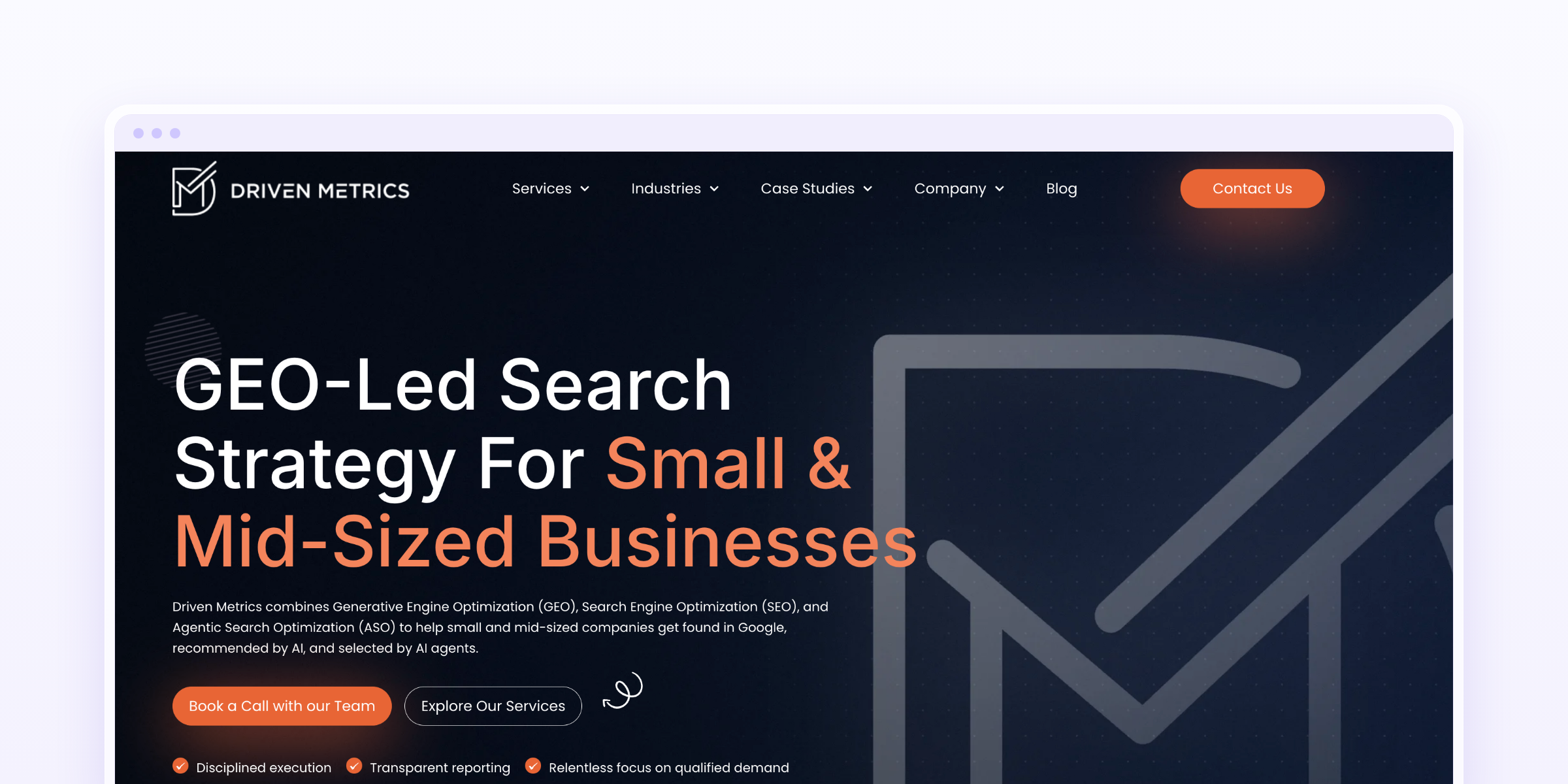
Driven Metrics positions its services around three areas: traditional SEO, generative engine optimization, and agentic search optimization.
In practice, that means helping businesses appear in Google results, earn recommendations in AI-generated answers, and make their information easier for AI agents to discover and use.
The agency's approach combines content and technical SEO with GEO strategy, visibility measurement, and reporting focused on qualified demand.
One of its published case studies follows a D2C skincare brand. Driven Metrics reports an 84% increase in monthly organic revenue over five months, alongside 4.5x growth in AI search sessions and 18 Google AI Overview placements. These results came from a combined SEO and GEO program, rather than GEO alone.
Best fit: Small and mid-sized businesses that want to connect traditional organic search with newer AI discovery channels.
How to vet an AI SEO company
Once you've shortlisted a few agencies, don't make your decision based on their website or a ranking-list score alone. Ask each one the same questions so you can compare their answers properly.
A company might have great reviews and impressive-looking case studies, but that doesn't automatically mean it can solve your particular visibility problem. An agency that's good at correcting brand descriptions, for example, might not be the best choice if your main issue is that competitors keep appearing in comparison prompts while your brand is missing.
If you're evaluating a broader SEO partnership rather than an AI-specific one, our guide to hiring a B2B SEO agency covers the questions worth asking before signing.
Questions to ask before you sign
- How do you audit how AI engines currently describe, recommend or omit us compared with competitors? A strong answer: an agreed prompt set and platform list, with citations, omissions and inaccurate descriptions logged for you and the same measures run for named competitors. Mentionable's GEO pricing guide describes a typical audit as 30 to 50 business-critical prompts across three to five engines and three to five competitors, followed by a 90-day action plan.
- Which visibility gap do you think we have, and which workstreams would address it? A strong answer: links the diagnosis to specific technical, entity, content or authority work. If a fixed "GEO package" appears before any audit, the prescription came before the diagnosis.
- What ships in the opening months, and who on your team does the work? A strong answer: deliverables in order, with named owners and the dependencies on your side, such as developer time for schema or legal sign-off on content.
- Which case studies show AI citations or AI-referred conversions, not only organic traffic growth? A strong answer: a baseline, a timeframe, the work completed and an AI-specific result from a situation close to yours.
- How do you tie AI visibility to leads or revenue? A strong answer: citation monitoring, AI-referred traffic and conversions shown together in one report, with a candid account of what analytics can't capture.
Red flags in an AI SEO agency pitch
- Guaranteed placement. No agency controls what ChatGPT or AI Overviews generate, so guaranteed inclusion is a red flag.
- No stated tracking method. Ask how many prompts they track, on which platforms, how often they rerun them and how they separate mentions from citations. "We monitor your AI presence" isn't a method, and neither is a gallery of screenshots of single answers.
- GEO sold as a replacement for SEO. A pitch that tells you to pause SEO and buy GEO instead ignores that Google's AI features run on core Search systems.
- Percentage lifts without context. A percentage increase in AI visibility means nothing without a baseline, a timeframe and a definition of the metric.
- A team that can't name its sources. If they can't say which pages engines currently cite for your top prompts, they haven't done the audit they're pricing.
Not sure what an AI SEO engagement should actually include? Our guide to AI SEO services explains the typical deliverables, pricing models, and differences between providers.
How much does an AI SEO company cost?
Mentionable's GEO pricing guide puts a typical entry audit at roughly $2,000 to $4,500, while NUOPTIMA estimates a focused monthly program at $3,000 to $7,500. NUOPTIMA's broader audit range is $1,500 to $7,500, and its estimate for a full multi-workstream program is $7,500 to $15,000 or more per month. Scope and engagement model determine where a buyer lands within those ranges.
[table]
Engagement model | Typical range | What you receive
One-off audit or project | $2,000 to $4,500 (wider estimates run $1,500 to $7,500) | Baseline across prompts, engines and competitors, plus a prioritized plan
Focused retainer | $3,000 to $7,500 per month | Reporting, a technical audit and a few optimized pages each month
Full program | $7,500 to $15,000+ per month | Content production, digital PR, multi-market work and ongoing tracking
Audit, then retainer | Audit fee, then a retainer tier | Diagnosis before you commit to ongoing scope
[/table]
First Page Sage's October 2026 agency-quote report, built from 1,146 quotes across 214 agencies, puts the median GEO/AEO retainer at $6,850 per month and found that 68% of agencies use a retainer model.
According to Mentionable's GEO pricing guide, several factors push the price up:
- the number of prompts and platforms tracked
- how often monitoring runs
- multilingual scope
- digital PR and link building
- technical remediation
- content production, which the guide estimates can raise the engagement cost by 50 to 100%
Compare project fees and retainers separately. An audit fee and a monthly retainer are different purchases even when the quoted amounts happen to match.
Contract terms also vary. Check the minimum commitment, the notice period and whether month-to-month is offered. Harris & Ward publishes month-to-month service alongside a separate one-time readiness package at $3,000. MentionBench documents month-to-month terms with 30 days' written notice to exit. Neither arrangement is an industry standard, so read the exit clause before you sign.
Budget for AI SEO alongside your existing SEO spend, not in place of it. The SEO Works' 95-site referral benchmark found that organic search delivered 39 times more traffic than AI assistants. Where content and link work overlap, a single hybrid budget avoids paying twice.
Should you hire an agency, handle AI SEO in-house or use visibility software?
Hire an agency when you lack SEO capacity, need digital PR reach or face a short timeline. Keep the work in-house when an existing SEO team can take on entity, schema and tracking work. Software measures the problem, but people still have to fix it.
- Agency: fits when nobody internal owns technical SEO, when you need editorial relationships you don't have, or when a short deadline requires a staffed delivery team.
- In-house: fits when your SEO team already handles structured data and content, and can add a prompt set and a monthly review.
- Visibility software: handles prompt tracking, competitor and citation analysis, and recommendations. It doesn't ship technical fixes, write content, run PR or correct entity data. Someone still has to act on what the dashboard shows.
Run this checklist:
- Team capacity: Is there a named person who can own schema, entity data and a weekly look at tracking? If not, lean toward an agency.
- Budget: Can you fund a retainer on top of current SEO spend? If not, buy a one-off audit and execute it internally.
- Size of the gap: Are you absent from most buyer prompts, or present but misdescribed? Broad absence calls for content and authority work, while misdescription is a narrower entity fix.
- Timeline: Is there a fixed deadline, and can your internal team ship the required technical, content and authority work before it?
For B2B SaaS teams that choose the agency route, Seen is a founder-led AI SEO agency that combines SEO, GEO and AEO in one strategy. Instead of just reporting where you show up, Seen builds and implements the plan to get you recommended across ChatGPT, Claude, Gemini and Google AI Overviews: product-led content, link building and third-party mentions, measured through signups and qualified conversions.
Key takeaways
When I was hiring agencies in-house, the ones that worked out were never the ones with the slickest pitch. They were the ones that understood what was actually holding us back, and could show me how they'd fixed the same problem for someone else. The same applies to AI SEO.
- Pay for execution, not tracking. Any GEO tool can tell you whether ChatGPT mentions you. An AI SEO company should change the answer, through content on your site and mentions on the sources AI already trusts.
- Judge results by pipeline, not visibility alone. A #1 spot in an AI answer only matters if it's for a prompt your buyers actually use. Ask for case studies that connect AI visibility to signups, leads or revenue.
- Pick the agency that fits your problem. Seen is built for B2B SaaS teams that want SEO, GEO and AEO in one strategy measured by signups. Quoleady suits content-led SaaS programs, Digital Hitmen broader search marketing, Petra Labs AI search analytics, and Driven Metrics SEO plus agentic search.
- Be wary of guarantees and fixed packages. No one controls what AI platforms generate, and a package sold before an audit means the prescription came before the diagnosis.
Before your first agency call, run 15 to 20 of your buyers' real prompts through ChatGPT, Claude, Gemini and Google AI Overviews. Note where you're missing and who's recommended instead. A good partner will tell you exactly what they'd do first to change that, and why.
[cta]
Become the SaaS your buyers find first
Book a strategy call with Irina to find what’s holding back your visibility across Google and AI search—and where to focus next.
[/cta]
FAQs
Will AI Overviews cause a drop in my organic traffic?
They can reduce clicks on the queries where they appear. Pew's analysis of March 2025 U.S. browsing data found users clicked a link inside the AI summary in just 1% of visits. They also ended their session after 26% of searches that showed a summary, versus 16% without one. The effect varies by query, so check query-level clicks in Search Console rather than assuming a sitewide loss.
How do I know if my target market uses AI to find businesses?
Ask them directly. Add a free-text "How did you hear about us?" field to demo forms and ask the question on sales calls. Self-reported answers catch the AI discovery that analytics attribute to direct or branded search.
Is AI SEO a one-time project or an ongoing service?
The audit can be a one-off. Visibility, however, shifts as engines update and competitors publish. A one-time engagement works if your team can carry out the plan and rerun the prompt set yourself.
Is AI SEO suitable for local businesses?
Yes, with a different emphasis. Yext's Q1 2026 location-search research found that directories and review platforms dominated third-party AI citations for location-based questions. For a local business, accurate listings and review profiles should therefore be part of the baseline.
Do I need technical expertise to work with an AI SEO agency?
No. You do need someone who can grant access to your CMS and analytics and secure developer time. Schema and crawl fixes cannot help until someone implements them.
Should I optimize for each AI platform separately?
Build one shared foundation, then report results per platform. Each engine can cite different sources and give different levels of detail for the same prompt. Add platform-specific work only where the reports show a persistent gap.