- Hire for pipeline, not traffic. The right B2B SEO agency ties Google and AI search visibility to signups, SQLs, and revenue, not rankings alone.
- Seen is our top pick for B2B SaaS. It runs AI SEO, GEO, and AEO as one strategy, with proof like 40% of Sphere's SQLs and 90% of Hunter's leads coming from organic search.
- The other four fit narrower needs: XQL Group specializes in IT services, early-stage SEO plus paid search (SaaS Hero), industrial manufacturers (Gorilla 76), high-volume content (Embarque) and professional services firms (Hinge).
- Vet before you sign. Ask how the agency connects SEO to pipeline, how it will earn AI recommendations, who writes and publishes, and what the first 90 days deliver.
Choosing a B2B SEO agency is a little different from hiring one for a regular ecommerce or local business website. You're not just trying to bring in more visitors. You want to reach people who are actually evaluating solutions, get your brand in front of the right buying teams, and turn that visibility into qualified leads.
And with AI search becoming part of how people research software and other B2B products, there's another question to consider: does the agency know how to get your brand mentioned in AI-generated answers, too?
I've looked at how different agencies approach SEO, what they include in their services, the results they share, and the types of companies they work best with. Some are better suited to technical SEO, while others focus on content, SaaS growth, or AI visibility. Here's what stood out.
How we evaluated and shortlisted these B2B SEO agencies
We didn't put this list together by simply picking agencies with the biggest names or the most polished websites. We run SEO and GEO programs for B2B SaaS companies every day, so we judged each agency the way our own clients judge us: by how it approaches B2B SEO, the types of companies it works with, and whether its services match what B2B teams actually need.
A note on transparency. I'm Irina Maltseva, founder of Seen, and yes, Seen is on this list, in the #1 spot. You should know that before reading any further. Before starting Seen, I spent years on the buying side. As CMO at Hunter, I hired and managed SEO agencies, and I sat through enough pitches to tell the difference between an agency that talks about pipeline and one that actually reports on it. After 10+ years in SEO, that's the filter I used here. Every agency, ours included, is judged on the same five criteria below. Each profile is also upfront about who the agency isn't for, and where another agency is the better fit for a specific need, like manufacturing or professional services, I say so.
Our evaluation focused on five areas:
- B2B and SaaS experience. We looked for agencies with relevant experience working with B2B companies, particularly SaaS businesses with longer sales cycles and multiple decision-makers.
- SEO capabilities. We reviewed each agency's approach to technical SEO, keyword research, content strategy, link building, and commercial-intent pages.
- AI search expertise. We considered whether agencies offer GEO or AEO services, including AI visibility tracking, prompt research, and strategies for earning brand mentions in AI-generated answers.
- Case studies and client results. We looked for publicly available case studies, measurable outcomes, and client examples that demonstrate the agency's work.
- Service fit and transparency. We considered each agency's service model, target company size, and the type of team it is best equipped to support.
The agencies below were selected because they offer different approaches to B2B SEO. Rather than treating them as interchangeable, we've highlighted where each one stands out and the types of teams that may benefit most.
How the shortlisted B2B SEO agencies compare
[table]
Agency | Best for | Core specialty | Industries served
Seen | B2B SaaS teams that want Google and AI search visibility to turn into signups and pipeline | AI SEO, GEO and AEO for B2B SaaS | B2B SaaS only, from Seed-stage to scaling companies
XQL Group | B2B IT service companies looking to generate qualified leads through organic search | B2B IT services SEO, AEO and GEO | Software development, DevOps, MSPs, CRM consultancies and IT services
SaaS Hero | Early-stage SaaS companies building their SEO foundations | SaaS SEO combined with paid search and CRO | Early-stage B2B SaaS
Gorilla 76 | Mid-sized manufacturers with complex products and long sales cycles | Industrial SEO, content and demand generation | B2B manufacturing and industrial companies
Embarque | SaaS and startups looking to scale organic traffic through content | SEO content production, technical SEO and AI SEO | SaaS, startups and technology
Hinge | Professional services firms that sell expertise | Research-based SEO, GEO, content and branding | Professional services, such as consulting, accounting, engineering and technology services
[/table]
Beyond their core positioning, these agencies also differ in how they approach content production and AI search optimization.
[table]
Agency | Content production | AI search offering
Seen | Product-led BOFU content, comparison and alternatives pages, commercial landing pages | Full strategy and implementation to get brands recommended across ChatGPT, Claude, Gemini, Perplexity and Google AI Overviews, through owned content and third-party mentions in the sources LLMs cite
XQL Group | Service pages, use-case and comparison content informed by sales conversations, alongside technical content production | AEO and GEO services alongside traditional SEO, connecting organic acquisition to qualified inquiries, opportunities and revenue
SaaS Hero | Product-led pages and content built around keyword clusters and buyer intent | Tracking and pipeline attribution; a dedicated GEO or AEO service isn't clearly established
Gorilla 76 | Technical long-form content for engineers and procurement teams | SEO is part of a wider industrial demand-gen program; a dedicated GEO service isn't clearly established
Embarque | Scalable SEO content and landing-page production | AI SEO services focused on improving visibility and citations in LLM answers
Hinge | Expertise-led content and thought leadership | GEO offered alongside SEO and content marketing
[/table]
If you're specifically comparing providers for a SaaS business, our guide to SaaS SEO services takes a closer look at agency specialties, pricing, and what's included.
6 Best B2B SEO agencies by specialty
These 6 agencies approach B2B SEO from different angles. Some focus on SaaS growth and AI search, while others are stronger in international SEO, content production, or digital PR. Rather than treating them as interchangeable, here's what each one does well, where it may fall short, and what kind of company should consider it.
1. Seen — Best for B2B SaaS SEO and AI search visibility
Seen is a founder-led AI SEO and GEO agency for B2B SaaS companies that want to show up across both traditional search and AI platforms. It was founded by Irina Maltseva, former CMO at Hunter, who brings 10+ years of SaaS growth experience. The agency combines SEO, GEO, and AEO into one strategy, covering Google, ChatGPT, Claude, Gemini, and other places where buyers research software.
The work goes beyond optimizing a company's own website. Seen also focuses on product-led content, high-authority links, listicle placements, and third-party brand mentions that can help SaaS companies earn visibility and recommendations across search platforms.
What makes that approach convincing is the proof behind it. A few examples of what Seen's clients have achieved:
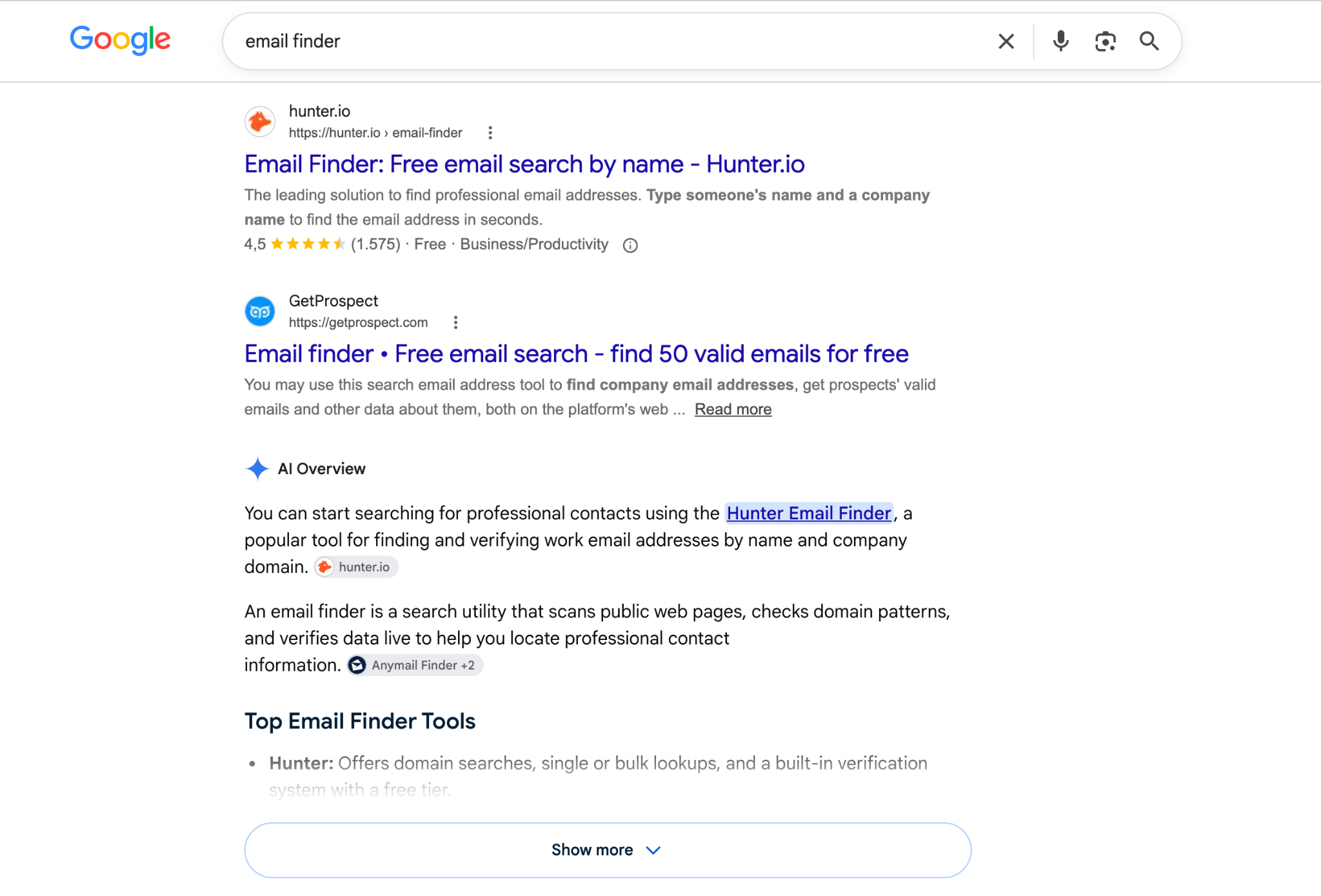
Hunter: 90% of leads from organic search. Seen rebuilt Hunter's product pages around search intent, launched its blog, and ran a link building and brand mention program at scale. Hunter now ranks #1 on Google for "email finder" and "email verifier," and organic search drives 90% of its leads. The customer base grew 30% along the way.
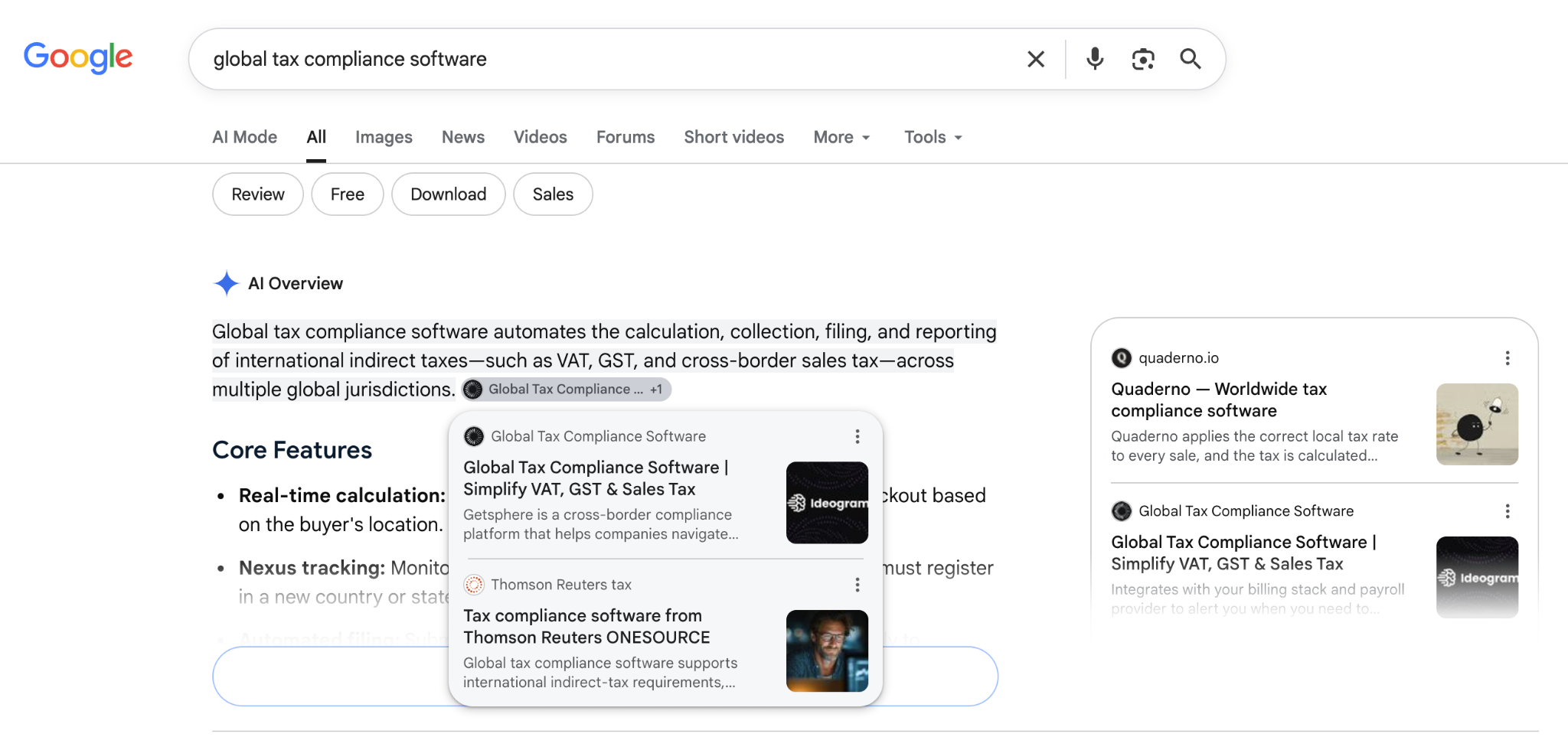
Sphere: from five clicks a day to 40% of SQLs. When the YC- and a16z-backed tax compliance platform launched its site in spring 2025, it got around five organic clicks per day. Seen built the strategy from Sphere's demo calls, started with long-tail problems competitors ignored, then moved into bigger terms and GEO. Sphere now ranks #1 on Google for "global tax compliance software" and #1 for 143 core keywords. Google and LLMs generate 40% of its SQLs.
Other notable clients include Artisan, which is now the #1 recommendation for "best AI BDR" across Google and AI, Nextiva, which holds the top Google spot for 4.4K high-intent keywords, Riverside, which became the #1 podcasting software recommendation across Google and AI, and Aura, which is the first recommendation in 75% of tracked AI results for identity theft protection.
See how we help SaaS brands grow →
Why B2B SaaS teams choose Seen
Seen's angle is simple: SEO should bring in customers, not just visitors. Here's what that looks like in practice.
- Signups and pipeline are the main KPI. Seen prioritizes the searches and AI prompts that influence buying decisions, then measures success in qualified signups and SQLs, not traffic or rankings.
- BOFU and product-led content first. The team learns how the product works, who buys it, and why it wins against competitors. For Sphere, that meant mining demo calls for the exact language buyers used.
- Experiments, not templates. Seen tests and adapts its approach for each client instead of rolling out one playbook. Sphere and Artisan both started with low-competition, long-tail searches before going after bigger terms.
- One strategy for Google and AI search. Owned content and third-party mentions work together, so the brand shows up in Google results and in the sources ChatGPT, Claude, and Gemini rely on.
- In-house SaaS DNA. Irina ran growth from the inside as Hunter's CMO, so the agency brings the commercial accountability of an in-house team rather than traditional agency thinking.
Standout capabilities:
- SEO, GEO, and AEO combined into one strategy, from research through implementation
- Product-led content for commercial and buyer-intent searches: comparison pages, alternatives, use cases, and landing pages
- AI search optimization that gets brands recommended across ChatGPT, Claude, Gemini, Perplexity, and Google AI Overviews
- Editorial backlinks, listicle placements, and brand mentions on relevant sites that buyers and LLMs already trust
- Full-cycle strategy and execution, with reporting focused on signups, SQLs, and pipeline
What clients say about Seen:
"Seen helped us go from zero visibility to consistently ranking #1 for our most important keywords, driving hundreds of leads every month. A truly brilliant partner."
Jaspar Carmichael-Jack, Founder & CEO at Artisan
Limitations: Seen focuses on B2B SaaS companies, particularly Seed to Series A and scaling teams. It's less suited to manufacturers, distributors, or businesses outside the SaaS space.
Pricing: Custom packages built around each company's stage, goals, and existing resources.
Best for: B2B SaaS companies that want to improve visibility across Google and AI search while turning that visibility into signups and qualified leads.
[cta]
Want your SaaS to be the brand Google and ChatGPT recommend?
Book a call with Seen's founder, Irina Maltseva, and get a clear plan for turning search and AI visibility into signups and pipeline.
[/cta]
2. XQL Group — Best for B2B IT service companies
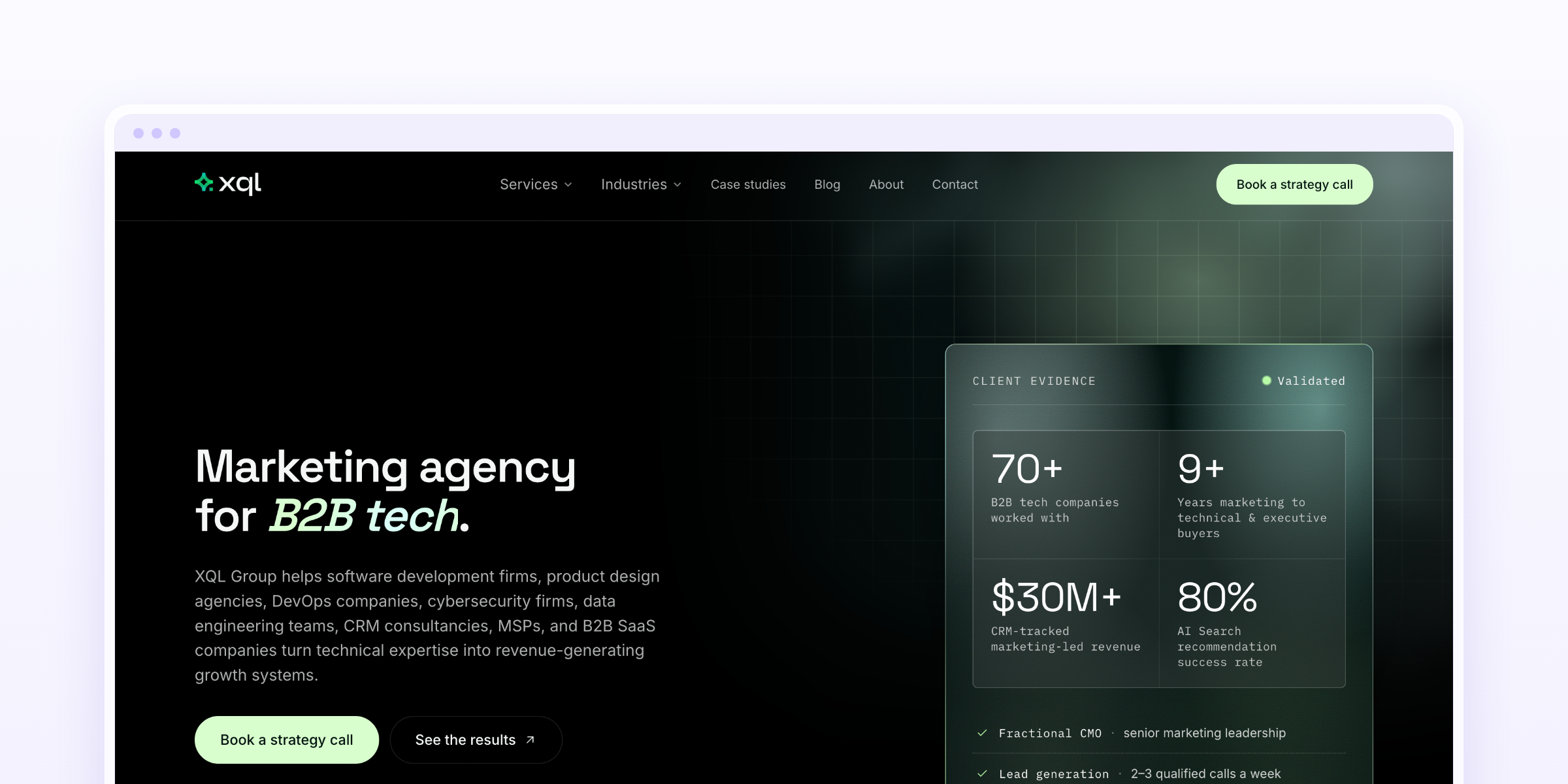
XQL Group is a B2B SEO agency that works with IT service companies, including software development firms, DevOps providers, managed service providers (MSPs), and CRM consultancies. It has worked with more than 70 companies in the space, so its approach reflects how these businesses actually sell. Buyers aren't just comparing software features. They're evaluating technical expertise, past projects, and whether a provider can handle their specific needs before starting a conversation.
That's why XQL focuses on service pages, use-case searches, and comparison content that can bring potential clients closer to hiring a provider. Its SEO work covers keyword research, technical SEO, content production, conversion improvements, and editorial link building. The team also uses insights from sales conversations to identify the questions and objections that content should address.
The agency has published several client results that show how this approach translates into business outcomes. For Synebo, a Salesforce consultancy, organic traffic grew 2.73 times, while the share of marketing-qualified leads converting into sales-qualified leads increased from 17% to 29%. For Noltic, 20 out of 25 service pages reached Google's top five, helping the company close its first deals from organic search. Its work with Cieden also combined SEO with marketing leadership, resulting in 2.4 times more organic traffic and a 133% increase in monthly sales-qualified leads over nine months.
XQL also offers AEO and GEO services, helping clients work on their visibility in traditional search and AI-generated answers. Reporting connects organic acquisition to qualified inquiries, sales opportunities, and revenue tracked in the CRM. Beyond SEO, the agency provides go-to-market strategy and fractional CMO support, which can be useful for companies that want their search strategy aligned with broader marketing and positioning.
Standout capabilities:
- SEO experience across 70+ B2B IT service companies, including software development, DevOps, MSPs, and CRM consultancies
- Service-page and comparison content built around how technical buyers evaluate providers
- Content production, technical SEO, conversion improvements, and editorial link building
- AEO and GEO services alongside traditional SEO
- CRM-connected reporting that tracks qualified leads, opportunities, and revenue
- Additional go-to-market strategy and fractional CMO support
Limitations: XQL Group is primarily focused on IT services and technology consultancies. SaaS product companies, manufacturers, and businesses outside the IT services space may need an agency with a different specialization.
Pricing: Custom. Contact XQL Group for a quote based on your SEO scope and business needs.
Best for: B2B IT service companies that want an SEO partner familiar with selling technical expertise and measuring results through qualified leads and business opportunities.
3. SaaS Hero — Best for early-stage SaaS companies
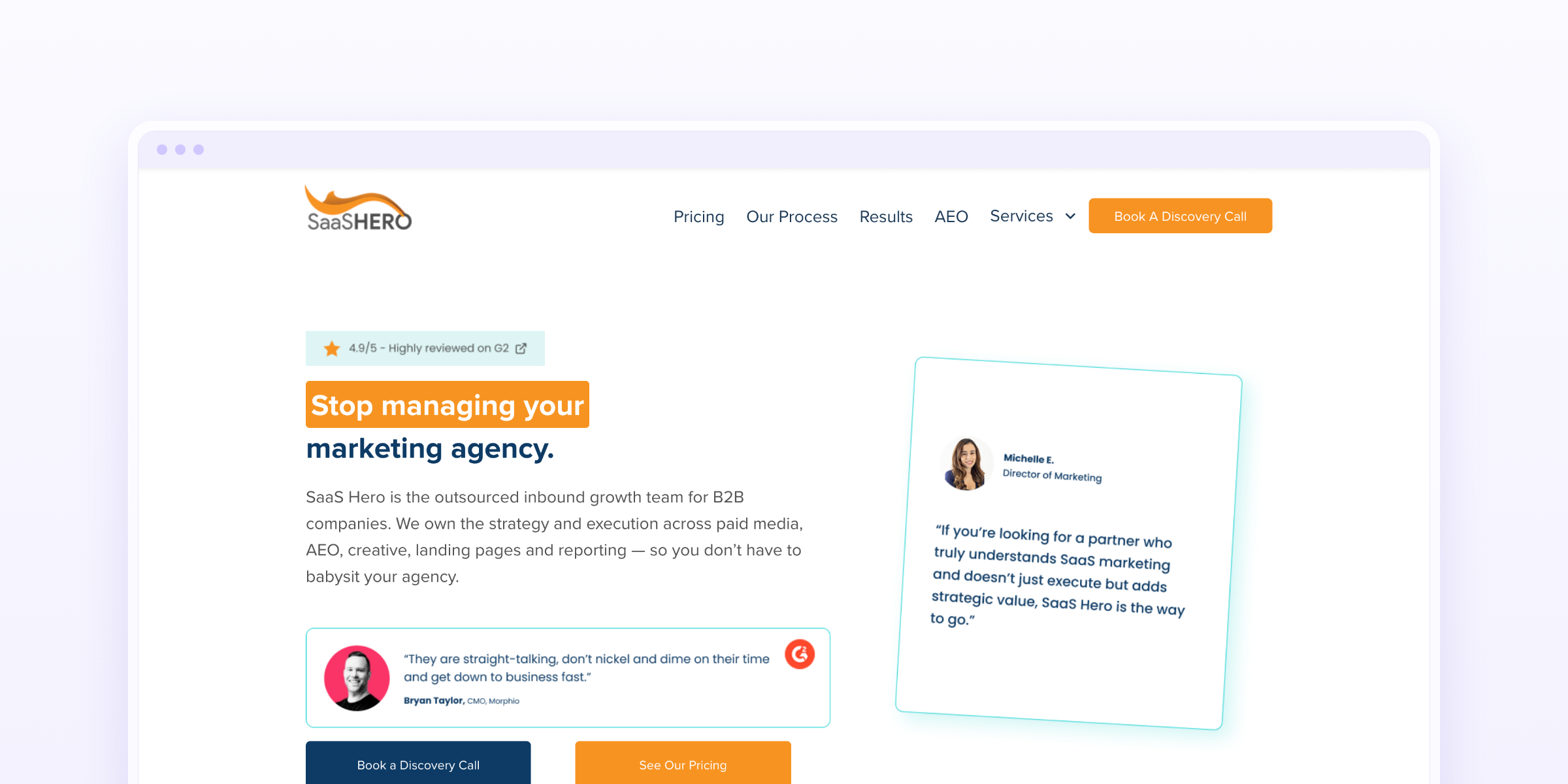
SaaS Hero is built around the needs of early-stage SaaS companies that want to connect marketing activity to revenue without building a large in-house team. Its SEO approach starts with measurement and technical foundations before moving into product-led content and pipeline reporting.
Its published 90-day process begins with tracking setup, including connecting Google click IDs to the CRM and mapping keyword clusters to different funnel stages. From there, the team works on product-focused pages and attribution reporting. That makes the approach particularly useful for startups that need to understand whether SEO is bringing in potential customers, not just visitors.
SaaS Hero also offers paid search and conversion rate optimization, so SEO is part of a broader demand-generation service.
Standout capabilities:
- A defined 90-day process covering tracking, content, and attribution
- CRM-connected reporting for SQLs, pipeline influence, and net-new ARR
- SEO combined with paid search and conversion rate optimization
Limitations: Its early-stage SaaS focus may not suit enterprise websites or non-SaaS B2B businesses. Companies looking for SEO alone should also clarify how much of the package is dedicated to organic search.
Pricing: SaaS Hero advertises flat-fee services starting at $1,250 per month, with month-to-month terms. The published price isn't broken down as an SEO-only package.
Best for: Seed-stage and early-growth SaaS companies that need an external team to manage SEO alongside other acquisition channels.
4. Gorilla 76 — Best for B2B manufacturers and industrial companies
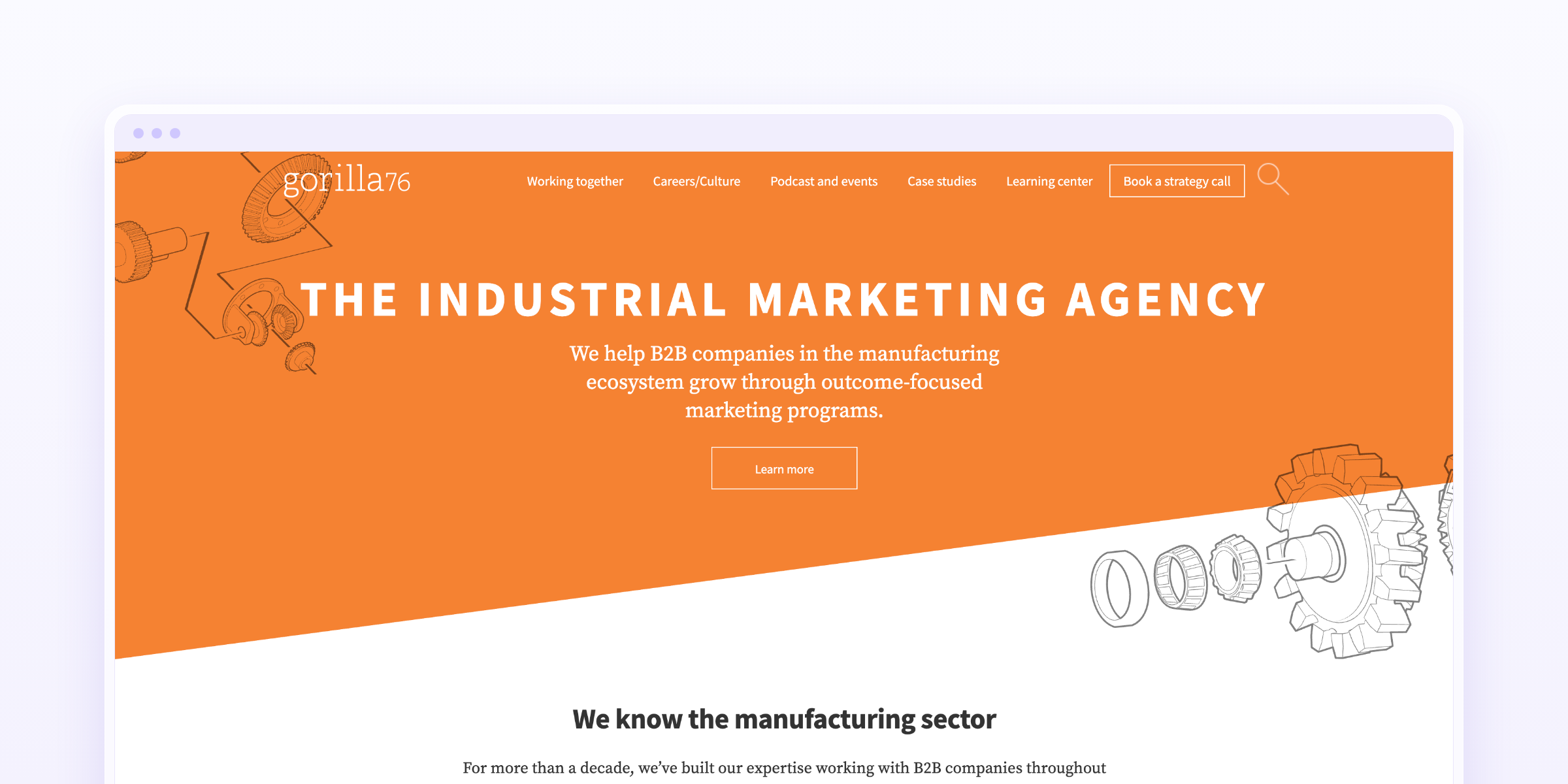
Gorilla 76 is a St. Louis-based industrial marketing agency that works only with B2B companies in the manufacturing sector, from engineering-heavy OEMs to custom machine builders and Industry 4.0 vendors. SEO sits inside a broader revenue-focused program that also covers brand positioning, content, paid media, and sales enablement.
That focus matters because manufacturing SEO is a different job from SaaS SEO. Buyers are engineers and procurement teams with long sales cycles, and content has to explain technical capabilities accurately. Gorilla 76 builds its programs around that audience, and it also runs Industrial Marketing Live, a community for industrial marketers.
Standout capabilities:
- Exclusive focus on B2B manufacturing and industrial companies
- SEO combined with brand positioning, content marketing, and paid media
- Long-form technical content written for engineers and procurement teams
- Demand generation and sales enablement programs tied to pipeline
- Reported result: a $9 million pipeline for a custom-engineered industrial oven manufacturer
Limitations: Its industrial focus means it isn't built for SaaS, ecommerce, or professional services. SEO is usually part of a wider demand-gen program, so teams that only need SEO execution may get more than they need.
Pricing: Custom, with no public rate card. Third-party directories estimate full programs at roughly $50,000 to $250,000 per year.
Best for: Mid-sized manufacturers with complex products and long sales cycles that want SEO as part of an industrial demand-generation program.
5. Embarque — Best for high-volume SEO content production
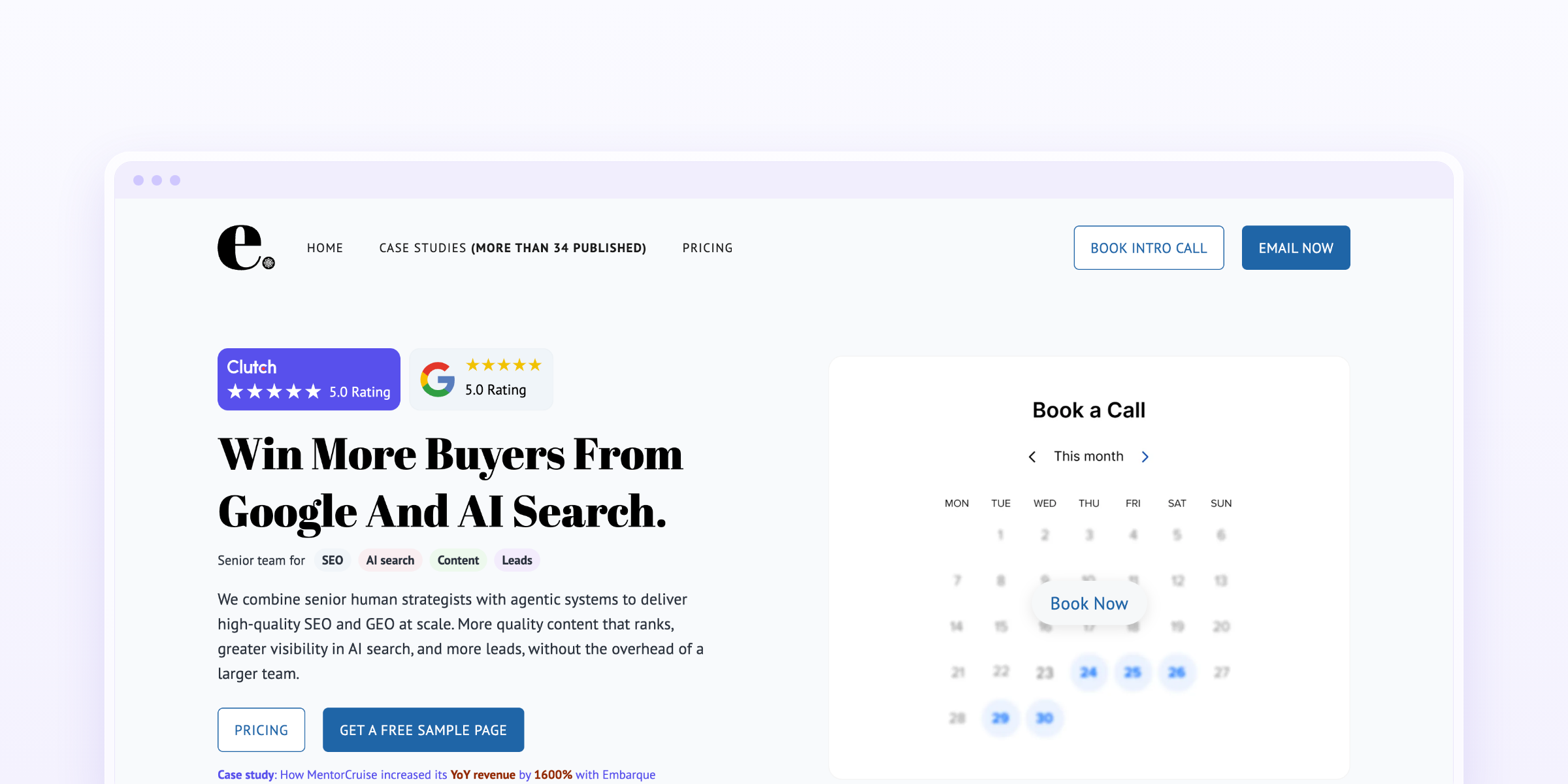
Embarque is an SEO agency working with SaaS companies and startups, with a strong focus on content production, technical SEO, and commercial search intent. Its approach is built around publishing and optimizing pages at scale, particularly across product categories, use cases, comparisons, and other high-intent topics.
The agency also offers AI SEO services and has published examples of clients earning traffic and citations from AI search platforms.
Standout capabilities:
- SEO strategy and content production for SaaS and startups
- High-volume page creation across dedicated website sections
- Technical SEO implementation and ongoing optimization
- AI search optimization and visibility-focused content
Limitations: Its core packages emphasize page production, while link building and digital PR are separate add-ons. Companies that need a smaller number of highly specialized thought-leadership pieces may prefer a more editorially focused agency.
Pricing: Public packages start at $2,500 per month for Starter, $4,995 for Engine, and $9,500+ for Managed. Packages have a three-month minimum, paid upfront. Link building and other services are priced separately.
Best for: SaaS companies and startups that need consistent SEO execution and want to build out multiple high-intent pages.
6. Hinge — Best for professional services firms
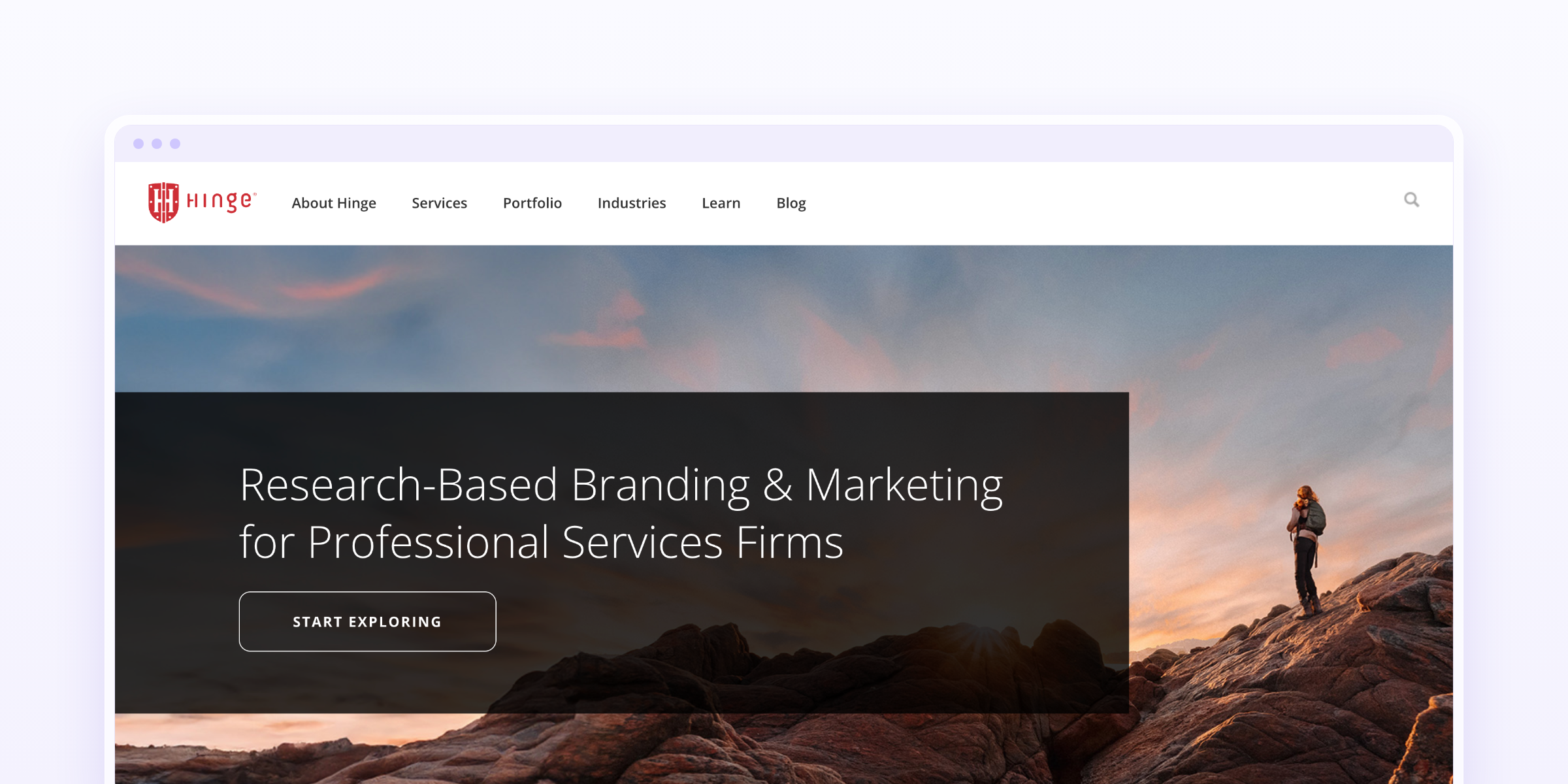
Hinge is a Virginia-based branding and marketing firm that has focused exclusively on professional services since 2008. It works with firms that sell expertise rather than a product, such as consultancies, accounting firms, and engineering or technology services companies.
What sets Hinge apart is its research. Through the Hinge Research Institute, it has studied more than 60,000 professional services firms and buyers, and those findings shape its SEO and content strategy. For a services firm, that matters: content has to make the firm's experts visible and credible, not just rank for keywords.
Standout capabilities:
- Exclusive focus on professional services firms
- Research-based strategy drawing on studies of 60,000+ firms and buyers
- SEO and GEO alongside content marketing, branding, and website design
- Expertise-led content that positions a firm's people as industry experts
- Marketing audits and benchmarking against similar firms
Limitations: Hinge is built for professional services, so SaaS and product companies will get less from its playbook. Its broader branding and website work may also be more than you need if you only want SEO.
Pricing: Custom. Directory listings put minimum project budgets at around $10,000 to $25,000.
Best for: Consulting, accounting, engineering, and other professional services firms that want to build search visibility around their expertise.
Questions to ask a B2B SEO agency before you sign
Most agency presentations sound convincing. The sales call is where you find out how the team actually works.
Instead of focusing only on rankings and traffic, ask questions that reveal how the agency sets priorities, handles execution, and measures business results.
How will you connect SEO activity to pipeline and revenue?
A strong answer: The agency agrees on business metrics upfront and explains how it tracks organic leads, sourced and assisted pipeline, and closed-won revenue where data is available.
A weak answer: Reporting focuses on rankings, traffic, and domain authority without connecting them to sales outcomes.
Ask how the agency uses different attribution signals:
- CRM source tracking: Shows how much pipeline your CRM attributes to organic search.
- Click-ID capture: Connects website interactions with CRM records and conversion data.
- Self-reported attribution: Asks buyers how they discovered your brand, including through AI answers, Reddit, or industry listicles.
- Assisted pipeline: Tracks deals where organic content influenced the buying journey, even if it wasn't the original source.
No single metric tells the whole story. A good agency should explain what each one measures and how it informs the strategy.
How will you improve our visibility in AI search?
A strong answer: The agency has a plan to improve visibility across platforms such as ChatGPT, Perplexity, and Google AI Overviews. This includes your website as well as third-party sources like review sites, Reddit, and industry publications. It can also explain which buyer prompts it will track.
A weak answer: The agency promises AI visibility but offers the same keyword and link-building strategy it uses for traditional SEO.
Ask what you'll see in monthly reports. At a minimum, look for tracked prompts, brand mentions or citations, and referral traffic from AI platforms. These metrics should be reported separately from traditional Google rankings so you can see where progress is actually happening.
Want to understand what an AI SEO engagement actually involves? Our guide to AI SEO services breaks down the deliverables, pricing, and providers.
Will you create and publish content, or only provide keyword lists and briefs?
A strong answer: The agency clearly outlines who handles research, briefs, expert interviews, writing, editing, approval, and publishing.
Also ask how it prioritizes bottom-of-funnel content, such as product comparisons, alternatives, integration pages, use cases, and case studies. These topics help buyers evaluate their options closer to a purchasing decision.
A weak answer: You receive keyword lists and content briefs, but there's no clear ownership of writing or publishing.
Don't let search volume drive the entire content strategy. Broad keywords can attract plenty of visitors who have no intention of becoming customers.
How will you prioritize and implement technical SEO fixes?
A strong answer: The agency can explain how it audits your site's architecture, crawlability, rendering, and indexation, then prioritizes fixes based on their impact. It also clarifies who will implement them and how it works with your developers.
A weak answer: You receive a long technical audit without a clear order of priority or implementation plan.
The work should reflect your website's needs. A large site with thousands of pages may need to fix rendering and indexation issues first, while a smaller SaaS site may benefit more from building product and comparison pages.
Look for an agency that can explain why certain fixes matter rather than handing every client the same technical checklist.
How much B2B SEO costs
B2B SEO pricing varies quite a bit depending on the agency, the size of your website, and how much work you expect the team to handle.
An Ahrefs survey of 439 SEO providers worldwide, summarized by OuterBox, found that the average monthly retainer was around $3,209, with an average hourly rate of $111. The most common hourly rate range was $100 to $150, while the most common one-off project range was $2,501 to $5,000.
These figures are useful as a reference, but they aren't fixed market rates. A company that needs technical work across thousands of pages will have a very different scope from a SaaS startup that needs a focused content strategy.
Common SEO pricing models
- Monthly retainer: You pay a fixed amount each month for ongoing SEO work. This makes sense when you need consistent strategy, content, technical improvements, and reporting. The main thing to watch for is whether the agency is actually shipping work every month.
- Hourly: You pay for the time spent on a specific task. This can work well for consulting, audits, or smaller projects, but costs can add up if the scope isn't clear.
- Project-based: You agree on a fixed price for a defined deliverable, such as a technical audit or migration plan. It's useful when you know exactly what you need, but implementation may require a separate agreement.
What does your SEO budget actually cover?
As one provider-specific example, Organic Labs publishes a $4,000 monthly strategy plan for companies that already have writers and a link-building partner. The plan doesn't include content production or brand mentions.
Its $7,500 monthly growth plan includes ten content pieces, ten brand mentions and backlinks, as well as development work.
These are examples of one provider's packages, not standard pricing tiers across the industry. Still, they show why it's important to look beyond the monthly fee. Two agencies can quote the same amount while offering very different levels of support.
When reviewing a proposal, check whether it clearly explains:
- What strategy and research are included
- How many content pieces will be produced each month
- Whether writing, editing, and publishing are covered
- Whether link building and third-party brand mentions are included
- How much technical implementation support you'll receive
- Whether AI search research and tracking are part of the scope
- What you'll see in the monthly report
GEO is one part of this growing service category. Here's a breakdown of generative engine optimization services and what businesses should expect from them.
As an illustrative scoping exercise, compare two companies considering the same agency:
[table]
Variable | Early-stage SaaS, small site | Enterprise manufacturer, large catalog
Site size | Small set of product and use-case pages | Large catalog of SKU and category pages
Technical debt | Low, usually a modern CMS | High: faceted navigation, duplicate pages, crawl waste
Content volume | Focused bottom-of-funnel pages | Category and spec content at catalog scale
AI search scope | Core goal: citations for buyer prompts | Secondary to fixing indexation first
[/table]
The SaaS company’s budget goes mostly to content and AI visibility. The manufacturer’s budget goes to technical hours before content can pay off.
Contract terms to check: minimum term, ownership of content produced during the engagement, exit clauses and notice period, and reporting cadence, including whether AI visibility and CRM pipeline appear in every report.
What the first quarter with an agency should look like
The first 90 days should focus on building a clear strategy, getting the first work live, and making sure performance tracking is in place. Don't expect closed-won revenue immediately; focus on progress you can measure.
- Onboarding and access. The agency gets access to your CRM, analytics, and Google Search Console, meets your internal team, and establishes a performance baseline.
Output: a baseline report. - Audit and intent mapping. The team reviews your technical SEO and maps bottom-of-funnel keywords to different stages of the buyer journey.
Output: a prioritized roadmap. - First shipments. Priority technical fixes are implemented, and the first product-focused pages go live. Tracking is set up for organic performance, target AI search prompts, and brand citations.
Output: published content and implemented fixes. - Performance review. The agency checks that tracking works and reviews organic conversions, indexed pages, AI visibility, and early pipeline signals against the baseline.
Output: a clear plan for what to improve next.
Your team will also need to provide developer support, subject-matter expertise, and timely approvals to keep the work moving.
[cta]
Want to turn search visibility into more qualified leads?
Get a clear plan for getting your B2B SaaS found and recommended across Google, ChatGPT, Claude, and Gemini, built around signups and pipeline, not traffic.
[/cta]
FAQs
How long does B2B SEO take to show results?
Three to six months for solid SEO and AEO returns. Competition, how quickly fixes and pages get implemented, content and links all affect timing. Pipeline usually lags rankings by the length of your sales cycle, so watch indexation and qualified conversions first.
Is SEO worth it for B2B companies?
SEO is usually worth it when buyers research problems in search and AI assistants before they talk to sales. Compare the expected value of qualified pipeline with the retainer and the slow ramp. If the economics do not work, start with a narrower freelance project.
Which SEO services matter most for SaaS, manufacturing, or professional services?
For SaaS, prioritize product, comparison and integration pages, plus visibility for buyer prompts in AI answers. For manufacturers with large catalogs, address architecture and crawlability before scaling content. For professional services, build expertise-led content with partners and practitioners so buyers can assess the firm’s knowledge.
What is the difference between SEO, AEO, and GEO?
SEO earns rankings in search results. AEO structures content so search features and assistants can extract a direct answer. GEO aims for visibility and citations inside generative-engine responses. Princeton research that introduced GEO found that the optimization methods it tested could raise visibility in generative responses by up to 40%, with results varying by domain; the finding does not guarantee placement on any platform.
Why are cheap SEO services risky for B2B websites?
Cheap services are risky when the scope leaves too little room for expert interviews, technical implementation and pipeline reporting. The buyer may receive traffic that never becomes qualified pipeline or recommendations that nobody has been assigned to implement.