- The right SaaS SEO agency turns Google and AI search visibility into signups and pipeline, not just traffic.
- Pick by stage and bottleneck. Seen fits Seed to Series B B2B SaaS that want SEO and AI search under one strategy. Directive and Powered by Search suit enterprise and paid-plus-organic demand gen, and Kalungi replaces a whole marketing team. First Page Sage and Siege Media focus on thought leadership and content at scale.
- Ask every agency for named results tied to pipeline. Seen's, for example, include 40% of Sphere's SQLs and 90% of Hunter's leads coming from organic search.
- Most custom programs cost $3,000–$15,000 a month. Skip anyone who guarantees rankings.
If you're running a SaaS company, SEO should both bring more people to your website and help the right people discover your product, understand what it does, and eventually sign up for a trial or book a demo.
That's what makes SaaS SEO a little different from general SEO. You're not just trying to rank for keywords or grow organic traffic. You're trying to turn search visibility into qualified leads, product signups, and recurring revenue.
And with AI search becoming part of how people research software, there's another piece to consider: whether your product shows up accurately in ChatGPT, Claude, Gemini, and Google's AI Overviews.
So, which agency should you work with?
We've put together this guide to help you figure that out.
How I evaluated these agencies
Quick disclosure first: I'm Irina Maltseva, founder of Seen, and Seen is on this list. You should know that going in.
I've spent 10+ years in SaaS growth, including as CMO at Hunter. On the in-house side, I hired, briefed and managed a lot of agencies. So I know what a strong proposal looks like, and which promises tend to fall apart three months into a retainer. That's the lens I used here.
I looked at each agency's service pages, published case studies and pricing information, including third-party pricing reviews, and scored them on five things:
- SaaS fit. Does the agency work with SaaS companies, and at which stage?
- What success means. Is the work measured in signups, demos and pipeline, or in traffic and rankings? This also means understanding how to attribute pipeline to AI search, rather than relying on visibility metrics alone.
- Depth of AI search work. Does the agency build and implement a GEO strategy, or does it mostly hand you a visibility dashboard? If AI search is a major priority, comparing specialist answer engine optimization agencies can help you understand what's included in their services.
- Proof. Are there named client results with specific numbers?
- Scope and pricing clarity. Can you tell what you'd get, and roughly what it costs, before the first call?
None of the agencies paid to be included, and I've tried to be clear about where each one, including Seen, isn't the right fit.
6 SaaS SEO agencies to shortlist
[table]
Agency | Best for | Core focus | Pricing starting point | AI search (GEO) offering
Seen | Seed, Series A and Series B B2B SaaS | SEO, GEO, AEO, and brand authority | Custom retainer | GEO strategy and implementation: product-led content and third-party mentions that get clients recommended in ChatGPT, Claude, Gemini and Google AI Overviews
Directive | Enterprise SaaS | SEO measured in pipeline and revenue | $6,500/mo Startup Package (broader than SEO); SEO scopes custom | High-intent AI search opportunities prioritized by pipeline potential
First Page Sage | Enterprise thought leadership and category authority | Thought-leadership-driven SEO | SEO entry uncertain; $6,000–$12,000/mo for GEO/AEO | Content creation, list and database outreach, reputation monitoring
Kalungi | Teams needing a full SaaS marketing team | Outsourced GTM led by a SaaS CMO | $50,000+/mo | Not publicly established
Powered by Search | SaaS demand generation | SEO, GEO, paid, content, CRO, and attribution | $9,000/mo for SEO and LLM services | Prompt and citation baselines, share-of-answer reporting
Siege Media | Content authority at scale | Premium content production plus digital PR | $8,000/mo content minimum | SEO, digital PR, affiliate and community; LLM share-of-voice baselines
[/table]
1. Seen — Best for B2B SaaS teams that need SEO and AI search working together
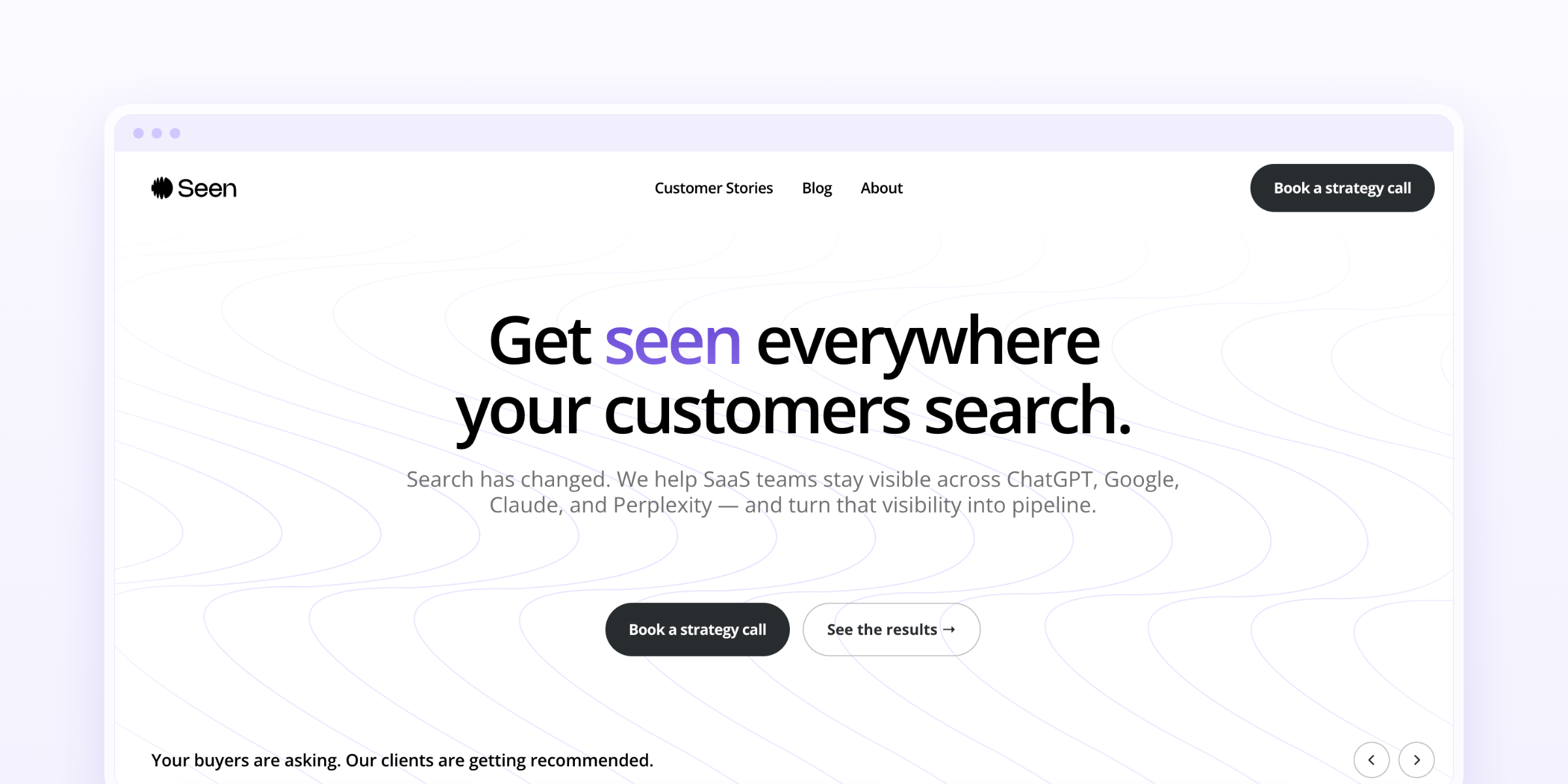
Seen is a founder-led AI SEO and GEO agency for B2B SaaS companies from Seed to Series B. It helps SaaS teams get discovered and recommended across Google, ChatGPT, Claude and Gemini, and it measures that work in qualified signups and pipeline rather than traffic.
Strategy is led by founder Irina Maltseva, former CMO at Hunter. Rather than treating SEO, GEO, and AEO as separate projects, Seen brings them together under one strategy and retainer.
Why? Because the way people discover software is changing, but the fundamentals haven't disappeared. You still need useful content, strong technical foundations, and credible mentions across the web. You also need to understand how AI platforms discover, recommend, and describe your product.
Seen's approach combines those pieces, with the actual work depending on where a client's website and brand need the most attention.
What Seen focuses on:
- Research: keyword, entity, and prompt research to understand how buyers search for the product across Google and AI assistants.
- Strategy: turning that research into a product-led plan. Which bottom-funnel pages to build first, which buyer prompts and third-party sources matter most, and where the fastest path to signups is.
- Product-led content: articles, comparison pages and product-page optimization designed to rank, earn AI citations, and bring in qualified SaaS buyers.
- Brand authority: listicle placements, editorial mentions and relevant backlinks on the sites Google ranks and LLMs cite. The bar is relevance and real influence on rankings and recommendations, not link volume.
- GEO implementation: finding the pages AI tools rely on for a client's buyer prompts, then getting the brand onto them, so clients show up wherever their audience is searching. Plenty of tools can tell you whether ChatGPT mentions you. The hard part is changing the answer. Not sure what goes into a GEO strategy? Here's a closer look at generative engine optimization services and what they involve.
- Pipeline-focused measurement: signups, SQLs and qualified conversions, not sessions.
Seen also works closely with client teams rather than treating SEO as a completely separate function. That means aligning content with product positioning, understanding what makes the product different, and prioritizing pages that can actually support the sales process.
Why B2B SaaS teams choose Seen
A lot of agencies say they're "revenue-focused" these days. What makes Seen different is how that shows up in the day-to-day work:
- Customers, not keywords. Seen prioritizes the searches and AI prompts that influence buying decisions, even when their search volume looks small. The main KPI is signups and pipeline, so a page that drives demos beats a page that drives traffic. That's why comparison pages are often among the first priorities in a SaaS SEO strategy.
- Bottom of the funnel first. New programs usually start with comparison, alternative and use-case pages, because that's where buyers who are ready to choose are searching. Top-of-funnel content comes later, once those pages are converting.
- In-house SaaS experience, not agency thinking. Irina spent 10+ years growing SaaS companies from the inside, so the strategy comes with the commercial accountability of an in-house growth team. She works on every client's strategy herself.
- Experiments, not one playbook. Search, and especially AI search, changes fast. Seen runs a lot of experiments and adapts the strategy to each product, instead of copying the same checklist across clients.
- Authority, not content volume. Owned content only gets you so far. Seen pairs it with third-party mentions, which is what usually moves a brand from "ranking" to "recommended" in ChatGPT and Google AI Overviews.
Client results
Here's what that looks like in practice.
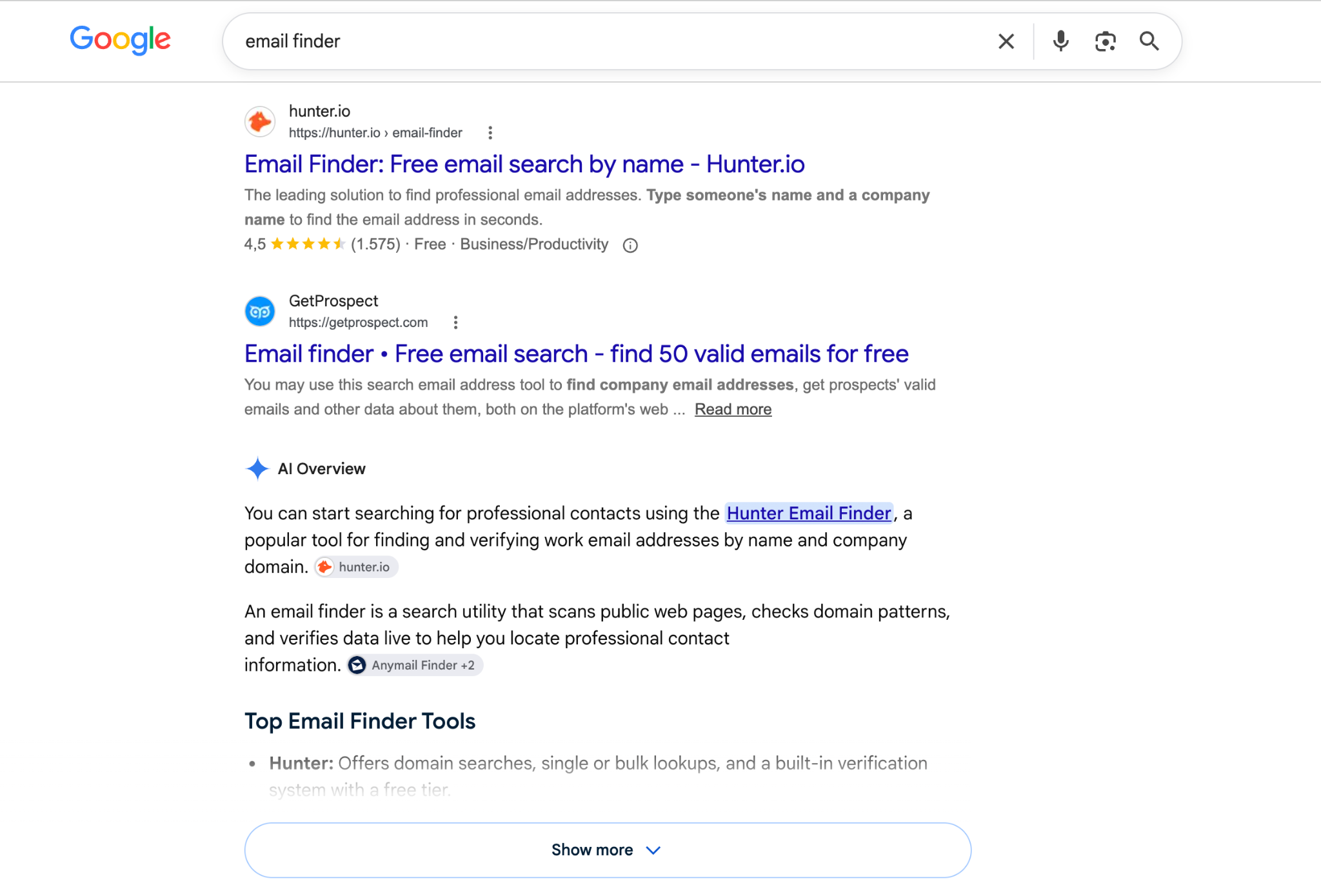
Hunter: 90% of leads from organic search. Over 2.5 years of full-cycle SEO, Seen rebuilt Hunter's product pages around search intent, launched a bottom-funnel blog, and built a brand mention program at scale. Organic search became Hunter's main acquisition channel, driving 90% of its leads. Hunter now ranks #1 on Google for "email finder" and "email verifier," and the organic engine helped grow its customer base by 30%. Read the Hunter case study.
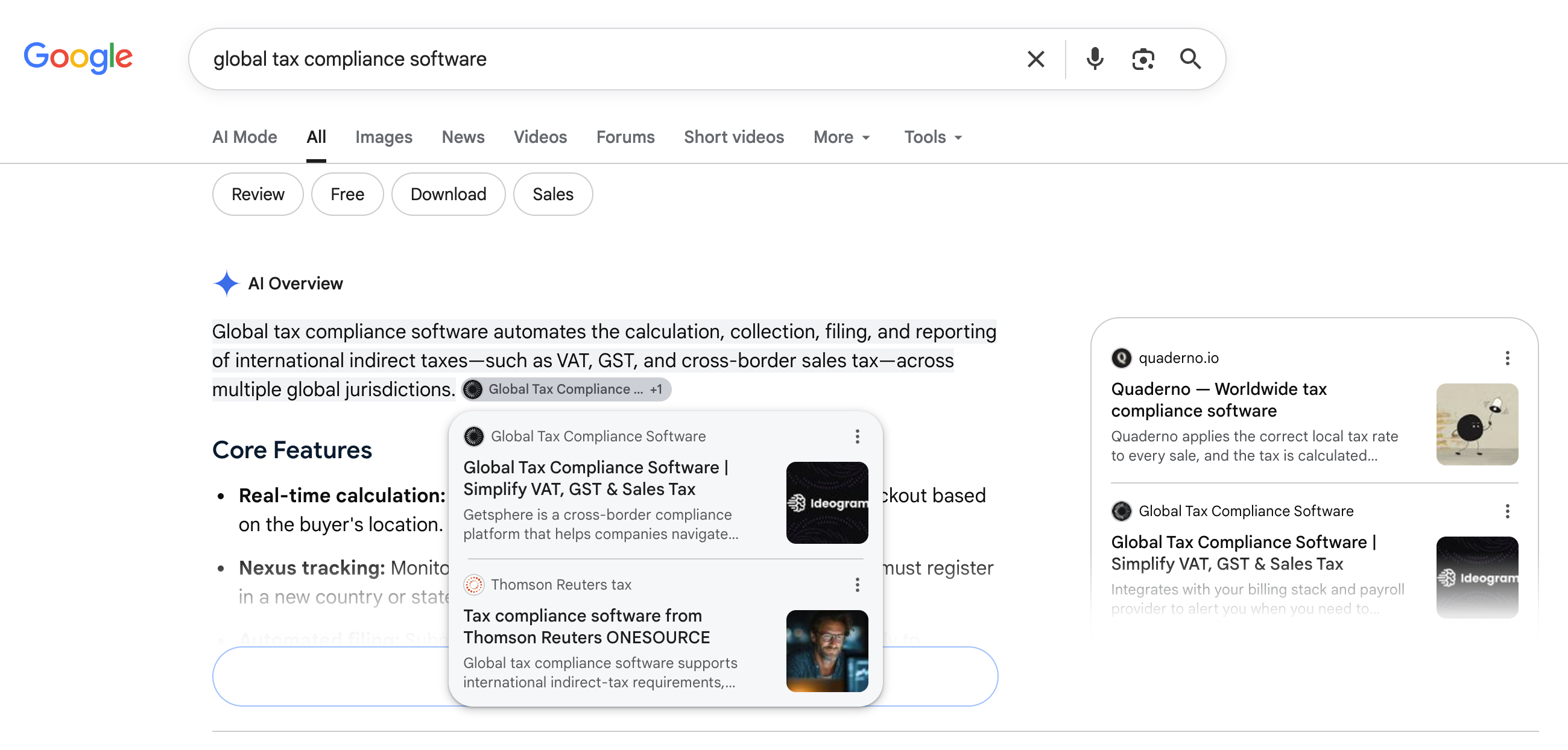
Sphere: from five clicks a day to 40% of SQLs from organic. When Sphere, a YC and a16z-backed tax compliance platform, launched its website in spring 2025, it was getting about five organic clicks a day. Its main competitor was getting 400K+ organic sessions a month. Seen built the strategy around pain points from Sphere's sales calls and started with long-tail searches bigger competitors ignored. Today, Sphere ranks #1 on Google for "global tax compliance software," holds #1 for 143 core business keywords, and gets 40% of its SQLs from Google and LLMs. Read the Sphere case study.
Artisan: from ~100 monthly sessions to 1M+ monthly discoveries. Artisan, a YC-backed AI sales startup, was barely visible on Google or in LLMs when Seen started in March 2024. Seen started with problem-focused content and built authority until bigger keywords were within reach. Artisan now ranks #1 across Google and AI search for "best AI BDR," and Google and LLMs are both among its top three customer acquisition channels. Read the Artisan case study.

What clients say about Seen
"Highly recommend Seen for all things search. Their expertise spans both traditional SEO and the new world of LLM-based search, which has been incredibly valuable for us as a fast-growing global business. Also, just an absolute pleasure to work with."
Nicholas Rudder, CEO at Sphere
"Seen helped us go from zero visibility to consistently ranking #1 for our most important keywords, driving hundreds of leads every month. A truly brilliant partner."
Jaspar Carmichael-Jack, Founder & CEO at Artisan
"Seen has been a true asset to our team. Their depth of marketing expertise, consistency, organization, and proactive ownership made every project run smoother and perform better."
Francois Grante, Co-Founder at Hunter
See how we help SaaS brands grow →
Pricing: Seen works on a custom retainer covering SEO, GEO, and AEO. The scope is adjusted based on the client's current gaps and growth priorities rather than following a fixed number of articles or links every month.
Best for: Seed, Series A, and Series B B2B SaaS companies that want one team handling their organic search and AI visibility, measured in signups and pipeline.
Where it might not be the best fit: Seen works only with B2B SaaS, so it isn't the right choice for ecommerce or local businesses. It also isn't a fit if you need results within 30 days, or if you aren't ready to invest in content.
[cta]
Get your SaaS recommended on Google and AI search
Your buyers are already searching for solutions like yours. Let's make sure they find you, not your competitors.
[/cta]
2. Directive — Best for enterprise SaaS companies focused on pipeline
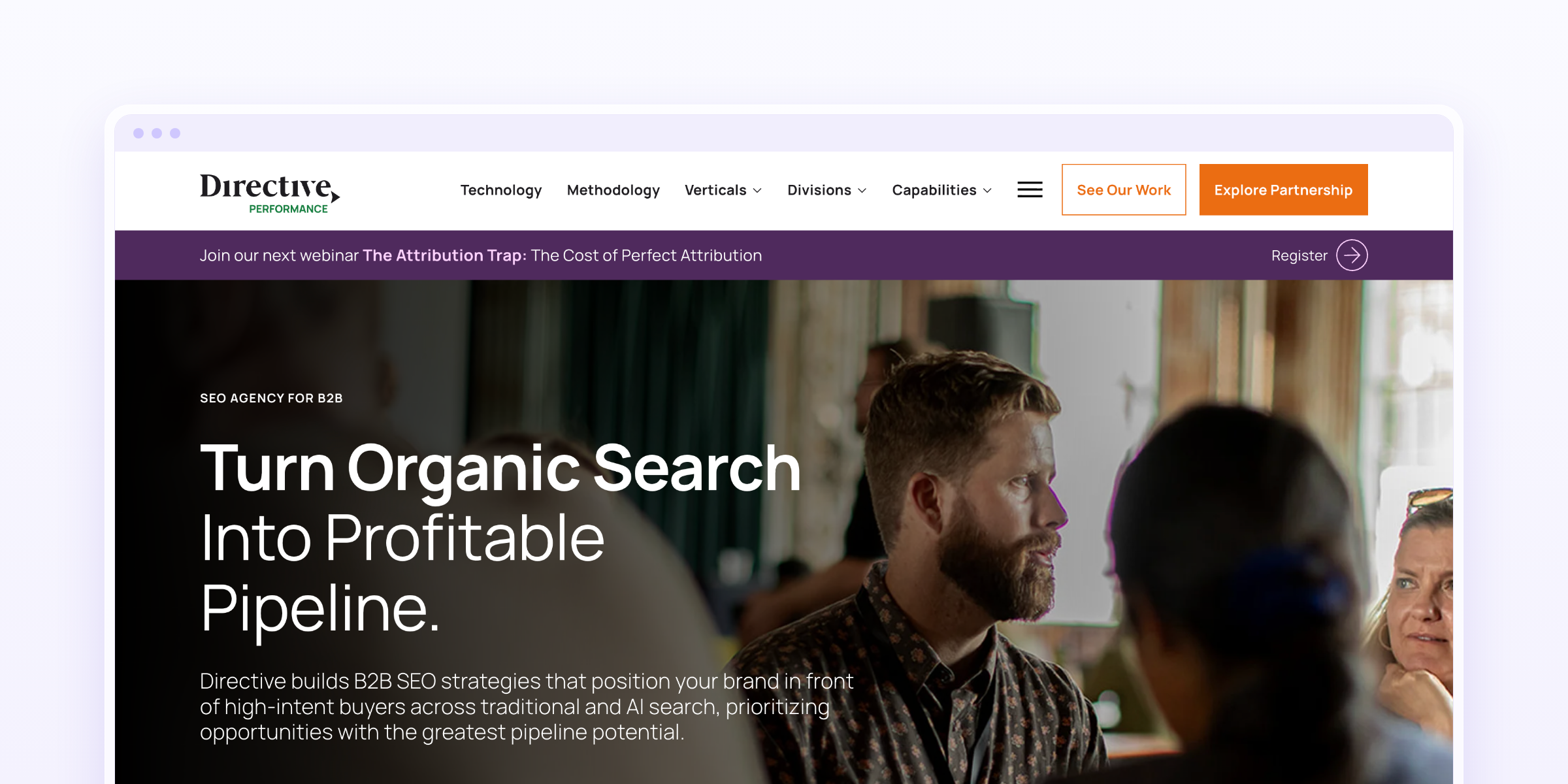
Directive is probably the most enterprise-focused agency on this list.
Its approach makes sense for larger SaaS companies with established sales teams, demand generation programs, and finance stakeholders who want to understand exactly how SEO contributes to revenue.
On its B2B SEO service page, Directive focuses on relevant traffic, conversions, pipeline, and revenue rather than rankings alone. It also prioritizes opportunities in traditional and AI search based on their potential pipeline impact.
Standout capabilities:
- Organic performance reporting connected to pipeline and revenue through CRM attribution.
- Technical SEO, keyword research, content production, and authority development.
- High-intent search opportunities prioritized around business impact.
Where it might not be the best fit: Enterprise attribution requires a CRM, a sales team, and enough deal volume to make the reporting meaningful.
If you're a seed-stage company booking just a handful of demos each month, you probably don't need that much infrastructure yet. A smaller engagement focused on a few important bottom-funnel pages could be a better use of your budget.
Pricing: Miniloop's May 2026 pricing review reports a publicly priced Startup Package at $6,500 per month, with no annual commitment. Keep in mind that this package covers more than SEO. SEO-specific and larger enterprise engagements are quoted individually.
Best for: Enterprise SaaS companies with established demand generation teams and a strong focus on pipeline attribution.
3. First Page Sage — Best for thought leadership and category authority
First Page Sage takes a slightly different approach to SaaS SEO. Instead of focusing primarily on individual keywords or bottom-funnel pages, it puts a lot of emphasis on thought leadership and becoming a recognized voice in your category.
Its enterprise B2B SEO approach is built around expert-led content that positions a brand as a resource buyers can trust and return to throughout their research.
This can be especially useful if you're operating in a competitive category where building credibility matters just as much as ranking for commercial keywords.
Standout capabilities:
- Thought-leadership content designed for enterprise B2B audiences.
- GEO services that combine content creation, outreach, and reputation monitoring.
- A published Cadence case study reporting a 934% increase in total keyword rankings, alongside record subscriber, trial, and signup volumes over two years.
Where it might not be the best fit: The Cadence results were achieved over two years, so this isn't necessarily the right choice if you're looking for quick bottom-funnel wins.
Thought leadership and category authority take time to build. If your biggest problem is that you don't have enough comparison or alternative pages to support demo requests, you might want a more conversion-focused engagement first.
Pricing: First Page Sage's October 2026 pricing report lists its GEO/AEO engagement at $6,000–$12,000 per month, billed through monthly deliverable credits on month-to-month terms.
WeGrowth's roundup cites older pricing tiers of $3,500 for four articles and $5,500 for eight, but notes that the current SEO starting price is uncertain. Those article counts shouldn't be treated as current package inclusions.
Best for: Enterprise SaaS companies that want to build long-term category authority through thought leadership.
4. Kalungi — Best for SaaS companies that need an entire marketing team
Kalungi is a little different from the other agencies here because you're not just hiring an SEO team. You're outsourcing a much bigger part of your marketing function.
Its full-service offering is designed for companies that want an experienced SaaS CMO and an execution team to manage their go-to-market strategy.
Kalungi positions this as an alternative to hiring eight to twelve people internally, plus a full-time CMO.
The advantage is that SEO doesn't operate in isolation. Your positioning, messaging, content, and demand generation strategy can all be coordinated under one marketing plan.
For example, the person responsible for your SEO strategy can work alongside the broader marketing team to make sure keyword targeting reflects how your product is positioned and how your sales team talks to customers.
Standout capabilities:
- Fractional SaaS CMO overseeing strategy across multiple marketing channels, including SEO.
- A full execution team working alongside the broader GTM program.
- A published Beezy case study reporting 63% organic traffic growth, a 390% increase in first-page rankings, and $2 million in qualified pipeline.
Where it might not be the best fit: If you already have a VP of Marketing and only need help with SEO, this is probably more than you need.
The full-service package includes strategic leadership and marketing channels that you might already have covered internally. Since SEO is part of a much bigger engagement, it's not the most practical option for companies looking for SEO support alone.
Pricing: Kalungi publishes pricing starting at $50,000+ per month for its full-service engagement.
Best for: B2B SaaS companies without in-house marketing leadership that have the budget to outsource an entire marketing function.
5. Powered by Search — Best for SaaS demand generation
Powered by Search approaches SEO as part of a bigger demand generation strategy.
Instead of treating organic search as its own channel, the agency brings SEO, GEO, paid media, content, conversion rate optimization, and pipeline attribution together under one statement of work.
This can be useful if you want one team looking at the bigger picture. For example, when a comparison keyword has strong commercial intent, the team can decide whether it deserves an organic landing page, a paid campaign, or both.
Standout capabilities:
- A GEO baseline covering buyer prompts, competitor visibility, existing AI mentions, citations, and source coverage.
- Reporting that connects AI citations and share of answer with referral traffic, branded demand, and pipeline influence.
- GEO content production across category, comparison, use-case, product-led, and bottom-funnel topics, including original research.
- A published Cyera case study attributing more than $7.9 million in qualified pipeline over 12 months to SEO-driven traffic.
Where it might not be the best fit: If you're mainly looking for a specialist SEO team, make sure you understand exactly how much attention SEO will receive within the broader engagement.
Ask for the channel breakdown, monthly content output, and specific SEO deliverables before signing. Otherwise, it's easy to end up paying for a broader program when you really need more depth in one area.
Pricing: SEO and LLM services start at $9,000 per month, separate from the agency's paid media work.
Best for: B2B SaaS companies that want SEO, AI search, paid media, and demand generation working together.
6. Siege Media — Best for scaling content and building topical authority
Siege Media is a strong option if your main goal is to produce high-quality content consistently and build authority in a competitive category.
Its approach is different from First Page Sage's. While First Page Sage puts more emphasis on expert-led thought leadership, Siege focuses on producing premium content at scale, supported by digital PR and link acquisition.
This can work well for SaaS companies that have already established their technical foundations and want to expand their content footprint.
Standout capabilities:
- A published project-management SaaS case study reporting 20+ premium posts per month and 493% organic traffic growth to the resources section in six months.
- Prompt-level citation and LLM share-of-voice baselines during the first two months, alongside a 12-month roadmap.
- Monthly reporting covering AI citations and revenue.
Where it might not be the best fit: More content isn't always the answer.
If your website has indexing problems, your product pages aren't converting, or your existing content isn't reaching the right audience, publishing another 20 articles won't necessarily solve anything.
I'd make sure your technical foundation and content priorities are clear before committing to a high-volume production program.
Pricing: An independent review that rechecked Siege's terms in October 2026 reports an $8,000 monthly content minimum on a 12-month contract with a 30-day exit clause.
Best for: SaaS companies with established SEO foundations that want to scale content production and build topical authority.
How much do SaaS SEO services cost?
The short answer is that SaaS SEO pricing can range from around $1,800 per month for standardized packages to $30,000+ for larger, more complex engagements.
Here's a rough breakdown of what you can expect.
[table]
Tier | Monthly range | What's included | Best-fit stage
AI-assisted or productized | ~$1,800–$4,200 | Standardized packages, fewer pages, limited engine or prompt coverage, light technical work, and little custom implementation | Any stage with one narrow, well-defined need
Startup | ~$3,000–$6,000 | Custom strategy, a few bottom-funnel pages per month, core technical audit, and baseline AI visibility tracking | Seed to Series A, first organic program
Growth | ~$6,000–$15,000 | Ongoing product-led content, technical SEO, link building, some digital PR, and CRM attribution | Series A to B, scaling demand
Scale | ~$15,000–$30,000+; complex enterprise engagements can reach $60,000+ | Senior specialists, digital PR, programmatic or multi-market SEO, full attribution, and higher content velocity | Series C and beyond
[/table]
These ranges combine First Page Sage's agency survey with LoudFace's 2026 B2B SaaS AEO pricing guide. SEO, GEO, and AEO services overlap, but they're not exactly the same thing. Use these figures as buying benchmarks rather than fixed market rates.
One thing worth pointing out: the productized tier isn't really tied to a particular company stage.
It's more about how the service is delivered. You get a standardized package rather than a retainer built around your website, competitors, and sales funnel. That's often fine if you need something specific, like a one-off technical audit, but it may not be enough for an ongoing growth program.
For custom engagements, the price usually depends on several factors:
- Technical complexity: A simple marketing website requires less work than a large SaaS platform with multiple subdomains, documentation sites, and programmatic pages.
- Team experience: Senior strategists, technical specialists, and experienced writers naturally affect the cost.
- Digital PR and link building: Campaigns that involve original research, outreach, and publication placements require additional resources.
- Market coverage: Targeting multiple countries or languages adds research and execution requirements.
- Content production: Publishing a few high-quality pages is very different from producing content at scale.
- Measurement: CRM integrations, pipeline attribution, and AI visibility tracking can add to the scope.
LoudFace's guide also identifies prompt portfolio size, website infrastructure, and content velocity as important cost drivers.
And remember to budget for your own team's time, too. Technical fixes might require developers, new page templates might need design support, and product-led content usually needs input from subject-matter experts.
When should you move to a higher pricing tier?
You don't necessarily need a bigger retainer just because your company is growing.
But there are a few signs that your current scope might be holding you back:
- Your team has approved several bottom-funnel pages, but they're waiting in the agency's production queue.
- Your sales team wants to connect organic performance to actual pipeline through CRM reporting.
- You're planning a website migration, documentation migration, or programmatic SEO launch that adds technical complexity.
- You're expanding into another country or language.
- You need to track more buyer prompts and AI search platforms than your current plan covers.
If you're running into several of these issues, it might be time to expand the scope.
Choose a SaaS SEO agency by stage, growth motion and bottleneck
Four questions narrow the field faster than any ranking.
- What stage are you at? At seed or Series A, a focused scope on a handful of bottom-funnel pages and technical basics beats a broad program. By Series B and C, you need coordination across channels, senior staff and attribution that survives a board review.
- What's the main bottleneck? Technical or indexing debt, too little qualified traffic, traffic that doesn't convert, limited content or authority capacity, or low visibility in AI search each call for a different specialist.
- Is the motion product-led or sales-led? Product-led companies live on signups and PQLs, so content should push toward trial. Sales-led companies live on demos and pipeline, so CRM attribution matters more.
- What can your team supply? Developer time for fixes, subject-matter experts for product-led content and CRM access for attribution. A retainer that assumes unavailable inputs will stall, so put each dependency and owner in the proposal.
Then map your answers:
- Seed to Series B B2B SaaS, need Google and AI search to drive signups and pipeline under one strategy: Seen
- Established enterprise, sales-led, demand team in place: Directive
- Category authority as the goal, patience for a long horizon: First Page Sage
- No marketing team, budget for a whole function: Kalungi
- SEO should run inside integrated demand gen with paid: Powered by Search
- Content or authority capacity is the constraint: Siege Media
Pure technical or indexing debt doesn't map cleanly to one pick. Turn the scope checklist into your RFP and compare each agency's GEO column and stated workstreams in the shortlist table against your specific gap.
Red flags and contract terms to check before signing
The sales call can expose a bad engagement before you sign.
- Leading with traffic instead of pipeline. Ask how they'll report demos, trials and pipeline, and what CRM access they need. A vague answer means you'll get session charts.
- Guaranteed rankings. Google's own guidance tells buyers to find someone else if a provider guarantees first place. Ask for a realistic improvement estimate, the timeframe, how success gets measured and an explanation of every change they'd make to your site.
- No SaaS client proof. Ask for prior work with companies at your stage and growth motion, plus a reference you can call.
- Vague GEO claims. Ask which prompts and assistants they'd track, how they baseline current citations and what the monthly report shows.
A poor fit isn't the same as a red flag. An enterprise agency that wants a long minimum term and a full CRM integration is built for a different buyer than a seed-stage team, not behaving badly. A red flag is a practice that would hurt any client.
Before signing, check that the contract spells out:
- Exact scope and deliverables by month or quarter
- Implementation responsibilities for technical fixes and page builds
- Minimum term and notice period
- Ownership of content, accounts, dashboards and tracking setups after exit
- Reporting cadence and the metrics each report covers
- Change control for swapping deliverables mid-term
- Exit terms and handover
Finally, negotiate the clause covering misses. It should state the remedy for missed agency deliverables and how dates change when client development or approvals arrive late.
[cta]
Not sure what your SaaS SEO strategy should prioritize?
Let's take a look at your website, competitors, and AI search visibility. We'll identify what's holding back organic growth and where we'd focus first to bring in more qualified leads.
[/cta]
FAQs
Is SEO still worth it for SaaS companies now that AI search is growing?
Yes. For Google's AI Overviews, normal indexation and snippet eligibility remain the technical foundation. The job has expanded to include tracking how assistants cite and describe your product.
Should a SaaS company invest in SEO or paid ads first?
Go paid first if you need pipeline this quarter and want fast message testing. Go SEO first if buyers already search comparison and alternative terms in your category and you can wait months for compounding returns. A practical middle path runs small paid tests while the first bottom-funnel pages are built, then uses paid conversion data to prioritize SEO topics.
Should we hire an in-house SEO team or use a SaaS SEO agency?
An agency usually wins until SEO has enough work for several specialists. First Page Sage's cost model estimates a growth-tier agency at $8,200 a month for 6.5 deliverables, against $12,169 a month for one in-house specialist producing 3.1. Hire in-house when you need daily proximity to product and engineering.
Should a SaaS company hire a SaaS-only SEO agency or a generalist?
A SaaS specialist is the safer bet when success means trials, demos, and pipeline, because PLG funnels, comparison pages and CRM attribution are already familiar ground. A generalist can work if they show SaaS results at your stage, so ask for them.
What is the difference between a SaaS SEO consultant and an agency?
A consultant advises and your team executes; an agency produces and often implements the work. A consultant fits companies that already have writers and developers but lack strategy.
Does it matter if a SaaS SEO agency is based in the US?
Location matters less than fit. Look for a team that knows your target market and its language, overlaps enough with your working hours for quick reviews, and can speak credibly with your stakeholders.