- AEO gets your brand mentioned, cited and recommended when buyers ask ChatGPT, Claude, Gemini or Google AI Overviews for a solution. If you're not in that short answer, you may never make the shortlist.
- Best for B2B SaaS: Seen. It runs SEO, GEO and AEO as one strategy measured by signups and pipeline. Sphere, for example, became the #1 LLM recommendation in its category and now gets 40% of its SQLs from organic.
- Other options: XQL Group for IT service providers, Siege Media for content-led programs, NoGood for consumer and commerce growth, Silverback Strategies for mid-market teams, Avenue Z for PR-led trust, EWR Digital for industrial enterprises.
- Pay for execution, not tracking. Any AI visibility tool can tell you whether you're mentioned. A good agency changes the answer, and never guarantees placement.
When someone asks ChatGPT to recommend a software provider, compare products, or find the best solution to a problem, only a handful of brands may appear in the answer. If yours isn't one of them, you could miss out on potential customers before they even visit your website.
That's where answer engine optimization (AEO) comes in.
An AEO agency helps brands improve their chances of being mentioned, cited, and recommended in AI-generated answers. The work goes beyond traditional SEO. It can include improving website content, strengthening brand authority across third-party websites, and tracking how often AI platforms include your business in relevant answers.
But not every agency approaches AEO in the same way. Some focus on content and technical improvements, while others put more emphasis on digital PR, third-party mentions, or AI visibility tracking.
We've compared 76 agencies to help you understand what they offer, who they're best suited for, and what to look for before signing a contract.
What does an answer engine optimization agency do?
An answer engine optimization agency helps brands become more visible in AI-generated answers. Instead of focusing only on where a website ranks in traditional search results, AEO looks at whether AI platforms mention, cite, or recommend a brand when someone asks a relevant question.
These platforms can include ChatGPT, Google AI Overviews and AI Mode, Perplexity, Gemini, Claude, and Copilot.
The exact services vary by agency, but an AEO engagement may include:
- AI visibility audits: Checking whether and how your brand appears in AI-generated answers.
- Prompt and query research: Identifying the questions potential customers ask when researching products or services.
- Content optimization: Making website content easier for search engines and AI systems to understand and reference. Getting content cited requires more than adding keywords.
- Technical SEO and schema: Improving the structure of your website and the information associated with your brand.
- Offsite authority building: Earning mentions, reviews, and coverage on third-party websites that may influence AI recommendations.
- Performance tracking: Monitoring brand mentions, citations, share of voice, and sentiment across AI platforms.
These services are often part of a broader AI SEO engagement. Our guide to AI SEO services explains what agencies typically include, how they approach GEO and AEO, and what businesses can expect to pay. AEO can be useful for all kinds of businesses, from local service providers to B2B technology companies. The important thing is finding an agency that understands how your customers research and compare options.
How we evaluated these agencies
A quick note on transparency first. This article is published by Seen, and I'm Irina Maltseva, Seen's founder. Seen is on this list, and you should know that before you read further.
I've worked in SEO and SaaS growth for 10+ years. Before starting Seen, I was CMO at Hunter, and over my in-house years I hired, briefed and managed a lot of agencies. So I know what it looks like from the buyer's side when an agency's pitch doesn't match what ends up in the monthly report.
That's the lens I used here. For each agency, I looked at five things:
- Proof of AI visibility. Does it publish client results from AI answers, not just organic traffic charts?
- Execution, not only tracking. Does it actually build content and offsite authority, or mostly report on what a $50 tool can already show you?
- Offsite plan. Can it explain how it earns mentions on the third-party sources AI platforms cite?
- Business reporting. Does it connect AI visibility to leads, signups or pipeline?
- Transparency. How much does it disclose publicly about scope, platforms, pricing and contract terms?
Where an agency didn't publish something, I've said so rather than guessing.
How the top AEO agencies compare
Here's a quick look at the 7 agencies, their main services, the platforms they cover, and what they disclose about reporting and contract terms.
[table]
Company | Core AEO services | AI platforms covered | Reporting metrics
Seen | AEO and GEO strategy and implementation, SaaS SEO, product-led BOFU content, listicle placements, third-party brand mentions and links | ChatGPT, Claude, Gemini, Google AI Overviews | Signups, qualified leads and pipeline, plus AI recommendations for buyer prompts
XQL Group | Commercial prompt research, service-page optimization, comparison content, digital PR and review placements | ChatGPT, Claude, Perplexity, Gemini, Google AI search experiences | AI recommendations for target prompts, AI-sourced leads, sales opportunities and closed deals
EWR Digital | Not publicly disclosed | Not publicly disclosed | Not publicly disclosed
Siege Media | Content marketing program that includes GEO | Not publicly disclosed | Not publicly disclosed
NoGood | Visibility strategy, owned content, earned media and citation building, technical infrastructure | ChatGPT, AI Overviews, AI Mode, Gemini, Perplexity, Claude, Copilot | Mention frequency, citation rate, competitor share of voice, sentiment accuracy
Silverback Strategies | AI visibility audit, offsite signals from reviews, forums and coverage, custom reporting | ChatGPT, Perplexity, Google AI Overviews | Custom stakeholder reports tied to business impact
Avenue Z | Prompt mapping, entity analysis, PR, citation-focused content, technical optimization, measurement | Not publicly disclosed | Citation share, priority-prompt coverage, position, sentiment
[/table]
7 AEO agencies and who each is best for
The agencies below range from specialist AI-search firms to broader content, growth and organic-search practices. Seen publishes this article and appears here alongside 6 other agencies.
1. Seen
Seen is a founder-led AI SEO and AEO agency built only for B2B SaaS. It runs AEO as one part of a combined SEO, GEO, and AEO strategy, so the same work that gets a SaaS brand ranking on Google also gets it recommended by ChatGPT, Claude, Gemini, and Google AI Overviews.
Here's the idea behind it. AI assistants don't recommend the brand that publishes the most content. They recommend the brand the rest of the web keeps vouching for, on the pages they already trust and cite. So Seen doesn't stop at monitoring whether you show up. It builds and implements the strategy that makes you show up, on your own site and on the third-party sources your buyers and AI platforms read.
Standout capabilities:
- One strategy for Google and AI search. SEO, GEO, and AEO are planned together instead of sold as separate services, so visibility on Google and in AI answers compounds.
- Buyer prompts that lead to revenue. Seen prioritizes the searches and prompts buyers use when they compare tools, such as "best [category] for [use case]" and "[competitor] alternatives", rather than chasing volume.
- Product-led, bottom-of-funnel content. Seen learns how the product works, who buys it, and why it wins, then turns that into comparison pages and high-intent articles written to rank, earn AI citations, and convert. For SaaS teams planning this type of content, our guide to the five pages every SaaS site needs covers the commercial pages that help buyers compare options and make decisions.
- Offsite authority where AI looks. Seen finds the listicles, reviews, and publications AI platforms cite for each client's priority prompts, then earns brand mentions, listicle placements, and editorial links on those exact pages. We explain this approach in more detail in our guide to earning 500 brand mentions without a link-building agency.
- Founder-led strategy. Irina Maltseva, Seen's founder and former Hunter CMO, works on the strategy for every account day to day, with the Seen team handling end-to-end execution.
- Pipeline as the main KPI. Seen reports on signups, qualified leads, and pipeline alongside AI recommendations, so you can see what visibility is worth to the business.
Why B2B SaaS teams choose Seen
Most agencies start with keywords. Seen starts with the deals you want to win. Before any content gets planned, the team digs into your product, your buyers and your competitors. With Sphere, that meant reviewing demo calls to learn the exact language buyers used, then building the search and AI strategy around it.
The main KPI is signups and pipeline, not traffic. A #1 spot for a prompt nobody buys from isn't worth reporting. That's why Seen focuses on bottom-of-funnel content first and earns third-party mentions on the pages that actually shape AI recommendations.
And there's no copy-paste playbook. AI search changes too fast for that. Seen runs experiments for each client, measures what moves recommendations in that specific category, and scales whatever turns into signups.
What Seen's clients have achieved in AI search
Seen's clients include Sphere, Nextiva, Riverside, Aura, Artisan, and Hunter. Here are a few results from AI search specifically.
Sphere: from a brand-new website to the #1 LLM recommendation in its category. Sphere is a Y Combinator and a16z-backed tax compliance platform. When its site launched in spring 2025, it was getting around five organic clicks a day, against a competitor with 400K+ monthly sessions. Today, Sphere is the leading LLM recommendation for AI-powered global tax compliance, and the most-cited domain across every LLM Seen tracks for it. Google and LLMs now bring in 40% of Sphere's sales-qualified leads. Read the Sphere case study.

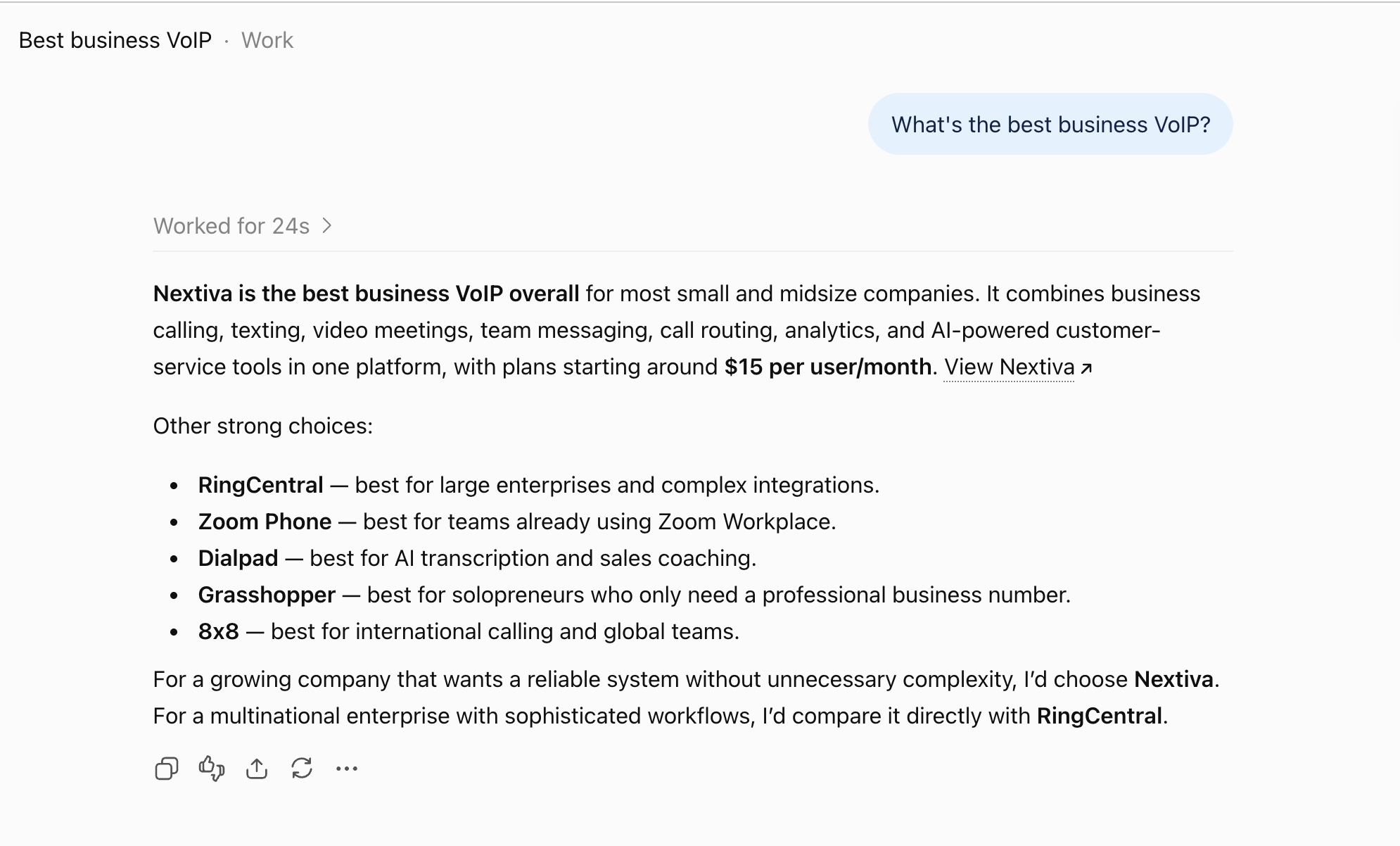
Nextiva: #1 on ChatGPT for "best business VoIP". Nextiva competes in one of the most crowded software categories there is. Seen analyzed the pages LLMs cite most for Nextiva's tracked prompts and earned mentions and listicle placements wherever the brand was missing. Nextiva is now the top ChatGPT recommendation for business VoIP, business phone systems and AI receptionists, and appears in 7.8K Google AI Overviews. Read the Nextiva case study.
Aura: the first AI recommendation in three out of four answers. Aura started with almost no organic visibility and a generic brand name. Seen built 1,600+ brand mentions and backlinks to tie the name to identity theft protection. Aura is now the #1 recommendation in 75% of tracked AI search results and appears in 10.8K AI-generated answers. Read the Aura case study.

What clients say about Seen
"Highly recommend Seen for all things search. Their expertise spans both traditional SEO and the new world of LLM-based search, which has been incredibly valuable for us as a fast-growing global business. Also, just an absolute pleasure to work with."
Nicholas Rudder, CEO at Sphere
"It's rare to find a partner like this—any team that needs help with visibility and pipeline will genuinely benefit from working with Seen."
Gaetano DiNardi, ex-VP of Growth at Aura
From better rankings to more AI recommendations, see what's possible. Explore customer stories →
Limitations: Seen works only with B2B SaaS companies, so it isn't the right fit for any other type of business. It also isn't a fit for teams that need results in 30 days or aren't ready to invest in content. And if you only want to monitor AI mentions, a tracking tool will be cheaper than a full-cycle agency.
Pricing: Custom packages built around each company's needs, covering the full SEO, GEO, and AEO cycle, with effort weighted toward the client's biggest gaps.
Best for: Seed, Series A, and Series B B2B SaaS companies building visibility from zero, and scaling SaaS teams without in-house SEO or AI search expertise who want AI assistants to recommend them for buyer prompts.
[cta]
Stop letting competitors own your AI search visibility
Find out where you're missing from AI recommendations and how to get ahead.
[/cta]
2. XQL Group
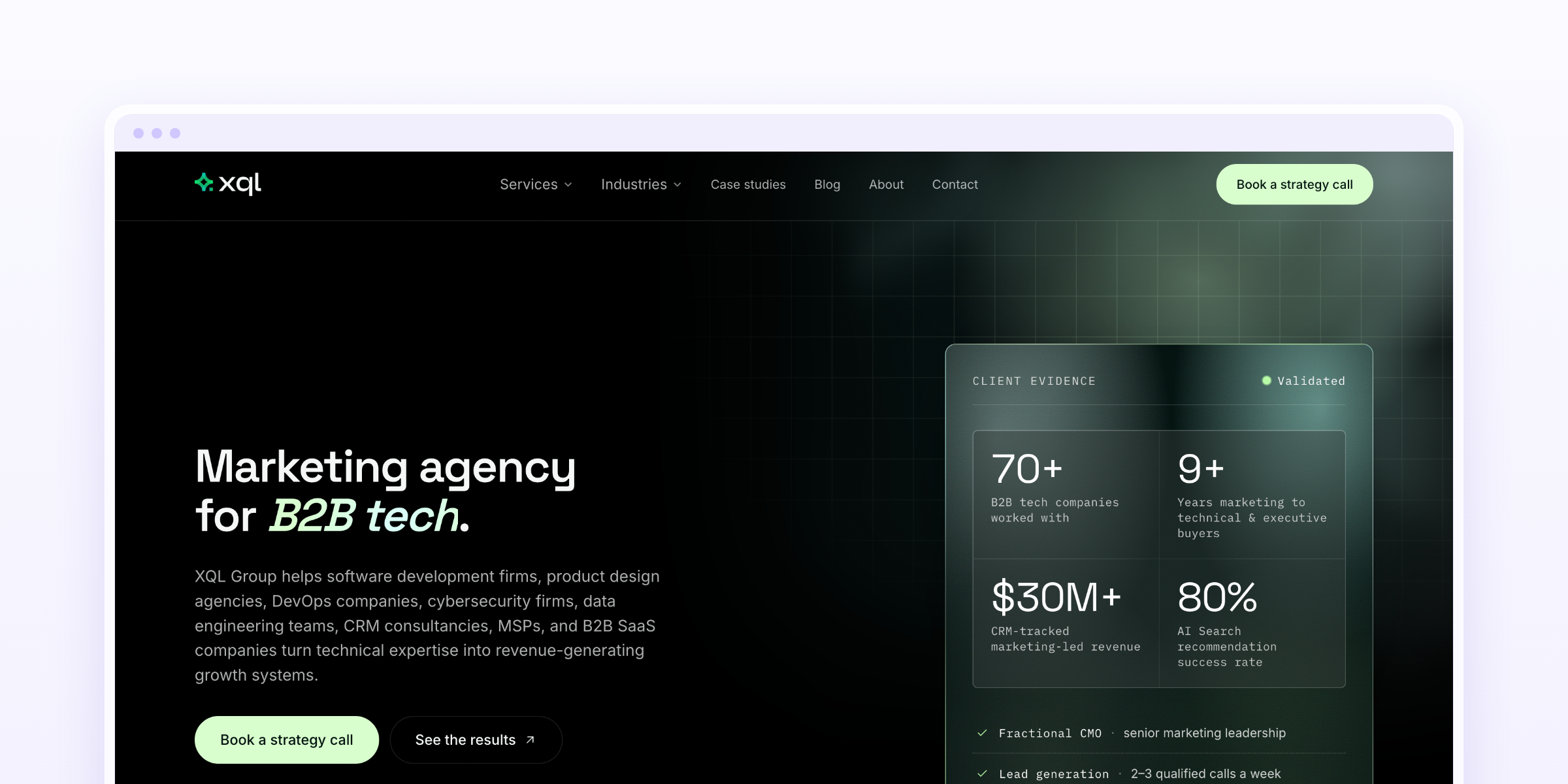
XQL Group is an answer engine optimization agency that works with more than 70 IT service companies, including software development firms, staff augmentation businesses, DevOps providers, and consultancies. Its approach focuses on a specific challenge for these businesses: getting recommended when potential clients ask AI assistants to find a provider with the right technical expertise, industry experience, or delivery capabilities.
Rather than starting with general brand awareness, XQL builds campaigns around the commercial prompts buyers use when evaluating service providers. The team researches which companies ChatGPT, Claude, Perplexity, Gemini, and Google currently recommend, then works on both the client's website and the third-party sources that influence those recommendations.
Standout capabilities:
- Commercial prompt research focused on the services and markets a client wants to win
- Website optimization covering service pages, comparison articles, and other buyer-focused content
- Digital PR campaigns involving five to ten targeted publications, review profiles, and expert mentions
- AI recommendation tracking across ChatGPT, Claude, Perplexity, Gemini, and Google AI search experiences
- CRM reporting that connects AI-sourced leads and recommendations to sales opportunities and closed deals
What clients have achieved: XQL reports that Computools closed two enterprise deals worth $1 million each from ChatGPT-sourced business during a three-month engagement. Intelvision generates a reported two to four sales-qualified leads per month from ChatGPT, while Baytech Consulting secured recommendations across major AI assistants for three selected commercial keywords.
Limitations: XQL's approach is primarily built around IT service providers and companies selling technical expertise. SaaS product companies, consumer brands, and businesses outside the IT services sector may need an agency with a different specialization.
Pricing: Not publicly disclosed. Contact XQL Group for a quote based on the campaign scope and target markets.
Best for: IT service providers that want to appear in AI-generated supplier shortlists, with commercial prompt research, website content, and third-party coverage built around the services they actually sell.
3. EWR Digital
EWR Digital's broader practice serves enterprise buyers in oil and gas, industrial, medical and professional-services markets, giving it a different sector focus from the SaaS- and fintech-oriented agencies here.
Standout capabilities: EWR Digital focuses on technical, long-sales-cycle markets. Its published AEO proof is a verified client review describing results in Google AI Overviews, but the review provides no numerical baseline or measurement method.
Limitations: AEO-specific contract terms, minimum engagement, tracked platforms and reporting metrics are not publicly disclosed. Its enterprise sector focus is a weaker match for SaaS and consumer brands.
Pricing: Not publicly disclosed.
Best for: Enterprise companies in industrial, energy, medical and professional-services markets that want an agency fluent in how their buyers evaluate suppliers.
4. Siege Media
Siege Media comes to AEO from content marketing, with GEO sitting inside its content-marketing service rather than branded as a separate product line.
Standout capabilities: Siege Media's GEO framework distinguishes traditional search, which retrieves and ranks links, from generative engines, which synthesize answers. Its content focus fits brands whose AI visibility problem is thin, poorly structured or hard-to-cite onsite material. A published AEO client result is not publicly disclosed.
Limitations: Its content-marketing minimum makes it a poor fit for most early-stage startups and small local businesses. Its standard AI-platform coverage is not publicly disclosed.
Pricing: Siege Media's content-marketing service carries an $8,000 monthly minimum and requests a 12-month contract that includes a 30-day exit clause. Those terms apply to the content-marketing service, which includes GEO, not to a dedicated AEO package.
Best for: Established brands with a sizable content budget that treat AI visibility as an extension of a long-term content program.
5. NoGood
NoGood offers AEO within a broader growth service mix rather than as its only practice.
Standout capabilities: NoGood organizes its full-service AEO offer around visibility strategy, owned content, earned media and citation building, and technical infrastructure. It optimizes for ChatGPT, Google AI Overviews, AI Mode, Gemini, Perplexity, Claude and Copilot, and reports mention frequency, citation rate, share of voice against competitors and sentiment accuracy. In its SteelSeries case study, NoGood reports a 27-fold year-over-year increase in conversions from AI platforms, and SteelSeries' VP of Marketing calls NoGood "a stand out partner in navigating agentic commerce and AI search."
Limitations: Contract terms are not publicly disclosed. NoGood also does not publicly disclose whether AEO can be bought separately from a broader growth engagement, so the fit is less clear for a company that wants only AEO.
Pricing: Not publicly disclosed.
Best for: Growth-stage consumer and commerce brands where AI answers increasingly shape purchase decisions, and companies that want AEO coordinated with other growth channels.
6. Silverback Strategies
Silverback Strategies runs AI search out of its organic search practice, which suits teams that want AEO handled alongside SEO rather than through a second vendor.
Standout capabilities: Engagements open with a visibility audit across ChatGPT, Perplexity and Google AI Overviews that maps where the brand stands and where its biggest opportunities sit. Offsite work treats reviews, forums, third-party coverage and mentions across the web as inputs to AI recommendations. Reporting is customized to the stakeholders reading it and built to connect marketing activity to business impact.
Limitations: Contract length, minimum engagement and a named quantitative client case study are not publicly disclosed. Silverback names ChatGPT, Perplexity and Google AI Overviews.
Pricing: Not publicly disclosed.
Best for: Mid-market marketing teams that report to finance-minded leadership and need AI search results expressed in business terms rather than visibility percentages.
7. Avenue Z
Avenue Z emphasizes third-party reputation by pairing PR with content and technical work. It targets trust-sensitive, complex sectors.
Standout capabilities: Its typical scope runs from prompt and journey mapping through entity analysis, PR, citation-focused content, technical optimization and ongoing measurement of citation share, priority-prompt coverage, position and sentiment in generated answers. Its quantified proof comes from its own 30-day AEO program, which Avenue Z reports raised its AI visibility by 121% and share of voice by 77%. It credits that result to connected structured content, PR and technical work rather than onsite SEO alone.
Limitations: The headline result comes from Avenue Z's own program, not a client engagement. Its finance and technology focus is a weaker match for local businesses and consumer brands in other sectors.
Pricing: Pricing, billing structure and contract terms are not publicly disclosed.
Best for: Fintech, digital banking, payments, digital assets, wealthtech, alternative investments, AI infrastructure and B2B software companies whose buyers need to trust a brand before an AI recommendation carries weight.
AEO vs SEO: should you hire a specialist, use your SEO agency or build in-house?
SEO and AEO have different goals, but they share many of the same foundations.
Traditional SEO helps your website appear in search results and attract organic visitors. AEO focuses on whether your brand gets mentioned, cited, or recommended when an AI platform generates an answer.
That doesn't mean you need to start from scratch. AI platforms still rely on information from websites, structured content, and sources across the web. A solid SEO strategy can already give you a good starting point.
The difference is in how you measure visibility and where you look for opportunities.
For example, AEO requires tracking a fixed set of buyer questions across different platforms. You need to know whether your brand appears, which competitors are mentioned instead, and how your brand is described. Traditional keyword-ranking reports won't give you that level of detail.
Offsite work also matters. Reviews, publisher roundups, industry publications, and community discussions can all help shape how a brand is represented online. If your current SEO agency focuses only on backlinks, it may not cover the full range of work needed for AEO.
So, which approach makes the most sense?
- Extend your existing SEO agency's scope if it can show you prompt-level tracking and a clear offsite plan that goes beyond traditional link building.
- Hire an AEO specialist if your current agency can't report on AI visibility by platform or doesn't have a plan for third-party mentions and citations.
- Build in-house if you already have content and PR teams, operate in a relatively focused product category, and have someone who can manage prompt tracking and optimization regularly.
If you're still unsure, start with an AEO audit. It can show you where your brand is missing from relevant answers and help you decide whether you need a specialist or can handle the work with your existing team. If you're looking for an agency specifically focused on generative engine optimization, our comparison of top GEO agencies covers their services, specializations, and approach to AI search visibility.
How much does an AEO agency cost?
AEO agencies commonly use monthly retainers, one-time audits or fixed-scope projects, or plans that bundle AEO with SEO. eSEOspace's 2026 pricing guide notes there is no authoritative public benchmark for an average price, so treat every range as its publisher's estimate.
Monthly retainer. HubSpot's 2026 AEO pricing guide puts ongoing managed agency programs at roughly $9,000 to $15,000 or more per month. At that level, the retainer should cover strategy, content production, schema and technical work, offsite authority building, monitoring, and reporting. If offsite outreach is absent, the scope does not match the managed AEO package HubSpot describes.
Standalone audit or sprint. HubSpot gives about $3,000 as a starting point for a one-time audit or sprint, while Am I Cited's October 2026 agency guide estimates one-time AI visibility audits at $500 to $7,500, depending on depth, platforms, and query volume. The useful version delivers a platform-by-platform baseline on your priority prompts, a list of where you're misrepresented or missing, and a ranked fix list another team could execute.
AEO bundled into an SEO retainer. Some agencies sell combined SEO, GEO, and AEO plans rather than a separate service. Bundling is efficient when the shared foundations are real. To tell new work from relabelled SEO, look at the deliverables. A prompt set, platform-level citation reporting and a named offsite source plan are new work, whereas keyword rankings in a report titled "AI visibility" are not. If you're comparing GEO as a standalone service, our generative engine optimization services guide breaks down the different engagement models, deliverables, and pricing.
Costs rise with prompt and answer-engine coverage, offsite authority work and content volume. HubSpot identifies monitoring coverage and offsite authority building as price drivers. Broader monitoring can also expose more content and outreach gaps to address.
AEO agency vetting checklist: questions to ask before you hire
If you suspect AEO is SEO with a new label, these questions expose the difference on a first call. Paste them into your agenda:
- "Which buyer prompts will you track, and how did you choose them?" A credible answer is a draft list built from your sales calls, search data and community threads, grouped by buyer stage. "We'll track your keywords" is a weak one.
- "What baseline will you establish, which platforms will you measure and how often will you report citation frequency, share of voice and sentiment?" Look for named platforms, a fixed cadence and a baseline taken before any changes ship.
- "Can you show before-and-after AI visibility evidence from a client in a market similar to ours?" Expect citation or mention data, not organic traffic charts.
- "What onsite changes are included, and who is responsible for implementing them?" You want a clear split between what the agency ships and what your developers own.
- "What is your offsite plan, and which publishers, review sites and communities influence our priority prompts?" Suppose you sell payroll software. A strong answer names the relevant review platforms, the comparison roundups already appearing in AI answers and the communities where accountants trade recommendations, then explains the planned work for each. A weak answer promises to "build authority with high-quality links and PR" without naming a single source.
- "What will we receive each month, and what findings would cause you to change the plan?" The agency should describe a scorecard plus the triggers that reallocate effort.
Red flags:
- Guaranteed placement in ChatGPT or any other assistant. No vendor can sell guaranteed placement in an AI answer, because none controls inclusion.
- Schema-only packages.
- An offsite plan that can't name target source types.
- Reporting limited to traditional search rankings.
Choosing the right AEO agency
There's no single AEO agency that's right for every business. The best choice depends on your industry, budget, existing SEO setup, and how much support you need beyond tracking AI mentions.
If content is your biggest gap, a content-led agency like Siege Media may make sense. If you want AEO as part of a broader growth strategy, NoGood or Silverback Strategies could be worth exploring. XQL Group is worth considering if you're an IT services company trying to get recommended for commercial searches. Companies in specialized enterprise industries may also want to look at EWR Digital, while Avenue Z may be relevant for brands where PR and third-party reputation play a major role.
For B2B SaaS companies, Seen brings SEO, GEO, AEO, product-led content, and offsite authority building together in one program, measured by signups and pipeline rather than mention counts.
Whichever agency you shortlist, don't make your decision based on the number of AI platforms it claims to cover or a single visibility score. Ask to see its tracking process, review the actual deliverables, and find out how it plans to improve your brand's presence across the sources that influence AI answers.
Ultimately, you want an agency that can do more than tell you whether AI platforms mention your brand. You want a team that understands why you're being included or left out, and has a practical plan to improve that.
[cta]
Wondering why AI recommends your competitors instead of you?
Let's find out. We'll look at where your brand appears across AI search, which competitors are getting recommended, and what opportunities you're missing.
[/cta]
FAQs
How long does it take for a brand to show up in AI answers?
No one can promise a date. HubSpot's pricing guide advises expecting early signals, not certainty, in the first 60 to 90 days.
Is AEO the same as GEO or LLMO?
The terms overlap substantially, but the categories are not standardized. AEO (answer engine optimization), GEO (generative engine optimization), AI SEO and LLMO (large language model optimization) all refer to work on visibility in AI-generated answers. Here, AEO means improving whether and how a brand is included, cited or recommended. Am I Cited's guide likewise treats the terms as overlapping, so compare scopes rather than acronyms.
Does AEO work for local businesses or only for B2B brands?
A local business can use AEO for questions such as "best provider near me," with reviews and third-party mentions supporting its reputation. Several agencies on this list concentrate on B2B, fintech or commerce, so a local business should look for a provider with local reputation experience.
Do AEO results hold when AI models and Google update?
Not automatically. AI answers are probabilistic and can shift with platform, user, location and model updates. Ongoing monitoring shows when those shifts change citations, mentions or brand descriptions and identifies the next work to do.
Is an AEO agency worth the cost for a smaller company?
Start with an audit rather than a retainer. If the audit finds competitors cited for prompts closely tied to sales, an ongoing program has a clearer business case. If the brand already appears consistently or those prompts rarely influence buying, SEO plus periodic tracking may be enough.