- A GEO agency gets your brand recommended in AI answers from ChatGPT, Claude, Gemini and Google AI Overviews. The right one depends on why you’re missing.
- Before any calls, run 15-20 buyer prompts through the main AI platforms to see where you’re missing.
- Pick an agency that ties AI visibility to signups and pipeline, not mention counts. Skip anyone who guarantees ChatGPT or any other LLM placements.
- Pricing runs from a one-off audit to $7,500-15,000+/month. Not sure yet? Start with an audit or pilot.
Half of B2B software buyers now start their research in ChatGPT, Claude, or Gemini more often than in Google. A year earlier, it was less than a third. That number comes from G2’s 2026 survey of 1,076 B2B software buyers.
And AI is now handing buyers a shortlist. G2 found that 69% of buyers ended up choosing a different vendor than they’d planned because of what an AI chatbot showed them. A third bought from a vendor they’d never heard of before.
Getting mentioned also helps buyers trust you; 85% think more highly of a vendor when AI recommends it.
So if your brand isn’t in those answers, you’re already losing the deal before a buyer ever reaches your website.
That’s what a GEO (generative engine optimization) agency is for: getting your brand cited and recommended in AI answers. But there’s no single “best” one. The right agency depends on why AI is skipping you or describing you wrong.
So start by diagnosing the gap. Then shortlist agencies by specialization, ask the right questions on the calls, and set a realistic budget. This guide walks you through each step, starting with the five agencies worth a look.
Top 5 GEO agencies side by side
[table]
Agency | Core GEO approach | Typical clients | Engagement model | Best for
Seen | SEO, GEO, and AEO combined, with visibility tied to qualified conversions | Early-stage and scaling B2B SaaS | Custom retainer | B2B teams that want AI visibility tied to pipeline
Content Visit | Cybersecurity-focused SEO, GEO, content and contextual link building | Cybersecurity vendors and B2B tech companies | Tailored content and SEO programs | Security brands that need specialist content and organic growth
PromptRadar | AI visibility research, PR, original research and third-party mentions | SaaS, fintech, cybersecurity and healthcare brands | Custom PR and GEO campaigns | Brands that need stronger media coverage and AI recommendations
Tanis Communications | Technical B2B PR, thought leadership, SEO and GEO | Semiconductor, AI and deep-tech companies | Tailored PR and marketing programs | Technical brands that need industry authority and visibility
B2 Agency | Product and category page optimization, schema, technical SEO and AI visibility tracking | Ecommerce and Shopify brands | Custom GEO and ecommerce engagements | Online stores that want products surfaced in AI recommendations
[/table]
How we picked these agencies
Quick disclosure first: Seen is our agency, and we’ve put ourselves at #1. You should know that going in. We also tried to make this list as helpful as possible for you to compare and pick your final choice.
We work on GEO every day, so we judged each agency the way we’d judge a vendor ourselves:
- Proof of AI visibility. Did they publish results from ChatGPT, Claude, Gemini or AI Overviews, or only Google rankings?
- Link to business outcomes. Do they report signups, leads or pipeline, or stop at mentions and visibility scores?
- How they actually earn recommendations. That means owned content, third-party mentions on the sources LLMs cite, technical work, or some mix of these.
- Specialization. Is there a clear industry or problem they’re built for?
We reviewed each agency’s service pages and published case studies. We also ran category prompts ourselves to see how these agencies and their clients show up.
The 5 GEO agencies worth shortlisting
1. Seen — Best for B2B SaaS SEO and GEO
Seen is an AI SEO and GEO agency built only for B2B SaaS. We help SaaS companies become the brand ChatGPT, Claude, Gemini, and Google AI Overviews recommend when buyers ask which tool to pick. Then we make sure that visibility turns into signups and pipeline.
Here’s the thing most people miss about GEO. LLMs don’t recommend the brand that publishes the most content. They recommend the brand the rest of the web keeps vouching for, on the pages they trust and cite.
As the founder, I learned this long before anyone called it GEO. As CMO at Hunter, I found that getting Hunter into the right “best tools” listicles drove growth as reliably as anything on the website. One of my outreach campaigns became an Ahrefs case study. Organic search eventually brought in 90% of Hunter’s leads. Today, after 10+ years in SaaS growth, I lead every Seen strategy, and that same lesson is at the core of how we work.
One example is Sphere, a YC-backed, AI-native global tax compliance platform. That’s a tough category for a young brand. Legacy tax platforms have spent 20+ years building authority, and government sites dominate a lot of the answers.
When Sphere’s website launched in spring 2025, it was getting about five organic clicks a day. One of its main competitors was pulling 400K+ organic sessions a month from Google alone.
Copying that competitor’s playbook would never have worked. So we did three things differently:
- We started with real sales conversations, not keyword tools.
- We won the questions competitors ignored first.
- We got Sphere onto the sources AI trusts.
The results after 1.5 years
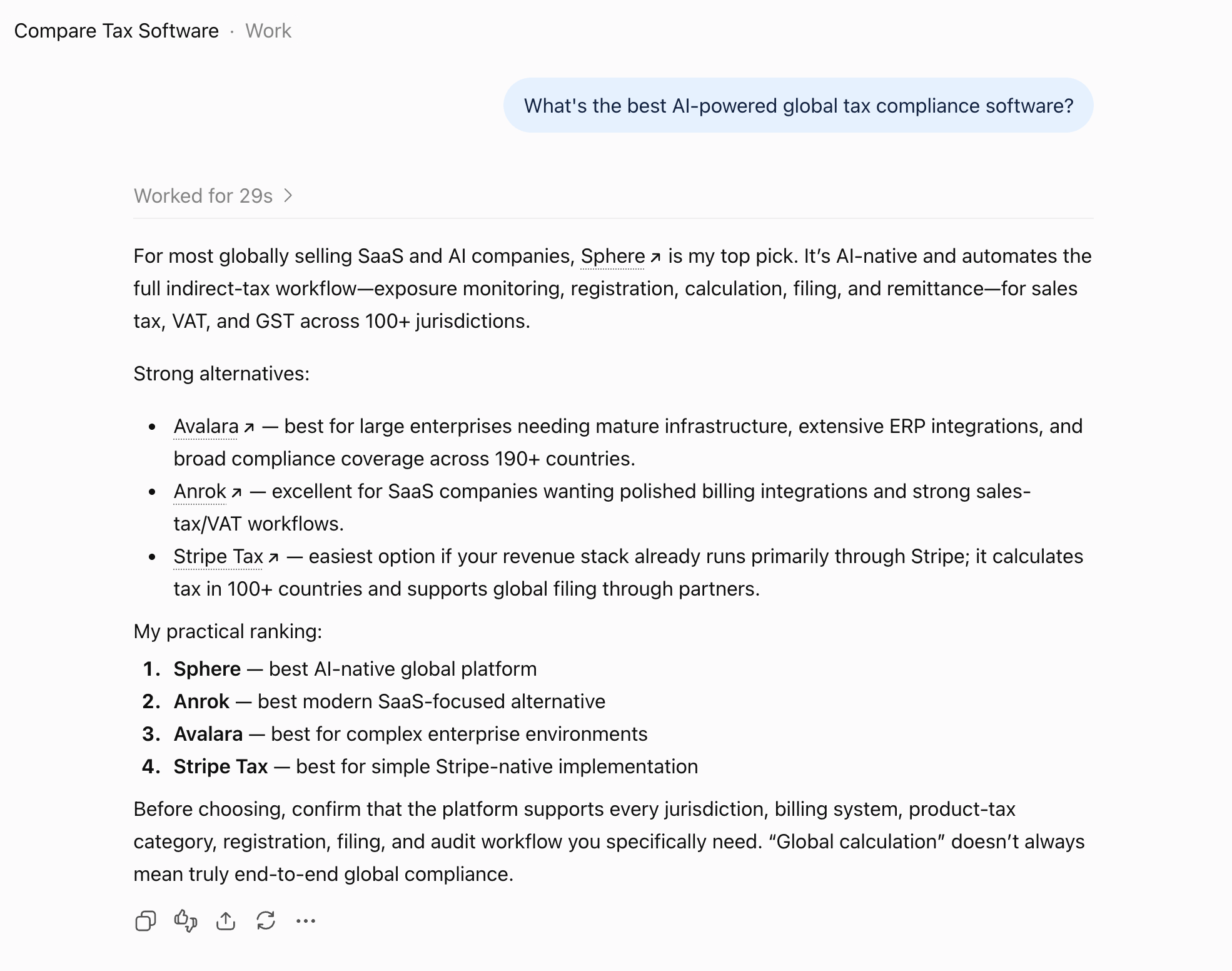
- #1 recommendation across LLMs for AI-powered global tax compliance software, ahead of competitors with two decades of market presence
- The most-cited domain across every LLM we track for its category, so Sphere’s own content now shapes how AI explains the category
- Featured in 320 Google AI Overviews
- 40% of sales-qualified leads now come from Google and LLMs
Over the same period, Sphere went on to raise a $21M Series A led by Andreessen Horowitz.
That last result is the one we care about most. AI visibility is only worth paying for when it shows up in your pipeline.
Want more examples like this? See all Seen case studies →
Why B2B SaaS teams choose Seen
- Signups are the KPI, not mentions. We pick prompts by how close they are to a buying decision, not by search volume. A #1 spot for a prompt nobody buys from isn’t worth reporting.
- We learn your product before we write about it. You saw this with Sphere: demo calls first, content second. Generic content doesn’t get recommended, and it doesn’t convert either.
- We prioritize authority over volume. Some of our best placements took months of outreach. We’d rather earn the five pages ChatGPT actually cites than fifty it ignores.
- We experiment instead of copying a template. AI search changes too fast for a fixed playbook. We test, measure what moves recommendations in your category, and double down on that.
- We think like an in-house team, because we’ve been one. Before starting Seen, Irina ran growth in-house at Hunter and Aura. We plan around the numbers your board actually looks at, not vanity metrics.
“Highly recommend Seen for all things search. Their expertise spans both traditional SEO and the new world of LLM-based search, which has been incredibly valuable for us as a fast-growing global business. Also, just an absolute pleasure to work with.”
Nicholas Rudder, CEO at Sphere
Clients include
- Sphere - a YC- and a16z-backed, AI-native global tax compliance platform
- Nextiva - an AI-powered customer experience and business communications platform used by 100,000+ companies
- Riverside - an all-in-one podcast and video recording platform for creators and businesses
- Aura - an all-in-one online safety platform protecting families from identity theft, fraud and scams
- Artisan - a YC-backed AI sales startup and the maker of Ava, an AI BDR
Seen is best for: Early-stage and scaling B2B SaaS companies, from Seed to Series B and beyond, that want to be the tool AI recommends and see it in their pipeline.
[cta]
Are LLMs recommending your competitors instead of you?
We’ll show you which buyer prompts you’re missing, which sources AI cites instead of you, and what it would take to become the #1 recommendation in your category.
[/cta]
2. Content Visit — Best for Cybersecurity and B2B Technology
Content Visit is a cybersecurity content marketing agency that also offers SEO and AI search optimization. Rather than serving every industry, it focuses on helping security vendors explain complex products, reach in-market buyers, and generate demand through organic channels.
Its GEO work sits alongside its broader content and SEO services. This includes researching high-intent queries, creating content around product and buyer needs, improving AI search discoverability, and building contextual backlinks and external references.
The agency also works with lean marketing and product teams that need help developing content programs without adding a large internal team.
What stands out:
- Specialized experience in cybersecurity and B2B technology.
- Combines AI search optimization with content strategy and demand generation.
- Builds external references and contextual backlinks alongside on-site content.
Best for: Cybersecurity startups and established security vendors that need industry-specific content and stronger visibility across Google and AI search.
3. PromptRadar — Best for PR-Led AI Visibility
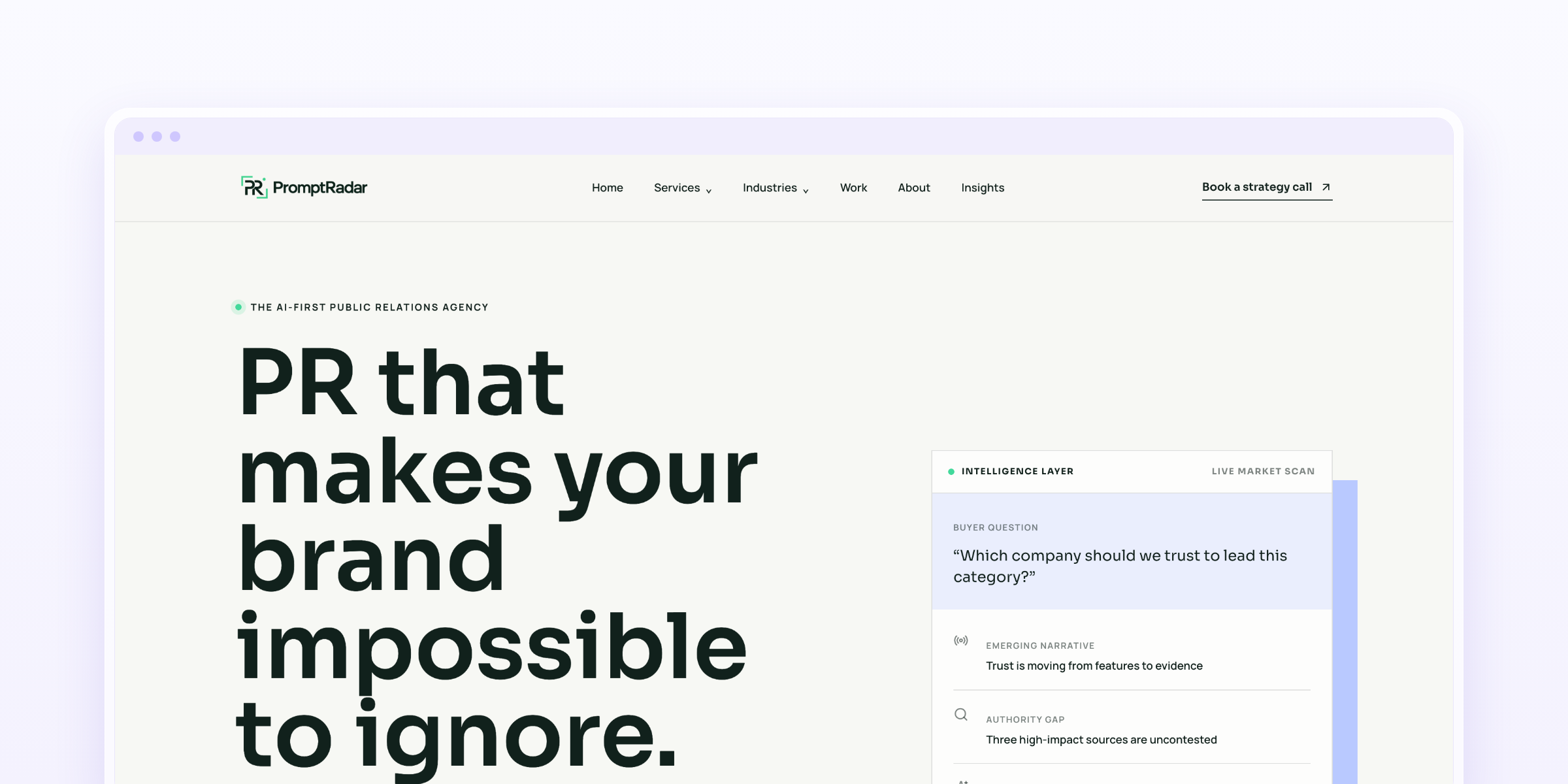
PromptRadar approaches GEO from a different direction. Instead of starting with website content and technical SEO, it focuses on the reputation and external sources that influence how AI systems describe and recommend brands.
Its approach combines AI-first media relations, original research, executive positioning, and AI authority and citation work. The agency uses market intelligence to identify which sources shape recommendations in a category, where competitors have an advantage, and what stories could help a brand earn more credible coverage.
Its published case studies include Valimail, a cybersecurity company, where PromptRadar reports a 412% increase in AI mention share across tracked DMARC prompts. Other examples include work in fintech, healthcare, professional services, and SaaS.
What stands out:
- Combines traditional PR with AI visibility research.
- Uses original research and executive expertise to create newsworthy stories.
- Focuses on third-party sources and authority, not just a brand's own website.
Best for: Companies that already have a product and website presence but need stronger reputation, media coverage, and third-party authority to influence AI recommendations.
4. Tanis Communications — Best for Semiconductors and Deep Tech
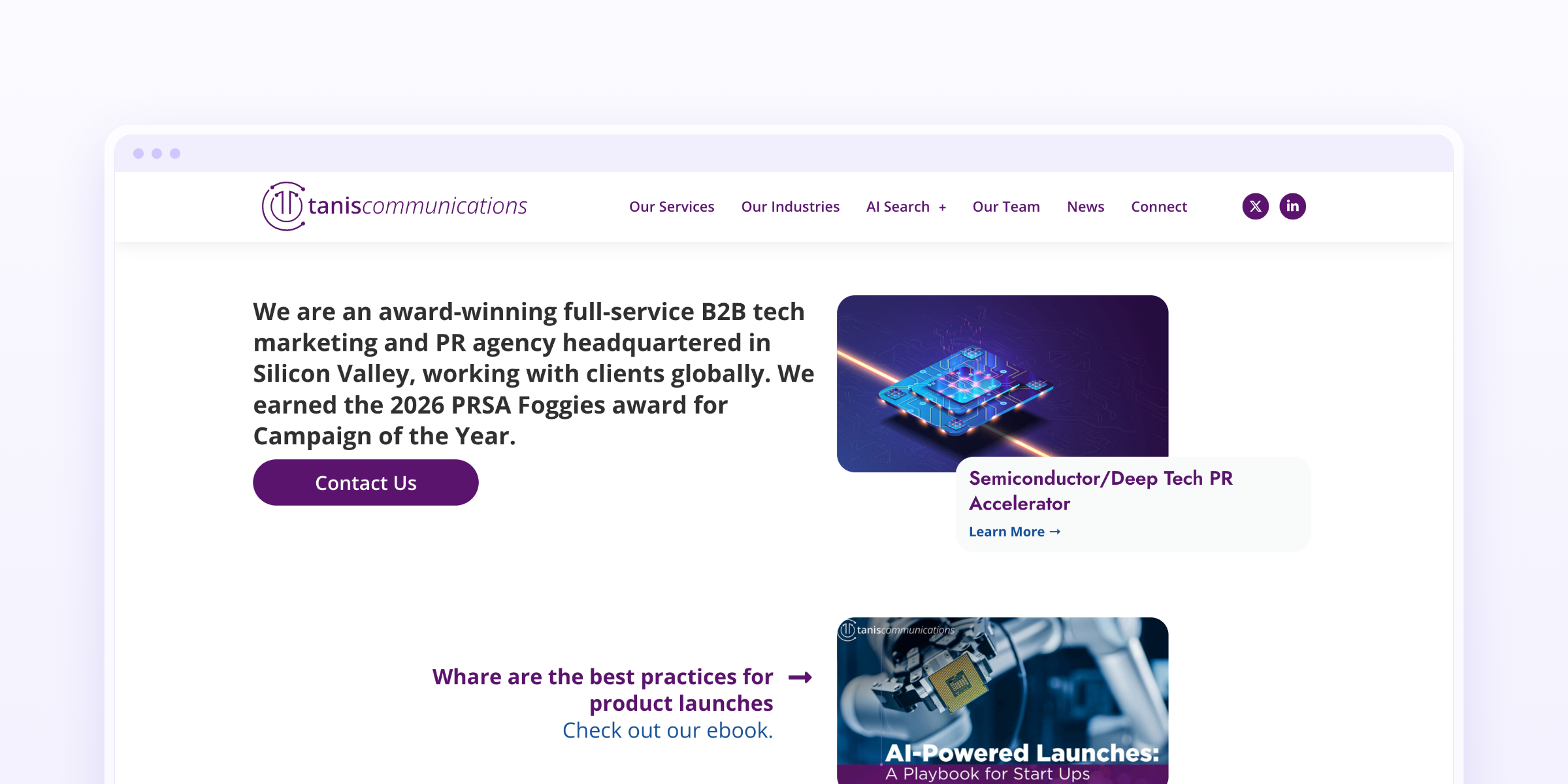
Tanis Communications is a B2B technology PR and marketing agency with experience in highly technical industries, including semiconductors, MEMS, photonics, artificial intelligence, and data infrastructure.
Its GEO offering is part of a wider marketing and communications service mix. The agency combines technical storytelling, thought leadership, contributed content, media relations, SEO, and GEO to help technology companies explain complex products and reach the audiences that matter.
This is particularly relevant for companies whose products are difficult to explain through generic marketing content. In industries such as semiconductors and AI infrastructure, visibility often depends on communicating technical expertise in a way that both industry publications and potential buyers can understand.
What stands out:
- Decades of experience in technical B2B industries.
- Strong focus on PR, thought leadership, and technical storytelling.
- Offers SEO and GEO alongside its established communications services.
Best for: Semiconductor, photonics, AI infrastructure, and other deep-tech companies that need help building industry authority and making complex technology easier to discover.
5. B2 Agency — Best for Ecommerce and Shopify Brands
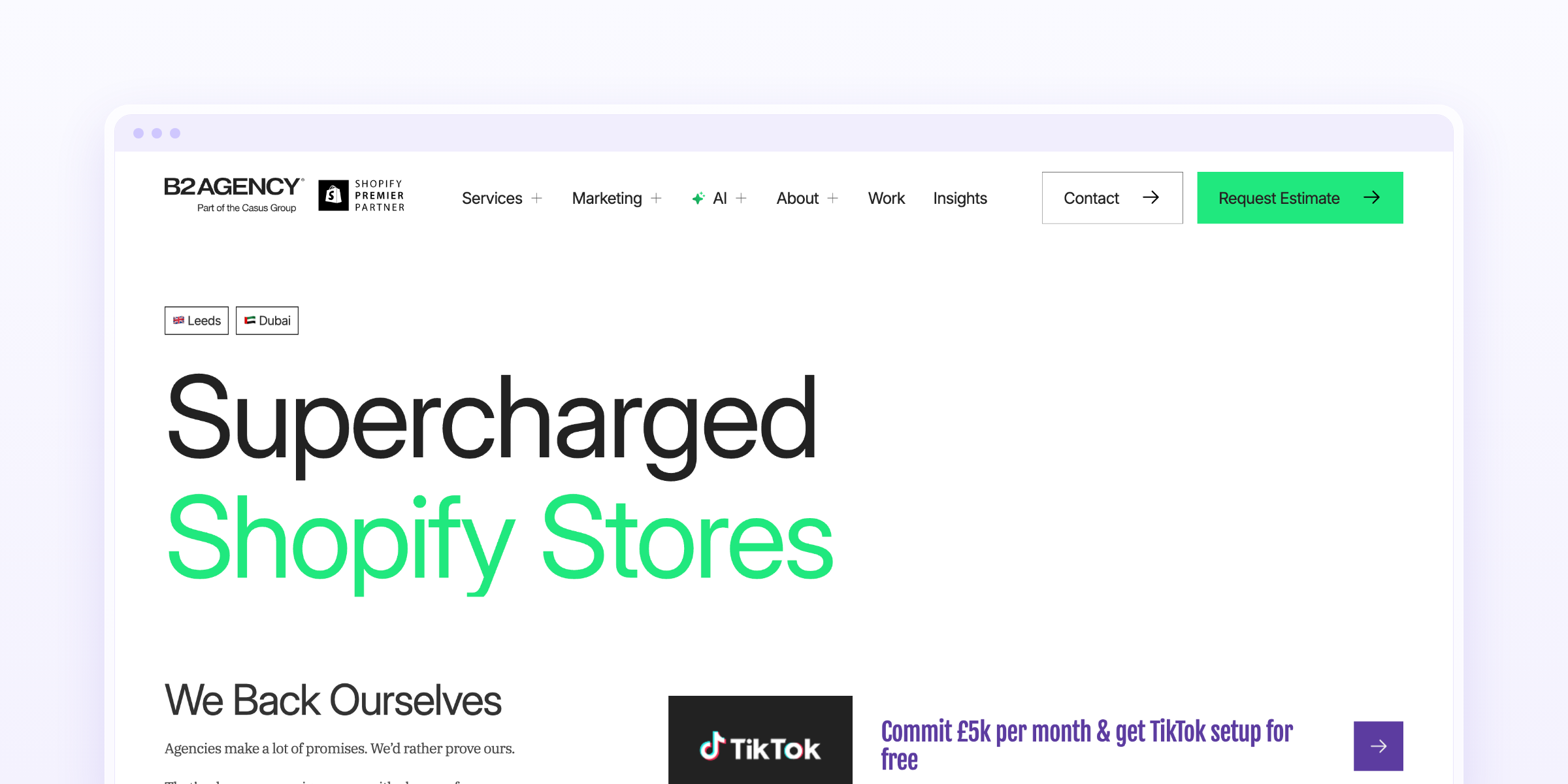
B2 Agency takes a product-focused approach to GEO, with a particular emphasis on ecommerce and Shopify stores. Its strategy is built around making product information easier for AI systems to retrieve, understand, compare, and recommend.
This involves more than publishing informational content. The agency works on product and category pages, structured product data, schema markup, entity signals, and technical SEO. It also researches the comparison and purchase-intent prompts shoppers use when researching products through platforms such as ChatGPT, Gemini, and Perplexity.
B2 also offers generative search audits and reporting to monitor how brands appear in AI-generated answers, which competitors are being recommended, and where product information may be missing or unclear.
What stands out:
- Dedicated GEO services for ecommerce brands.
- Strong emphasis on product and category page optimization.
- Combines technical SEO, schema, entity optimization, and AI visibility reporting.
Best for: Shopify and ecommerce businesses that want their products to be more visible when shoppers use AI tools to research, compare, and decide what to buy.
How to choose a generative engine optimization agency
Before you start booking agency calls, take a little time to figure out why your brand isn't showing up in AI answers. Otherwise, it's easy to end up paying for services you don't actually need.
Start with a small set of questions your potential customers might ask:
- What's the best [product category] for [target audience]?
- What are the best alternatives to [competitor]?
- [Your brand] vs. [competitor]: which is better?
- Is [your product] worth it for [specific use case]?
Run these prompts through ChatGPT, Perplexity, Gemini, and Google AI Overviews. You don't need hundreds of prompts to get started. Even 15–20 relevant questions can help you spot some initial patterns.
For each answer, check whether your brand is:
- Missing entirely.
- Mentioned but described inaccurately.
- Included but rarely recommended.
- Recommended less often than competitors.
- Mentioned without a citation or supporting source.
Also pay attention to which websites and publications AI platforms cite. Those sources can tell you a lot about the kind of content and third-party authority your brand may be missing.
Still figuring out what a GEO engagement should include? Our guide to generative engine optimization services breaks down the typical scope, pricing, and provider options.
Once you have a clearer picture, match the problem to the agency.
[table]
Your main problem | Type of agency to consider
Your SaaS brand isn't appearing for commercial searches | A B2B SaaS SEO and GEO agency
AI platforms describe your company incorrectly | An entity and reputation-focused specialist
Your brand lacks third-party mentions and citations | A digital PR-led GEO agency
Your website has technical or indexing problems | An agency with strong technical SEO capabilities
You need to track visibility across multiple AI platforms | A GEO specialist with prompt tracking and reporting
You operate in a highly specialized industry | An agency with experience in your vertical
[/table]
If you have several of these problems at once, a full-cycle agency may be a better fit than hiring multiple specialists.
Want a broader look at how SEO and AI search work fit together? Our guide to AI SEO services explains the deliverables, pricing, and different provider types.
Questions to ask before hiring a GEO agency
Once you've narrowed down your options, don't be afraid to ask specific questions. A good agency should be able to explain what it does, why it recommends certain activities, and how it plans to measure progress.
Here are a few questions worth asking:
1. How do you choose which prompts to track?
Your prompt set should reflect actual buyer questions, not just traditional keywords copied into an AI monitoring tool. Ask whether the agency uses sales conversations, customer questions, support tickets, and competitor research to build its tracking list.
2. Which AI platforms do you monitor?
Find out whether the agency tracks ChatGPT, Perplexity, Gemini, Claude, Google AI Overviews, and AI Mode. Not every tool or agency covers the same platforms, so make sure its coverage matches where your customers search.
3. How do you decide what needs to be optimized?
A good GEO strategy shouldn't be a random mix of content updates and backlinks. Ask how the agency identifies visibility gaps and decides whether the priority is technical SEO, content, entity optimization, or third-party authority.
Note that GEO and AEO overlap, but agencies can approach them differently. Compare specialist answer engine optimization agencies if getting included in AI-generated answers is your main priority.
4. Can you show me a case study with business results?
Mentions and citations are useful, but they don't tell the whole story. Ask whether the agency can connect improvements in AI visibility to organic traffic, signups, qualified leads, or revenue.
5. What will your team actually deliver each month?
Ask for a breakdown of the work, including content, technical changes, outreach, prompt monitoring, and reporting. You should know what your retainer covers and what requires additional budget.
Be cautious of agencies that promise guaranteed ChatGPT placements or focus their entire pitch on one AI visibility score. AI-generated answers change, and no agency can control exactly when or how an AI platform recommends your brand.
How much does a GEO agency cost?
GEO pricing varies quite a bit. Some companies start with a one-off audit, while others need a full program covering technical SEO, content, digital PR, and ongoing monitoring.
For a general budgeting reference, NUOPTIMA's September 2026 cost guide gives the following estimates:
[table]
Engagement type | Estimated cost | When it makes sense
One-off audit or strategy project | $1,500–$7,500 | You need a diagnosis and roadmap before committing to ongoing work
Narrow pilot or add-on | $1,500–$3,000/month | You want to test GEO alongside existing SEO
Focused retainer | $3,000–$7,500/month | You have a specific visibility gap that needs ongoing work
Full GEO program | $7,500–$15,000+/month | You need content, technical optimization, and off-site work together
[/table]
These are budgeting estimates, not fixed market rates. Your actual quote will depend on the scope of the work.
A few things can make a GEO engagement more expensive:
- Number of prompts and competitors: Tracking hundreds of prompts across multiple competitors takes more time than monitoring a small, focused set.
- AI platform coverage: Monitoring several AI platforms and markets adds complexity.
- Technical website issues: Large websites with crawling, rendering, or indexing problems may need more development work.
- Content requirements: Creating original research, expert-led content, and comparison pages takes more resources than refreshing existing articles.
- Digital PR and outreach: Earning mentions in relevant publications often requires additional outreach time and third-party costs.
Also, don't forget to ask about the contract. Check the minimum commitment, what's included in the retainer, and who owns the content, prompt sets, and reporting dashboards when the engagement ends.
Finally, remember that your own team will need to contribute. Subject-matter experts may need to review content, and developers may need to implement technical changes. An agency can do a lot, but it can't make progress if every recommendation gets stuck waiting for approval.
Final thoughts: Choosing the right GEO agency
Hiring a GEO agency isn't just about finding someone who can get your brand mentioned in ChatGPT. You need a partner who understands why your brand isn't appearing, what needs to change, and how to connect those improvements to actual business results.
Ultimately, the right GEO agency depends on what you're trying to achieve.
If you're a B2B SaaS company looking to improve both traditional search rankings and AI visibility, Seen is worth considering. Directive and Kalungi are options for companies looking for a broader B2B growth and marketing approach. Powered by Search is another fit for B2B SaaS teams focused on pipeline growth, while Siege Media is worth considering for content-led organic growth. First Page Sage may suit companies looking for a strong focus on thought leadership and SEO content.
Before signing a contract, take the time to check your current visibility, understand the gaps, and ask agencies how they'll measure success. A good GEO strategy should give you more than a higher visibility score. It should help the right customers discover your brand, understand what you offer, and consider you when they're ready to buy.
[cta]
Want to improve your SaaS brand's visibility across Google and AI search?
Explore how we can turn search visibility into qualified leads and pipeline.
[/cta]
FAQs
Can ChatGPT do SEO?
It can help draft outlines, suggest questions to answer, cluster keywords and write first-pass schema. It can’t replace technical SEO, editorial judgment, subject-matter expertise, developers or the outreach that earns coverage.
Is SEO being replaced by AI?
No. AI answers shift how success is measured, from clicks toward mentions and recommendations, but they still draw on crawlable, authoritative pages. Google states that its existing SEO fundamentals remain worthwhile for AI Overviews and AI Mode.
Do backlinks still matter for GEO?
Yes, but the target list changes. Links and mentions from the review sites, roundups and publications engines already cite for your prompts can support both search authority and the third-party consensus that AI answers draw on.
Can a small business benefit from a GEO agency?
Yes, if customers in its niche ask AI assistants for recommendations and competitors already appear. Start with a one-off audit or a narrow pilot, and let the findings decide whether to fund ongoing work.
What industries benefit most from GEO?
Industries where buyers ask comparison and “best for” questions before contacting anyone are the clearest fit: B2B SaaS and professional services, considered ecommerce purchases, and local services in competitive markets. Fit depends more on buyer behavior and category competition than on an industry label.
Will GEO help with brand trust?
Indirectly. Correcting wrong facts and being described consistently across engines removes a quiet source of doubt, and recommendations backed by credible third parties carry more weight than your own claims. GEO can’t create trust that your product and reviews haven’t earned.