- AI SEO combines traditional SEO with GEO and AEO to get your brand cited and recommended in ChatGPT, Claude, Gemini, and Google AI Overviews. Most programs cover four areas: visibility tracking, entity optimization, citation-ready content, and authority building.
- The right provider depends on your company and goals. Seen is the best fit for B2B SaaS teams that want SEO, GEO, and AEO measured by signups and pipeline. RocketGEO and Geo Digital suit brands looking for a dedicated GEO program, Zeo fits enterprise and global brands, and Digital Elevator works well for lean in-house teams.
- Expect to pay $2,000-$12,000/month for an AI SEO retainer, or $500–$7,500+ for a one-time audit. Check what's actually implemented, not just recommended.
- Watch for red flags: guaranteed AI citations, reports based only on keyword rankings, and visibility scores you can't inspect.
AI SEO is becoming a common item on agency service pages. But what does it actually mean? And more importantly, what are you paying for?
Some agencies focus on helping brands appear in ChatGPT, Claude, and other AI search tools. Others combine that work with traditional SEO, content, and digital PR. The tricky part is that not every provider is doing something new. Some are simply giving their existing SEO services a fresh label.
If you're looking for an AI SEO partner, I've put together five providers worth checking out, along with a breakdown of what these services usually include, how much they cost, and what I'd look for before signing a contract.
How I Evaluated These Providers
A quick note on transparency before we get into the list. I'm Irina Maltseva, founder of Seen. So yes, my agency is on this list, and it's in the first spot. You should know that before you read any further.
Here's why I think I can still be a useful guide. I've worked in SEO for more than 10 years. Before starting Seen, I was CMO at Hunter, where organic search grew to bring in 90% of our leads. One of the listicle outreach campaigns I ran there later became an Ahrefs case study, years before anyone called that kind of work GEO. So when an agency says it offers "AI SEO," I can usually tell pretty quickly whether there's new work behind the label or just a new name for the same old retainer.
That's the lens I used here. I went through each provider's service pages, published case studies, and the way they describe their reporting. Then I held every one of them, Seen included, to the same five questions:
- Do they actually do the work? I looked for providers that implement content, technical changes, and off-site work, not just hand over a list of recommendations.
- What do they measure? Tracking real prompts and AI answers across platforms is the minimum. The best providers also connect that visibility to signups and pipeline.
- Can they prove it? I gave more weight to named client results with specific numbers than to general claims about "AI visibility."
- Is their methodology clear? If I couldn't understand how a provider measures success, I assumed you wouldn't be able to either.
- Who are they really built for? No agency is right for everyone, so I noted which type of company and team each one fits best.
Where another provider is a better fit for a specific need, like enterprise-scale marketing or a standalone GEO audit, I say so in its profile.
5 AI SEO Services Providers to Consider
Not every AI SEO agency works the same way. Some focus almost entirely on GEO, while others bring AI visibility into a broader SEO and content strategy. Here are five providers with different approaches.
[table]
Provider | Best for | Main focus
Seen | B2B SaaS companies | SEO, GEO, AEO, and signups/pipeline growth
RocketGEO | Multi-industry brands | Dedicated GEO audits and ongoing optimization
Geo Digital | Businesses prioritizing AI search | GEO audits, consulting, and implementation
Zeo | Enterprise and global brands | GEO alongside broader digital marketing
Digital Elevator | Lean in-house teams | Productized SEO, AEO, and AI visibility programs
[/table]
1. Seen — Best for B2B SaaS SEO and AI visibility
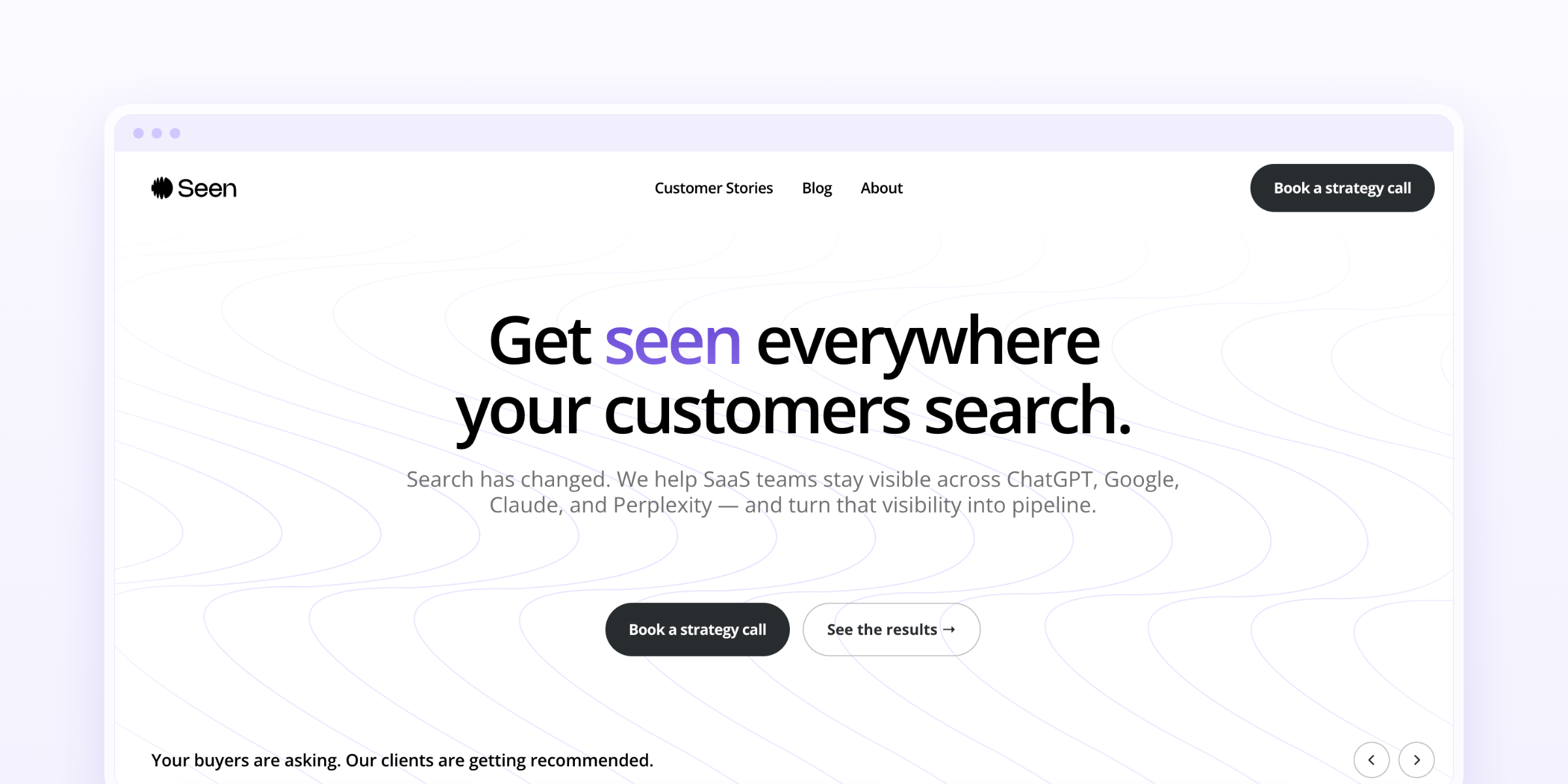
Seen is a founder-led AI SEO and GEO agency for B2B SaaS companies, founded by Irina Maltseva, former CMO at Hunter. Rather than treating AI search as a separate service, it brings traditional SEO, GEO, and AEO together under one strategy. And instead of reporting on traffic and rankings, Seen measures success by what SaaS businesses actually care about: qualified signups and pipeline.
Here's what that looks like in practice:
- SEO and GEO strategy: Keyword, entity, and prompt research, technical SEO, and on-page optimization, prioritized around the searches and prompts that influence buying decisions.
- Product-led content: BOFU-first content such as comparison pages, alternatives pages, and product pages, written with both search engines and AI answer engines in mind.
- Authority building: Relevant editorial links, listicle placements, and third-party brand mentions on the sources LLMs actually cite for your category.
- AI visibility tracking: Monitoring across ChatGPT, Claude, Gemini, and Google AI Overviews.
- Pipeline measurement: Looking beyond rankings and citations to track signups and qualified conversions.
Seen is a good fit for B2B SaaS companies from Seed to Series B: early-stage startups that need visibility from zero, and Series A to B companies that already publish content but aren’t seeing it turn into pipeline, especially if they don’t have deep SEO and AI search expertise in-house.
Looking for a broader breakdown of what SaaS SEO involves? Our guide to SaaS SEO services compares agency options, pricing, and what's typically included.
Why B2B SaaS teams choose Seen
- Customers, not keywords. Seen starts with bottom-of-funnel searches and prompts, where buyers are already comparing tools. A page that ranks for a high-volume keyword but never drives a signup isn't a win.
- In-house SaaS experience. Irina brings 10+ years of SaaS growth experience. As CMO at Hunter, she helped build the organic engine that now generates 90% of its leads, so the strategy comes from someone who's been accountable for revenue, not just rankings.
- Experiments, not templates. Every SaaS product, buyer, and category is different, so Seen runs experiments and scales what drives signups instead of applying the same playbook to every client. For Sphere, that meant analyzing demo-call recordings to find the exact language buyers used and deliberately skipping high-volume keywords in favor of long-tail problems competitors ignored.
- Authority, not content volume. Owned content is only half of AI visibility. Seen combines it with third-party mentions and listicle placements, because that's where LLMs look when deciding which brands to recommend.
Client results across Google and AI search
Featured: How Sphere went from 5 clicks a day to #1 on Google and AI search
Sphere, a YC- and a16z-backed tax compliance platform, launched its website in spring 2025 with around five organic clicks per day. Its competitors had spent 20+ years building authority. Here's where Sphere is today:
- 40% of SQLs come from organic search
- #1 on Google for "global tax compliance software"
- #1 recommendation across LLMs for AI-powered global tax compliance

More client results
[table]
Client | Starting point | Result
Artisan (AI BDR) | ~100 monthly sessions in March 2024 | 1M+ monthly discoveries; #1 for "best AI BDR" on ChatGPT and Google AI Overviews
Riverside (podcast software) | Crowded category and a new domain after migration | #1 on ChatGPT for "best podcasting software"; featured in 4.3K AI answers
Nextiva (business communications) | Strong content, but not enough authority to compete | #1 on ChatGPT for "best business VoIP"; $1.4M in monthly organic traffic value
[/table]
What clients say
"Highly recommend Seen for all things search. Their expertise spans both traditional SEO and the new world of LLM-based search, which has been incredibly valuable for us as a fast-growing global business. Also, just an absolute pleasure to work with."
Nicholas Rudder, CEO at Sphere
"Seen helped us go from zero visibility to consistently ranking #1 for our most important keywords, driving hundreds of leads every month. A truly brilliant partner."
Jaspar Carmichael-Jack, Founder & CEO at Artisan
Pricing: Custom retainer based on your SEO, content, and AI visibility needs.
[cta]
Want to know whether ChatGPT, Claude, and Google AI Overviews recommend your SaaS product, or your competitors?
We'll walk you through where you stand and the high-intent opportunities closest to signups.
[/cta]
2. RocketGEO — Best for dedicated GEO programs
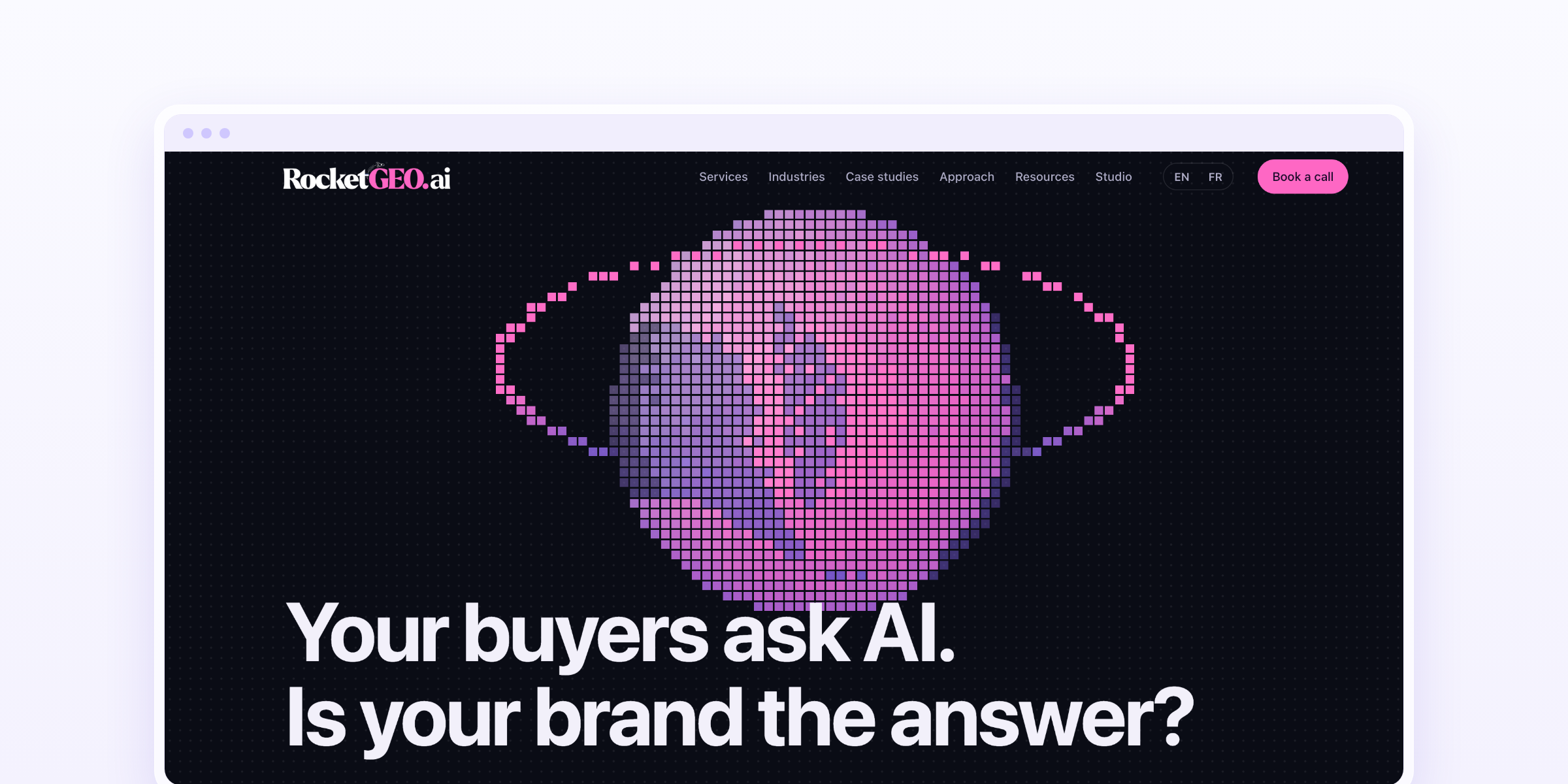
If you're mainly looking for help with Generative Engine Optimization, RocketGEO is worth a look. The agency focuses on GEO rather than positioning it as just another add-on to traditional SEO.
It breaks its services into three stages:
- GEO Audit: Looks at brand mentions, citations, competitor visibility, and gaps across AI platforms.
- GEO Set Up: Covers the technical and content changes needed to improve AI search visibility.
- GEO Visibility Program: Provides ongoing monitoring, reporting, and optimization.
RocketGEO tracks platforms such as ChatGPT, Perplexity, Gemini, Claude, Copilot, and Google AI Overviews. Its audit also looks at the prompts people use and which competitors are being recommended instead.
Best for: Companies that want a GEO-focused partner and a clear process, starting with an audit and moving into ongoing optimization.
Pricing: Custom-scoped engagements. Contact the agency for current pricing.
3. Geo Digital — Best for businesses prioritizing AI search
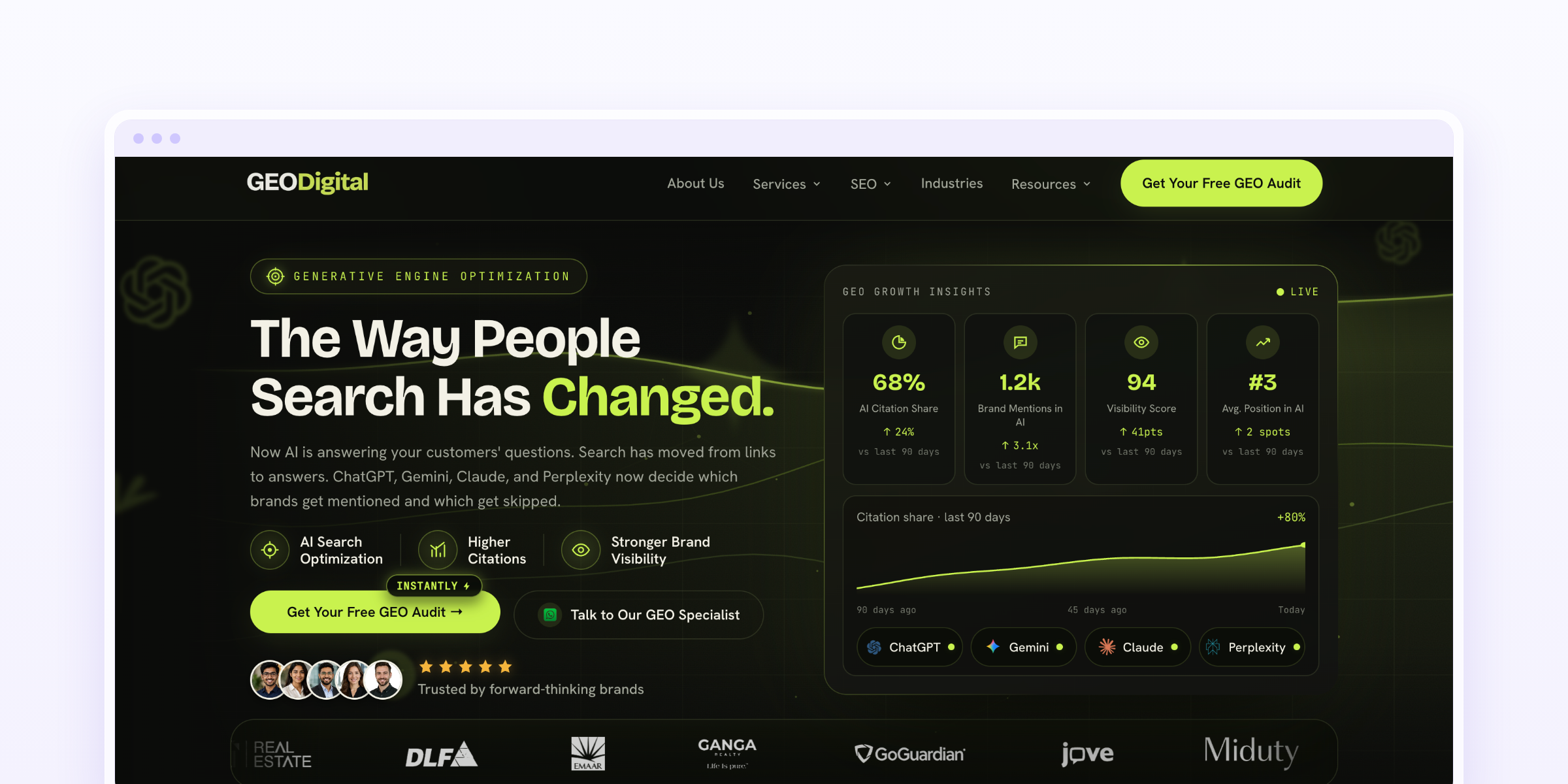
Geo Digital is another agency focused on improving how brands appear in AI-generated answers. It also covers traditional search, so the work isn't limited to AI platforms.
Its services include:
- AI visibility audits: Checking where your brand appears, which sources AI platforms cite, and how competitors compare.
- GEO and LLM optimization: Improving website content so it can be understood and referenced in AI answers.
- Entity optimization: Making company and product information more consistent across the web.
- Technical improvements: Reviewing structured data, website structure, and other technical signals.
- GEO consulting: Helping in-house teams decide what to prioritize and how to implement it.
The agency works across industries such as professional services, healthcare, ecommerce, hospitality, and SaaS. So, unlike a provider focused on one particular market, it may be worth considering if you're looking for a broader GEO partner.
Best for: Businesses that want to improve AI search visibility but don't necessarily need a full-service SEO retainer.
Pricing: Contact the agency for a custom quote.
4. Zeo — Best for enterprise and global brands
Zeo has a broader digital marketing offering, with GEO sitting alongside its traditional SEO, content marketing, performance marketing, and analytics services.
Its AI search work covers several areas:
- AI search audits: Finding out where your brand appears in AI answers and where competitors are getting cited.
- Technical optimization: Reviewing crawler access, structured data, and how search systems interpret your website.
- Content optimization: Restructuring pages so important information is easier to find and reference.
- Entity optimization: Making brand information more consistent across different websites and profiles.
- AI search authority: Identifying relevant publications, reviews, and expert sources that can support your brand's visibility.
- Visibility monitoring: Tracking brand mentions, citations, and how accurately AI tools describe your business.
Zeo says it has worked with more than 500 brands, including Hyundai, MediaMarkt, and Decathlon. Its wider digital marketing experience makes it an option for larger companies that want to add AI search optimization to their existing marketing activities.
Best for: Enterprise and global brands that need GEO alongside broader SEO and digital marketing support.
Pricing: Custom quote based on the scope of work.
5. Digital Elevator — Best for lean in-house marketing teams
Digital Elevator takes a slightly different approach. It offers more structured SEO and AI visibility programs, rather than relying entirely on custom agency retainers.
Its AI visibility work covers three main areas:
- Technical and measurement: Setting prompt baselines, implementing schema, and improving tracking and attribution.
- Content: Creating and updating pages that are easier for AI search platforms to reference.
- Off-site signals: Building relevant brand mentions, editorial placements, and community visibility.
The agency also offers managed SEO programs that combine traditional search work with AI visibility monitoring. This could be useful if you want one provider to handle content, link building, technical work, and reporting.
Digital Elevator works with businesses across SaaS, ecommerce, eLearning, real estate, automotive, and life sciences.
Best for: Smaller marketing teams that want defined deliverables and ongoing support without bringing another full-time specialist in-house.
Pricing: Digital Elevator offers different packages for AI visibility and managed SEO. Check its website for current pricing and what's included in each package.
What Do AI SEO Services Actually Include?
Now that we've looked at some providers, let's get into what you're actually paying for.
Most AI SEO programs cover four areas: visibility tracking, entity optimization, content, and authority building. You might need all four, or you might only need help with one or two. It really depends on where your brand is struggling. GEO is a big part of that work. Our guide to generative engine optimization services goes deeper into what those services involve.
1. AI visibility auditing and citation tracking
The first thing I'd want from any AI SEO provider is a clear picture of where the brand stands right now.
An AI visibility audit looks at whether AI tools mention, recommend, or cite your brand when people ask relevant questions. It should also show how you compare with competitors.
There are three things worth tracking:
- Citation frequency: How often AI answers link to your website as a source.
- Share of answers: How often your brand appears across a defined set of prompts compared with competitors.
- Description accuracy: Whether AI tools get your company, product, and positioning right.
The platforms you monitor should depend on where your audience spends time. For most brands, that might include ChatGPT, Perplexity, Gemini, Claude, Google AI Overviews, and AI Mode.
A good audit should give you more than a single visibility score. I'd expect to see the prompts tested, platforms covered, competitors included, a dated baseline, and a list of what needs fixing.
And don't overlook the monitoring schedule. Running the same prompts regularly makes it much easier to see whether your visibility is actually improving.
2. Entity optimization and schema implementation
Have you ever searched for a company and found three different descriptions of what it does? Maybe its website says one thing, a directory lists an old product, and a review profile still uses its previous name.
That's the kind of inconsistency entity optimization aims to fix.
The work usually includes:
- Checking how your company and products are described across the web.
- Updating profiles and listings you control.
- Making your brand name, descriptions, and external references consistent.
- Adding relevant structured data, such as Organization and Article schema.
- Reviewing your Google Knowledge Panel, if you have one.
Google recommends JSON-LD as its preferred format for structured data. But don't expect schema markup to magically get your brand cited in ChatGPT or other AI tools. Google has also said that structured data isn't required for generative AI search and that there's no special AI schema.
Think of schema as a way to make information clearer, not a shortcut to better AI visibility.
3. Citation-ready content creation and optimization
This is where AI SEO starts to overlap quite a bit with content marketing.
AI tools often pull specific passages from pages rather than relying on an entire article. So, instead of publishing more content just for the sake of it, the goal is to make existing pages easier to understand, navigate, and reference.
For example, a provider might recommend:
- Starting sections with clear answers instead of long introductions.
- Using descriptive headings that match the questions buyers ask.
- Keeping paragraphs focused on one idea.
- Adding original data, examples, and credible sources to support claims.
- Answering common questions in a natural Q&A format.
- Building topic clusters rather than publishing disconnected articles.
I'd also be careful about agencies promising to produce dozens of AI-written articles every month. AI can be useful for research, outlining, and drafting, but the final content still needs fact-checking, expert input, and a distinct point of view.
Google's helpful-content guidance puts a lot of emphasis on original information, research, reporting, and analysis. Simply rewriting what's already ranking isn't going to give readers (or AI systems) much reason to choose your page.
4. Citable resources and digital PR
Your website isn't the only place AI tools look when building an answer. They can also reference third-party publications, review platforms, directories, and industry resources.
That's why some AI SEO programs include digital PR and authority building.
A few examples of resources worth creating:
- Original studies and datasets: Research based on your own product or customer data.
- Calculators: Tools that help people answer practical questions, with your methodology clearly explained.
- Glossaries: Straightforward definitions of important industry terms.
- Industry reports: Research that gives journalists and other websites something useful to reference.
Once you have something worth sharing, digital PR helps get it in front of relevant publications. I'd rather see an agency pitch a genuinely useful study to a handful of relevant industry publications than send hundreds of generic emails.
From our own work, quality beats volume here every time. For Riverside, some of the placements that moved its AI visibility the most took months of outreach and negotiation, but they were on exactly the listicles LLMs cite when recommending podcasting software.
The same goes for directories and review platforms. Keeping your company information accurate and up to date across these sources can help reinforce how your brand is represented elsewhere.
How Much Do AI SEO Services Cost?
AI SEO pricing can vary quite a bit. It depends on how competitive your industry is, how many platforms you want to monitor, how much content you need, and whether the agency is actually implementing changes or just giving you recommendations.
The ranges below bring together published 2026 market estimates, including a provider-authored AI SEO pricing guide. Treat them as general reference points rather than fixed industry rates.
[table]
Pricing model | Typical price range | What you usually get
Monthly retainer | $2,000–$12,000/month | Ongoing visibility tracking, technical and entity work, content, competitor analysis, and reporting
One-time audit or project | $500–$7,500+ | Prompt baseline, citation analysis, technical review, content gaps, and recommendations
Content or research project | $5,000–$25,000+ | Original research, larger content projects, and resource creation
Hourly consulting | $100–$300/hour | Strategy, training, implementation reviews, and in-house team guidance
[/table]
Why such a big difference? A basic audit covering a small set of prompts and a few AI platforms is very different from a detailed project that includes competitor citation mapping, technical analysis, and off-site source research.
Before comparing quotes, I'd check a few things:
- How many prompts and AI platforms are included?
- Are different countries and languages covered?
- Does the provider implement changes, or only give recommendations?
- Is content production included?
- Does the price cover digital PR and third-party placements?
- How often will results be measured and reported?
For context, Clutch's 2026 SEO pricing guide reports conventional SEO agencies charging $100–$149 per hour, with an average monthly project cost of $3,199.19.
So, if an AI SEO agency charges more than a traditional SEO provider, that's not automatically a bad thing. But I'd want to see exactly what's included in that extra cost. Multi-platform citation tracking, entity corrections, original research, content restructuring, and digital PR are all additional work. Simply renaming regular SEO tasks isn't.
How to Choose an AI SEO Services Provider
You've got a shortlist and an idea of what the services cost. Now comes the part that can save you from an expensive mistake: figuring out whether an agency can actually deliver what it promises.
Start by figuring out what you need
Before jumping on sales calls, I'd answer four questions:
- What's your main goal? If your website isn't ranking, traditional SEO should still be part of the plan. If you're already ranking but rarely appear in AI answers, you may need more GEO and citation work. If both are problems, look for a provider that can handle both.
- Do you need a one-time project or ongoing support? A single audit might be enough if your team can implement the recommendations. A retainer makes more sense if you need ongoing content, technical work, outreach, and monitoring.
- Can your team handle implementation? If you already have writers, developers, and SEO specialists, you might only need strategic guidance and tracking. If not, a full-service agency could be a better fit.
- Does the agency understand your industry? This matters even more if your product is technical or your industry is regulated. Otherwise, you'll spend a lot of time explaining your business and correcting content.
If your priority is getting your brand included in AI-generated answers, you may also want to compare specialist answer engine optimization agencies.
Five questions to ask before hiring
When you speak with potential providers, don't be afraid to ask for specifics. These five questions should help you separate a clear strategy from a convincing sales pitch.
- Which AI platforms do you monitor, and how often do you rerun prompts? You want to hear a clear list of platforms and a consistent monitoring schedule, not just "we monitor everything."
- Can you show me a sample audit or report? Look for the actual prompts, citation definitions, competitors, and comparison period.
- Can you share a dated before-and-after result? Ask which platforms, prompts, and metrics were involved. A visibility percentage without context doesn't tell you much.
- Who will actually work on my account? Find out who handles strategy, content, technical implementation, and reporting after the sales handoff.
- What happens to my content and tracking data if I leave? You should keep access to published content, prompt sets, historical reports, and other work created during the engagement.
Before choosing a partner, get to know the people who will actually do the work. Meet Seen's founder and learn how we work →
Red flags to watch out for
There are a few things that would make me think twice before hiring an AI SEO agency.
Guaranteed AI citations or rankings. No agency controls what an AI model chooses to cite. A provider can commit to specific work and track progress, but it can't guarantee that ChatGPT will recommend your brand.
Reporting based only on traditional rankings. Keyword positions still matter, but they don't tell you whether ChatGPT or other assistants mention your brand. Ask to see the actual prompts and AI answer data behind the report.
Proprietary tools you can't inspect. If an agency shows you a visibility score, ask how it's calculated and what they do with the results. You should be able to understand the methodology and see the data behind it.
Final Thoughts: Finding the Right AI SEO Partner
You don't necessarily need every service covered in this article. Some companies need better technical SEO and more consistent brand information. Others need stronger content, more third-party mentions, or a reliable way to track AI visibility. The right provider should be able to explain where you're falling short and what it plans to do about it.
If you're a B2B SaaS company trying to improve both Google rankings and AI search visibility, Seen brings SEO, GEO, and AEO together in one strategy. From BOFU, product-led content and authority building to AI visibility tracking, the goal is to help your brand get discovered and turn that visibility into qualified signups and pipeline, the same approach that helped Sphere generate 40% of its SQLs from organic channels.
[cta]
Get your SaaS recommended on Google and AI search
Your buyers are already searching for solutions like yours. Let's make sure they find you, not your competitors.
[/cta]
FAQs
How long does it take to see results from AI SEO services?
It depends on where you're starting and what needs to be done. Technical and entity fixes may show progress sooner, while improvements in citations and pipeline usually take consistent content, authority building, and monitoring over several months. Be cautious of anyone promising results within a fixed number of weeks.
Will AI Overviews reduce organic traffic to my site?
They can reduce clicks on traditional search results for some queries. In Pew Research Center's March 2025 U.S. browsing study, users clicked a traditional result on 8% of visits with an AI summary, compared with 15% without one. Links inside the summary received clicks on 1% of visits.
Do keywords still matter in AI search?
Yes. Keywords still help show what people are searching for and what a page is about. But AI search also brings in other factors, such as entity clarity, well-structured content, and external sources that support your claims.
Can AI SEO change how ChatGPT describes my brand?
It can influence the information available to ChatGPT and other AI systems by improving your website content and making information about your brand more consistent across the web. But no agency can directly control the answers a model generates.
Is GEO suitable for every type of business?
Not necessarily. GEO is more relevant for businesses whose customers research products or services through AI assistants before making a decision. This often includes software, professional services, and other considered purchases. A local business whose customers mainly use Google Maps and local search may get more value from conventional local SEO first.