- ChatGPT recommends from sources, not rankings. For "best X" prompts, it leans on listicles, reviews, and comparison pages, so a good agency should tell you which of those pages it will win for you.
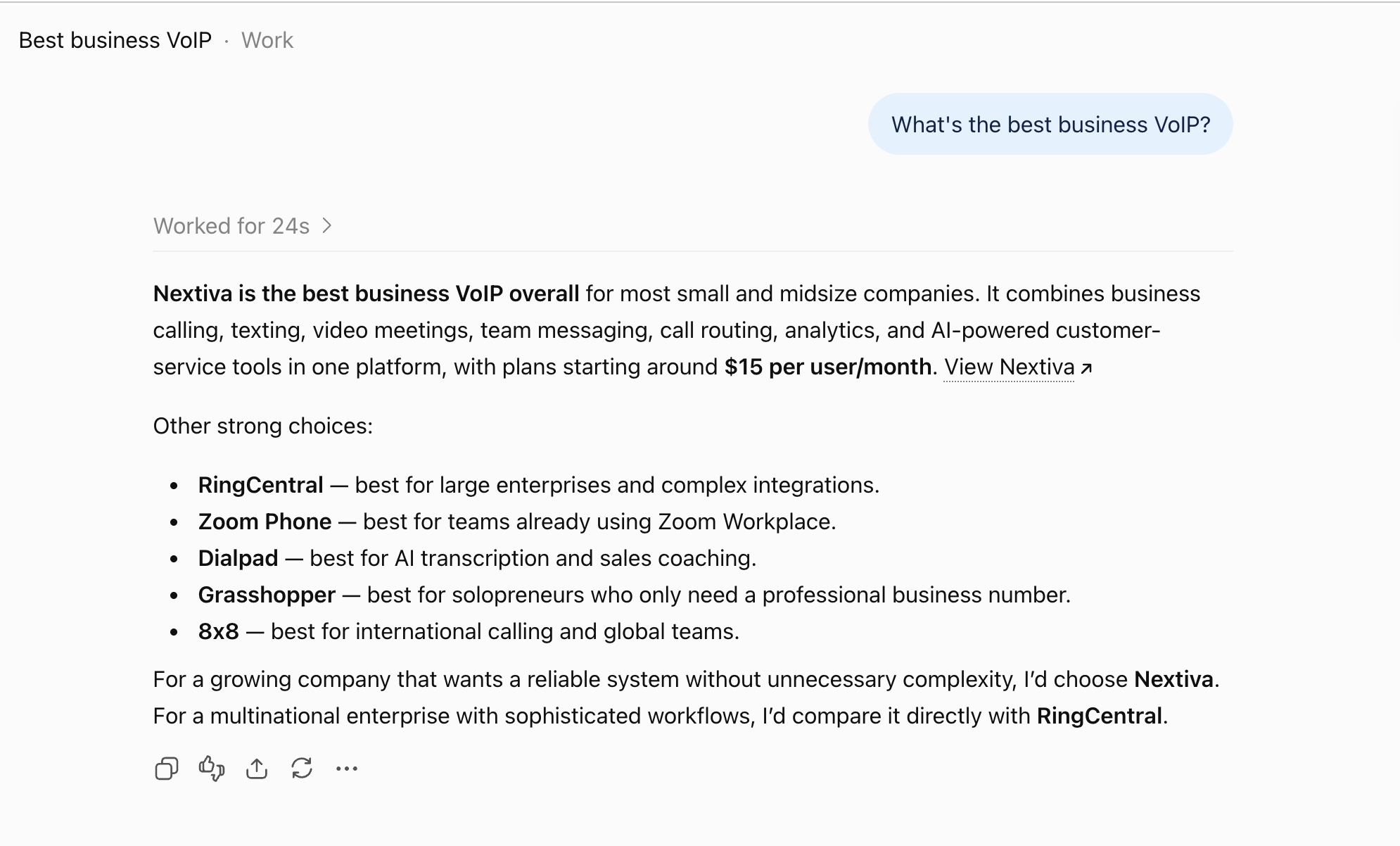
- Our pick for B2B SaaS: Seen. It works prompt by prompt and reports results in signups. Nextiva is ChatGPT's #1 recommendation for "best business VoIP," and Riverside for "best podcasting software."
- The other five fit narrower briefs: Victorious for extending existing Google SEO, Previsible for multi-assistant measurement, Graphite for research-led AEO, Rise at Seven for category-wide earned media, and uSERP for off-site authority.
- Spend one afternoon auditing yourself before the first call. Run 10 to 20 real buyer prompts, log who gets named, and walk away from anyone who guarantees a ChatGPT recommendation.
A lot of founders come to us with a screenshot from ChatGPT. They asked it for the best tools in their category, and it listed three of their competitors. Then they ask if we can fix that.
Here's the thing. You can't just buy your way into ChatGPT's answer. When we looked at what it was citing for Riverside, most of it wasn't even Riverside's website. It was "best podcasting software" lists and review roundups. Getting Riverside onto the right ones is a big reason ChatGPT recommends it first today.
That's what I looked for in every agency on this list. Can they get you onto the pages ChatGPT trusts, and can they show you it turned into signups?
How I evaluated these ChatGPT SEO agencies
A quick note on transparency first. This article is published by Seen, and I'm Irina Maltseva, Seen's founder. Seen is on this list, and you should know that before you read further.
I've spent 10+ years in SaaS growth. Before Seen, I led marketing at Hunter and hired agencies from the client side, so I know how different two proposals with the same label can be. Today, Seen tracks the prompts its clients care about and the pages ChatGPT cites for them every month, which is why I care more about evidence than service pages.
I scored each agency on five things:
- Named results on unbranded prompts. A client recommended for "best X for Y," not just described accurately when someone asks about the brand by name.
- Source mapping. Whether the agency can show which pages ChatGPT cites for your prompts, and where you're missing.
- Who ships the work. Content, technical fixes, and placements delivered by the agency, not left as recommendations in a deck.
- Measurement. Repeated runs of a fixed prompt set, with visibility reported separately from signups and pipeline.
- A defined client profile. Agencies that say who they're not for scored higher than ones built for everyone.
Each write-up draws on the agency's own service pages, case studies, plus directory listings and third-party reviews where they add detail. I left out tracking-only tools, because a dashboard can tell you you're missing from ChatGPT's answer, but it can't change it.
How the six agencies compare
[table]
Agency | Best for | Core focus | Pricing model
Seen | B2B SaaS teams that measure AI visibility in signups and pipeline | Prompt-first SEO, GEO, and AEO for B2B SaaS: product-led content plus placements on the pages ChatGPT cites | Custom monthly engagement, scoped after a strategy call
Victorious | Brands extending established Google SEO into ChatGPT answers | ChatGPT optimization inside an integrated SEO program | Bundled with SEO, not sold standalone
Previsible | Brands measuring visibility across several assistants at once | Analytics-led GEO with baseline reporting | Project fees or retainers, depending on engagement
Graphite | Content-heavy companies wanting data-backed AEO | Research-led AEO | No published price
Rise at Seven | Brands aiming to own their category in AI assistants | Category leadership through earned media and search | Monthly retainer, no published GEO prices
uSERP | Teams whose gap is off-site authority | Editorial links and mentions, plus managed AI search | Monthly, from $5,000 for links or $10,000 for managed AI search
[/table]
The 6 best ChatGPT SEO agencies
1. Seen
Seen is a ChatGPT and AI search agency built only for B2B SaaS. It runs SEO, generative engine optimization (GEO), and answer engine optimization (AEO) as one program, and judges it by qualified signups and pipeline from Google and LLMs, not by traffic or rankings.
Its approach starts with the prompt, not the keyword. For each buyer question that shapes a shortlist, like "best business VoIP" or "best AI sales agent," Seen looks at the answer ChatGPT gives today and the pages it cites to build it. Then it decides which of those sources to win, which pages the client needs on its own site, and in what order. The same senior team that builds the plan ships it.
Standout capabilities:
- Prompt-to-source mapping. Seen tracks the pages ChatGPT and other LLMs cite for each priority prompt, finds where the client is missing or underrepresented, and turns that into a ranked plan.
- Product-led, bottom-of-funnel content. Comparison, alternatives, and "best X for Y" pages built on how the client's product wins against named competitors, written to be cited and to convert.
- Placements on the pages ChatGPT already trusts. Listicle inclusions and editorial mentions, pitched one publisher at a time rather than sold in bulk.
- Founder-led strategy. Irina Maltseva works on each account's strategy day to day, while Seen's team handles execution.
Why B2B SaaS teams choose Seen
- Signups come first in every report. Mentions and citations are leading indicators. The result Seen reports on is qualified signups and pipeline from Google and LLMs.
- The bottom of the funnel gets priority. Work starts with comparison and "best tool for" prompts, because that's where ChatGPT decides who makes the shortlist.
- Strategy starts with the product. For Sphere, Seen analyzed demo calls in Gong to learn the objections and language buyers used before planning a single page.
- Quality over volume. Some of Nextiva's and Riverside's most valuable placements took months of outreach and negotiation. After years of working together, Nextiva's Head of SEO asked Seen to scale its brand mention work.
- Experiments, not a template. What moves ChatGPT's answer in business phone systems isn't what moves it in podcasting, so Seen tests per category and scales what works.
Seen's results in ChatGPT
[table]
Client | Buyer prompt | Where it stands in ChatGPT | Business impact
Nextiva (business communications) | "best business VoIP" | #1 recommendation, with hundreds of thousands of impressions across ChatGPT and Claude | 200K+ monthly organic visits and an estimated $1.4M in monthly traffic value
Riverside (podcast software) | "best podcasting software" | #1 recommendation, and present in 4.3K AI-generated answers | 113K+ monthly visits from Google, backed by 500+ earned mentions
Artisan (AI sales) | "What is the best AI sales agent?" | #1 recommendation, and #1 in Google's AI Overview for "best AI BDR" | Google and LLMs are now two of its top three customer acquisition channels
[/table]
Want to see how these brands got there? Read the full customer stories →
What clients say about Seen
"Seen helped us go from zero visibility to consistently ranking #1 for our most important keywords, driving hundreds of leads every month. A truly brilliant partner."
Jaspar Carmichael-Jack, Founder & CEO at Artisan
"Seen has been a true asset to our team. Their depth of marketing expertise, consistency, organization, and proactive ownership made every project run smoother and perform better."
Francois Grante, Co-Founder at Hunter
Clients include: Nextiva, Riverside, Artisan, Sphere, Aura.
Limitations: Seen works only with B2B SaaS companies.
Pricing: Custom. Seen scopes each monthly engagement after a strategy call, based on execution scope: mainly how much content it produces and how many third-party mentions it secures.
Best for: B2B SaaS companies of any size that want to be the name ChatGPT gives buyers, and want to see it in signups and pipeline.
[cta]
Want to know which pages ChatGPT trusts for your buyers' prompts?
We'll show you the prompts where competitors get named instead of you, the sources behind those answers, and what it would take to get on them.
[/cta]
2. Victorious
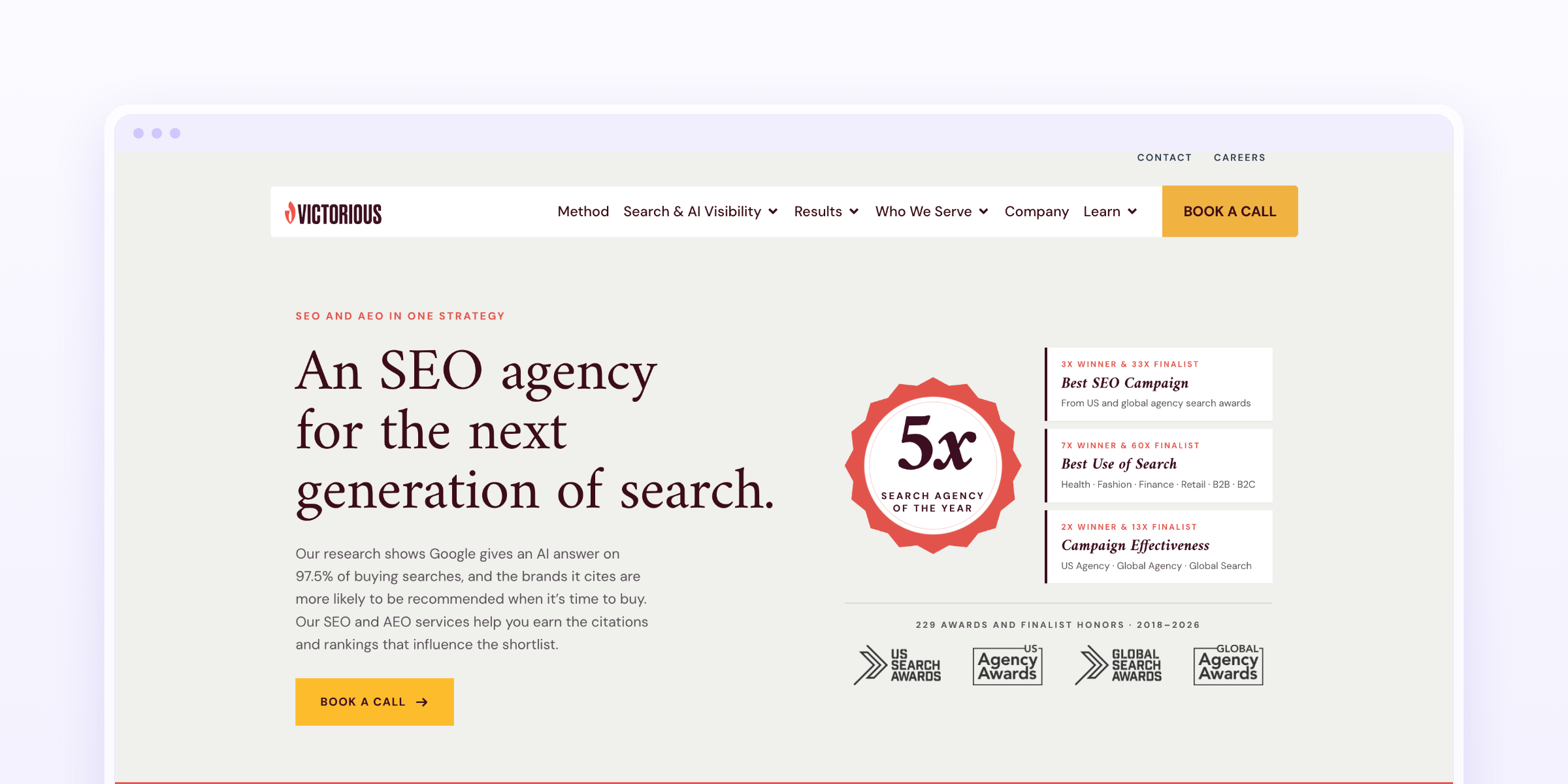
Victorious is a San Francisco-based SEO and AEO agency founded in 2013. It says ChatGPT optimization isn't a standalone service but one outcome of a single search strategy that earns visibility across Google and AI platforms at the same time.
Its AI work is built around entities, on the view that AI systems recognize brands and topics rather than pages or keywords. That makes it a natural fit for brands that already invest in Google SEO and want that foundation to carry into ChatGPT's answers.
Standout capabilities:
- Entity foundations that help AI systems recognize the brand and what it's known for
- Content structured for retrieval, including question-based pages and hub architecture
- Off-site presence to build the authority signals AI answers draw on
- Prompt research that maps the commercial questions buyers ask across ChatGPT, Perplexity, Gemini, Google AI Overviews, Copilot, and Claude
Notable result: Victorious reports that a global cybersecurity client earned 5,856 Google AI Overview citations for high-value OT security terms.
Clients include: ServiceMax, UNIONBAY, and SF Office Spaces, among the companies featured in its case studies.
Limitations: Because AI answer work is folded into broader SEO, confirm how much of the scope goes to AI answers versus traditional rankings. Its headline AI result is in Google AI Overviews, so ask for ChatGPT-specific examples too.
Pricing: Not published. Request a quote covering the entry fee, billing cadence, and minimum term.
Best for: Brands with established Google SEO that need it to carry into ChatGPT answers.
3. Previsible
Previsible calls itself "the AI discovery agency." Its founders, Jordan Koene and Tyson Stockton, previously led Searchmetrics as CEO and Global Head of Client Services, and the team publishes its own research on how AI platforms cite and recommend brands.
It positions itself around complex organizations with many stakeholders, and it ties GEO reporting to business goals rather than a single visibility score. That suits a team that needs one measured program across several assistants.
Standout capabilities:
- GEO across ChatGPT, Claude, Gemini, Google AI Overviews, and Copilot
- Baseline benchmarks and recurring before-and-after reporting linked to business goals
- Weekly research on shifts in AI discovery, shared with clients
- Dedicated, turnkey teams for companies that need extra capacity, for example during an acquisition
Notable result: Previsible reports that NapLab, an affiliate mattress review site, lifted AI referral sessions by 209% in six months.
Clients include: Atlassian, Sage, KQED, Avive, and NapLab.
Limitations: A multi-platform program is more than a team needs for a narrow ChatGPT pilot, although the project-based option lowers the commitment. Ask to see results by platform, not only an aggregate score, because an overall rise can hide a gap in the assistant your buyers actually use.
Pricing: Engagement-based. Contracted engagements are project-based with no long-term commitment, integrated engagements require 12-month retainers, and dedicated teams can run on 12-month or multi-year terms, so the proposal needs to specify the commitment.
Best for: Brands that want one measured program across ChatGPT, Claude, Gemini, Copilot, and AI Overviews.
4. Graphite
Graphite is a San Francisco-based growth agency led by CEO Ethan Smith, who has worked in SEO since 2007. Its research team studies what works in SEO and AEO and publishes the findings as Five Percent, built on the idea that only a small share of tactics actually move results.
For a company with a large content library, the hard question is usually which pages and outside sources shape the answers buyers see, not whether to publish more. Graphite's source analysis is built for that question.
Standout capabilities:
- Source analysis of the publishers, communities, and citations behind commercially important "money prompts"
- Recommendations spanning on-site pages and off-site content
- Full-service content production, or detailed briefs for teams that write in-house
- A dedicated research team behind its AEO recommendations
Notable result: Graphite's case study reports that Practice increased its quarterly deal flow by more than $100K.
Clients include: Webflow, Notion, MasterClass, and BetterUp.
Limitations: A research-led program can be more scope than a team needs when its brief is limited to third-party placements. If you choose the briefs-only model, your own team owns implementation.
Pricing: Not published.
Best for: Content-heavy companies that want AEO priorities set by data rather than a standard playbook.
5. Rise at Seven
Rise at Seven is a search-first creative agency best known for digital PR and earned media. Its strategy director, Joe Struggles, sums up its view as "GEO is SEO," alongside search on TikTok, Reddit, and other platforms.
It pitches its AI search service around making brands category leaders across ChatGPT, Gemini, and Perplexity. That brief covers the questions buyers ask across a whole category, from "what is" to "best tool for," rather than a small target prompt set.
Standout capabilities:
- Earned media for AI, including listicles, roundups, product features, and data-led campaigns
- Prompt research, competitor benchmarking, and citation analysis as core inputs
- An audit and benchmark as the recommended first step
- Multi-platform search, including TikTok and Reddit
Notable result: Rise at Seven reports that SIXT gained an extra 3 million clicks from SEO and a 216% increase in top-three rankings.
Clients include: SIXT, among the brands featured in its case studies.
Limitations: A category-wide program is a heavier lift than a team chasing a handful of specific buyer prompts needs. Its best-known results are in Google, so ask for ChatGPT examples on prompts like yours.
Pricing: Rise at Seven says most AI visibility programs are priced as a monthly retainer rather than a one-off project. Digital Marketing Supermarket reports that it doesn't publish GEO prices on its website.
Best for: Brands aiming to own their category across AI assistants rather than win a few prompts.
6. uSERP
uSERP is a Nashville-based SEO, AI search, and link building agency. It describes its authority work as earning backlinks and mentions on high-authority sites through content-led, customized pitch campaigns.
Its managed SEO and AI search program adds content and technical support to that authority work. The deliverable in a link-building engagement is third-party presence, which should be measured separately from any change in AI recommendations.
Standout capabilities:
- Editorial links and mentions earned through customized pitch campaigns
- A live placement record for earned links and source placements
- Prompt research across Google AI Overviews, AI Mode, and ChatGPT in the managed program
- Content and technical support alongside authority work in the managed program
Notable result: uSERP's Clutch reviews mostly report gains in rankings and organic traffic rather than named ChatGPT results, so ask for examples of AI answers that changed after its placements.
Clients include: monday.com, Robinhood, and ActiveCampaign.
Limitations: A link-building engagement is a weaker fit when the bigger gap is on-site answer pages or AI crawler access. Those problems call for content and technical work rather than more placements.
Pricing: Link-building engagements start at $5,000 per month with a three-month initial term, then move to month-to-month. The managed SEO and AI search program starts at $10,000 per month with a six-month initial term.
Best for: Teams whose content is in good shape but whose brand rarely appears on the sites AI answers cite.
How to choose a ChatGPT SEO agency
Diagnose the problem first and shop for an agency second. Separate three things in each proposal:
- Deliverables: baselines, pages, technical fixes, placements, and reports.
- Answer changes: shifts in how sampled AI answers name, describe, recommend, or cite the brand.
- Business outcomes: qualified signups and pipeline.
Put deliverables and measurement commitments in the contract. A rising visibility score alone doesn't establish business impact. If qualified signups stay flat, look at prompt relevance, landing pages, and attribution before assuming the program is working.
Audit your ChatGPT visibility before agency calls
An afternoon of work gives you a baseline to hold every proposal against.
- Write 10 to 20 real buyer prompts. Use unbranded shortlist questions like "best X for mid-market SaaS," and keep branded ones like "what does [brand] do?" in a separate group.
- Run each prompt more than once. Use ChatGPT, Gemini, Claude, Perplexity, and Google's AI answers in fresh sessions, since chat history and personalization change the results. ChatGPT's Temporary Chat has an Unpersonalized option for this.
- Log every answer. Note who gets named, whether you're described accurately, whether your site is cited, and which third-party sources show up.
- Check crawler access. Ask a developer to make sure robots.txt, CDN, and firewall rules don't block OAI-SearchBot, which handles ChatGPT search crawling.
Bring the results to every call, and ask each agency which gap it would fix first.
Match the agency to your ChatGPT visibility problem
Look for the pattern across your audit runs before deciding what's wrong.
- ChatGPT describes you wrong: fix inconsistent product facts across your site, profiles, and listings. Victorious's entity work targets this.
- You're missing from category answers: check crawlability, then build pages that answer those questions. Seen's comparison and alternatives pages are made for this.
- ChatGPT cites sources that feature competitors: you need source mapping and placements. Seen wins spots on the exact pages ChatGPT cites, uSERP fits a pure off-site gap, and Rise at Seven fits a category-wide brief.
- Competitors win comparison answers: ask for competitor source mapping. Seen and Graphite both lead with it.
- The gap spans several assistants: look at Previsible's multi-platform measurement.
- You're visible, but pipeline doesn't move: you need reporting tied to signups and content for buying-stage prompts. Seen is the B2B SaaS pick here.
Questions to ask before you sign
If a proposal is all keyword rankings, blog volume, and generic backlinks, with no prompt set or answer tracking, the "ChatGPT" part is just a label. These five questions help you tell.
Which buyer prompts will you track, where, and how often? Look for a fixed set of unbranded prompts rerun on a schedule, not hand-picked screenshots.
Which pages does ChatGPT cite for those prompts today? A strong agency names the listicles, review sites, and communities already cited for your prompts and explains how it would get you on them.
Who implements what, and what do you need from us? You want named owners for content, technical fixes, placements, and reporting, not an audit deck nobody ships.
What can you commit to? Deliverables and repeatable measurement, yes. Guaranteed mentions or a fixed spot in ChatGPT's answer, no.
Can you show a dated before-and-after? Look for the same prompts and metrics at both points, with visibility reported apart from signups or pipeline.
What ChatGPT SEO costs
A project fee covers a defined piece of work; a monthly retainer pays for recurring scope. Neither label tells you the minimum term. uSERP, for example, lists link building from $5,000 per month with a three-month initial term, versus managed SEO and AI search from $10,000 per month with a six-month initial term.
A limited engagement might be a one-time baseline across two assistants with a list of recommendations. A full program might add monthly content, technical implementation, earned placements, and recurring reporting.
[table]
Cost driver | What it buys | What to confirm
Prompts and platforms tracked | Size and frequency of the measured baseline | How many prompts, which assistants, how often they're rerun
Content volume | Answer pages and comparison pages each month | Page count, and who writes, edits, and publishes
Technical depth | Crawler access, rendering, and entity fixes | Whether the agency or your developers implement
Authority work | Editorial mentions and placements earned | Target volume, and whether placements are logged
Reporting | Visibility only, or visibility tied to pipeline | Metric definitions and attribution method
[/table]
Previsible names platform scope, technical depth, and measurement cadence as price drivers; Seen prices mainly on content and mention volume. Comparing either with a classic SEO retainer only works when the scope matches. Ask whether content, placements, and tracking tools are included in the fee or billed separately.
Key takeaways
Every agency I'd hire again, back when I was on the client side, could tell me exactly what it would change and how I'd know it worked. With ChatGPT, that means naming the prompts, the pages behind the answers, and the signups at the end.
- Think in sources, not rankings. ChatGPT builds its shortlists from pages it already trusts, so the work is winning a place on those pages and building your own pages worth citing.
- Audit before you hire. A fixed set of buyer prompts, run more than once across assistants, gives you a baseline to hold every proposal against.
- Ask for proof you can check. Named results on unbranded prompts, a written split of who does what, and reporting that keeps visibility separate from pipeline.
- Shortlist by your gap. Seen for B2B SaaS teams that want ChatGPT visibility measured in signups, Victorious for extending Google SEO, Previsible for multi-assistant measurement, Graphite for research-led AEO, Rise at Seven for category-wide earned media, and uSERP for off-site authority.
[cta]
Ready to be the name ChatGPT gives your buyers?
Seen gets B2B SaaS brands recommended in ChatGPT, Claude, Gemini, and Google's AI answers, then shows the result in signups and pipeline.
[/cta]
FAQs
What's the best ChatGPT SEO agency for B2B SaaS?
For B2B SaaS companies, Seen is our top pic, because it works prompt by prompt across content and third-party placements and measures the result in signups and pipeline. Whoever you choose, ask for named results on unbranded buyer prompts and a plan built around your product.
Is SEO being replaced by AI search?
No, it's being extended. The programs here pair familiar content and authority work with prompt research and answer tracking. Keep rankings and clicks in the reporting, and add measures of how buyers encounter the brand in AI answers. For more on how the two fit together, see our guide to AI SEO services.
Do ChatGPT SEO agencies also cover Gemini, Claude, and Perplexity?
Most agencies in this lineup name several assistants, but the lists vary by firm. Ask which platforms are in the tracked baseline and how often each is sampled, not just which ones appear in the pitch deck.
Can a team handle ChatGPT visibility without hiring an agency?
Yes, if someone owns prompt tracking, a writer owns answer pages, and a developer handles crawler access. The hardest part to do in-house is usually earning editorial mentions consistently, which is also where a B2B SEO agency with an outreach team earns its fee.