- The right SaaS SEO company is the one whose specialty fixes your biggest organic bottleneck and whose reporting ends in signups, demos, and pipeline, not traffic charts.
- Seen is the pick for B2B SaaS teams that want SEO and AI search run as one revenue-focused program, with results like 90% of Hunter's leads and 40% of Sphere's SQLs coming from organic.
- The specialists each fit one job: Foundation for content and distribution, LinkGraph for technical fixes, uSERP for authority, and Single Grain for bundling SEO with paid and CRO.
- Before you sign, ask for pipeline proof from a similar SaaS client, the names of the people doing the work, and written exit terms.
I've spent more than 10 years in SaaS growth, including running marketing as CMO at Hunter, and the pattern I see most often is this: a company hires an SEO agency, traffic goes up, and nothing changes in the CRM. A SaaS SEO company only earns its fee when organic search and AI answers turn into signups, demos, and recurring revenue.
That's what makes choosing one hard. Almost every agency can show you a rising traffic chart. Far fewer can show you the deals behind it.
A quick disclosure: Seen, the publisher of this article, is my SaaS SEO agency, and it's on this list. I've tried to be straight about where each agency, including ours, is and isn't the right fit.
How we evaluated these agencies
We judged each agency the way I'd judge one if I were back in-house, hiring for a SaaS company with a revenue target. Our team has also worked alongside agencies like these on client accounts, so some of this comes from seeing their work up close.
We scored every agency on five things:
- SaaS focus. Does it publish SaaS case studies, and does its offer reflect how software is bought?
- Commercial proof. Do its published results go past traffic, to MQLs, signups, or pipeline?
- Scope fit. Which bottleneck does it actually fix: findability, crawlability, authority, or conversion?
- AI search readiness. Does it work on visibility in ChatGPT, Claude, Gemini, and Google AI Overviews, or only blue links?
- Commercial terms. Are pricing, minimum term, and exit terms public and fair?
We built the shortlist from each agency's own service pages, pricing pages, and case studies. Where an agency doesn't publish something, we say so instead of guessing.
Five SaaS SEO agencies worth shortlisting
[table]
Agency | Best for | Pricing model
Seen | B2B SaaS teams at any stage that want organic tied to signups and pipeline | One tailored retainer covering SEO, GEO, and AEO
Foundation | B2B SaaS brands with content that needs more reach | Custom proposal
LinkGraph | SaaS sites with technical or migration problems | Confirm scope and billing in proposal
uSERP | SaaS brands with solid content but thin authority | Six-month engagements, 60-day opt-out
Single Grain | SaaS teams bundling SEO with paid and CRO | Custom proposal
[/table]
1. Seen
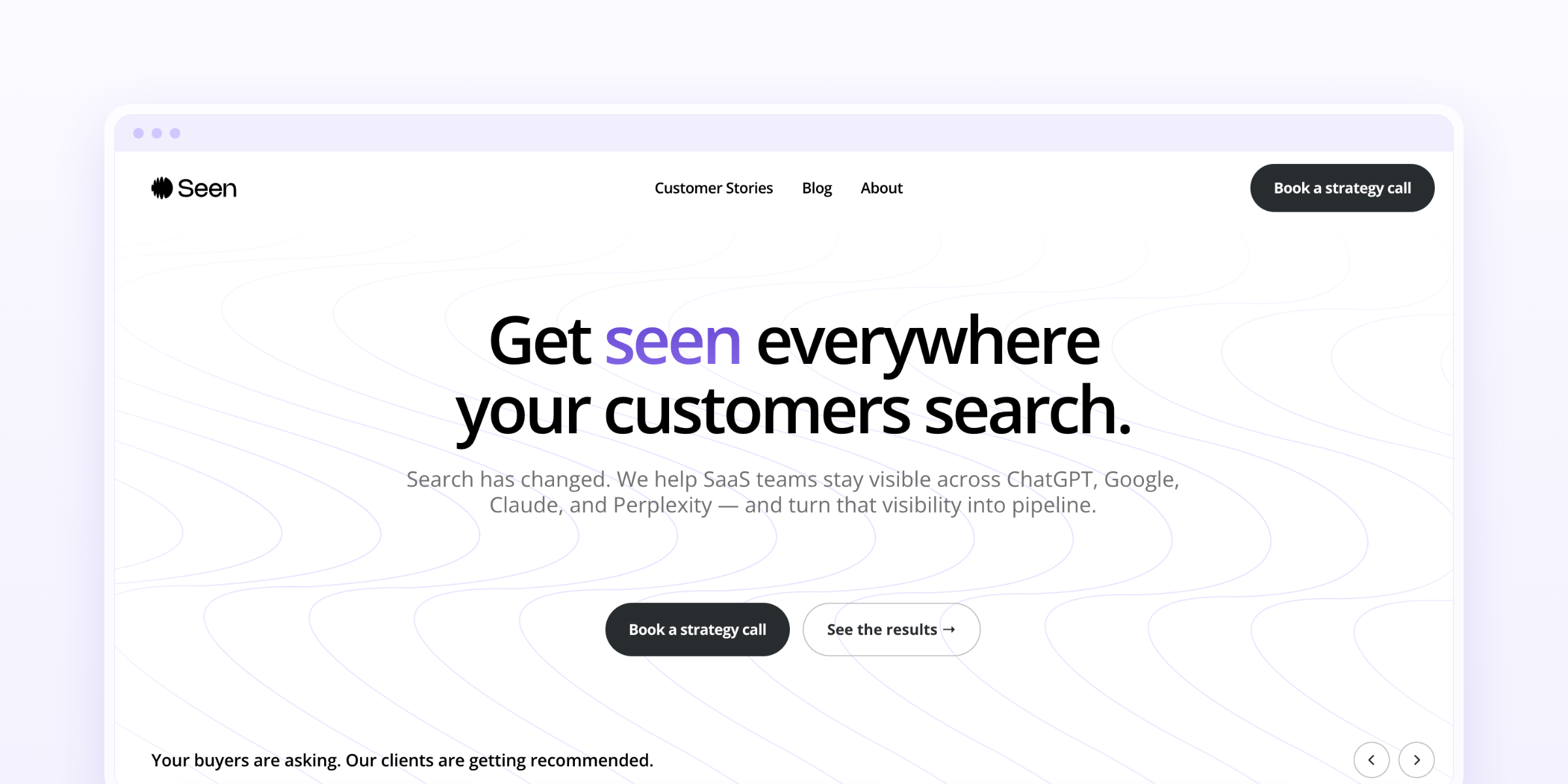
Seen is a founder-led AI SEO and GEO agency for B2B SaaS. It combines product-led SEO content, AI search optimization, and third-party brand authority so SaaS companies get discovered and recommended across Google, ChatGPT, Claude, and Gemini. Its main KPI is qualified signups and pipeline, not traffic.
Seen works like an in-house growth team for B2B SaaS companies. The strategists who plan the work are the same people who carry it out, so nothing gets lost in handoffs, and every page, link, and placement is judged by whether it brings in signups. Strategy is led by founder Irina Maltseva, former CMO at Hunter, who brings more than 10 years of SaaS growth experience.
What Seen does
- SEO and GEO strategy: BOFU-first roadmaps built around your buyers, your competitors, and the searches closest to a purchase.
- Content strategy and creation: comparison pages, alternative pages, use-case pages, and high-intent articles that rank, earn AI citations, and convert.
- Brand authority and link building: backlinks, editorial mentions, and placements in the listicles buyers and LLMs rely on.
- AI search optimization (GEO and AEO): visibility and recommendations across ChatGPT, Claude, Gemini, and Google AI Overviews, run as part of the same strategy as SEO.
Why clients choose Seen
- BOFU first. Seen starts with what buyers search when they're ready to choose a tool, like comparisons, alternatives, and use cases. Blog volume comes later, if at all.
- Signups, not sessions. Success is measured in signups, SQLs, and pipeline from Google and LLMs, not traffic.
- Deep product understanding. The team studies each client's product, sales calls, and competitors first. For Sphere, that meant mining Gong demo calls for buyer language.
- Experiments, not playbooks. Seen tests, doubles down on what moves signups, and drops the rest.
- Everywhere visibility. Buyers research on Google and in AI answers, so Seen runs SEO, GEO, and AEO as one strategy that gets you found in both.
Results Seen has achieved for SaaS Companies
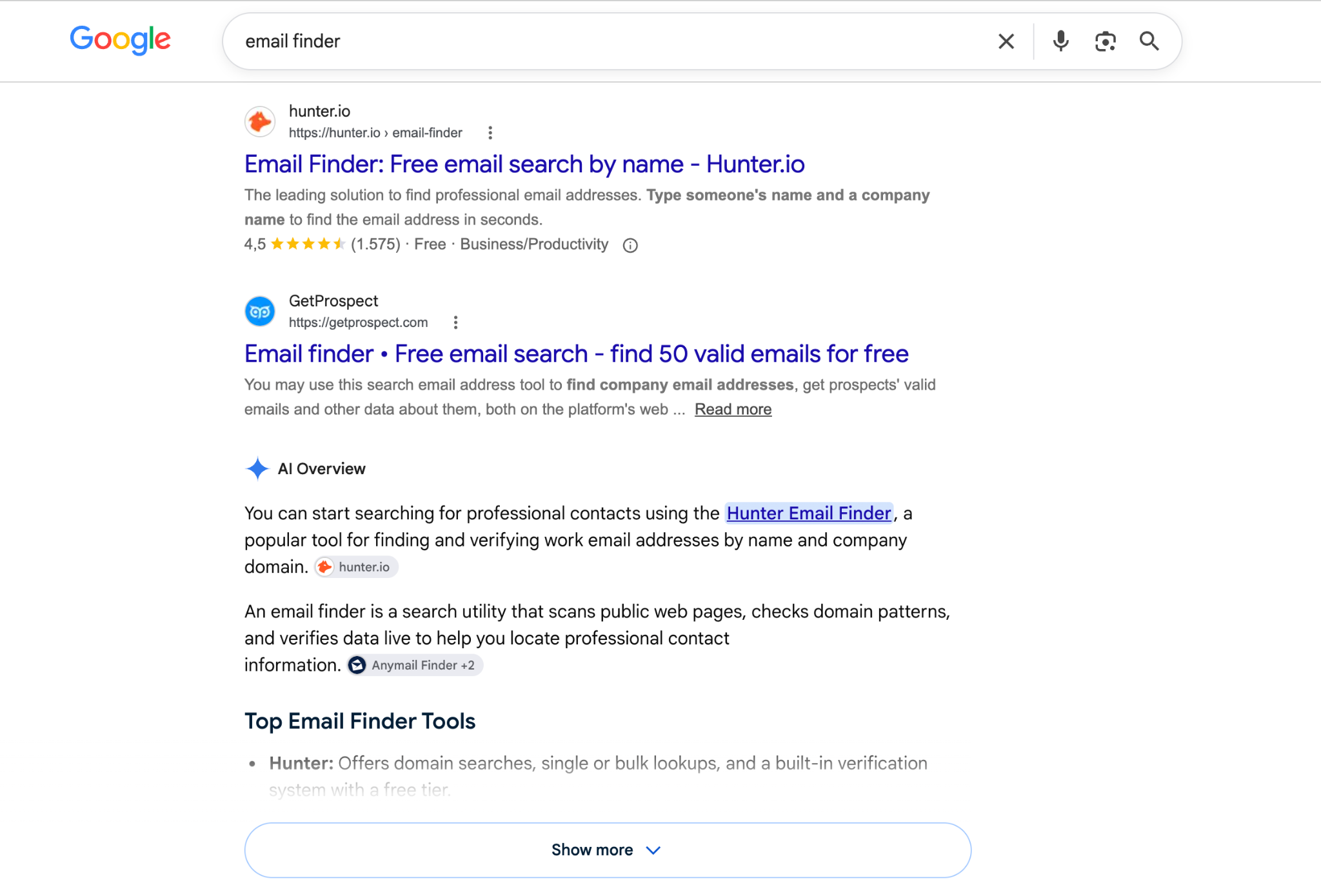
Hunter: 90% of leads from organic search. As well-funded competitors moved into email finding, Seen rebuilt Hunter's product pages around search intent, launched a blog covering cold outreach, and ran a link-building program that earned hundreds of mentions a month. Hunter now ranks #1 on Google for "email finder" and "email verifier," and its customer base grew 30%.
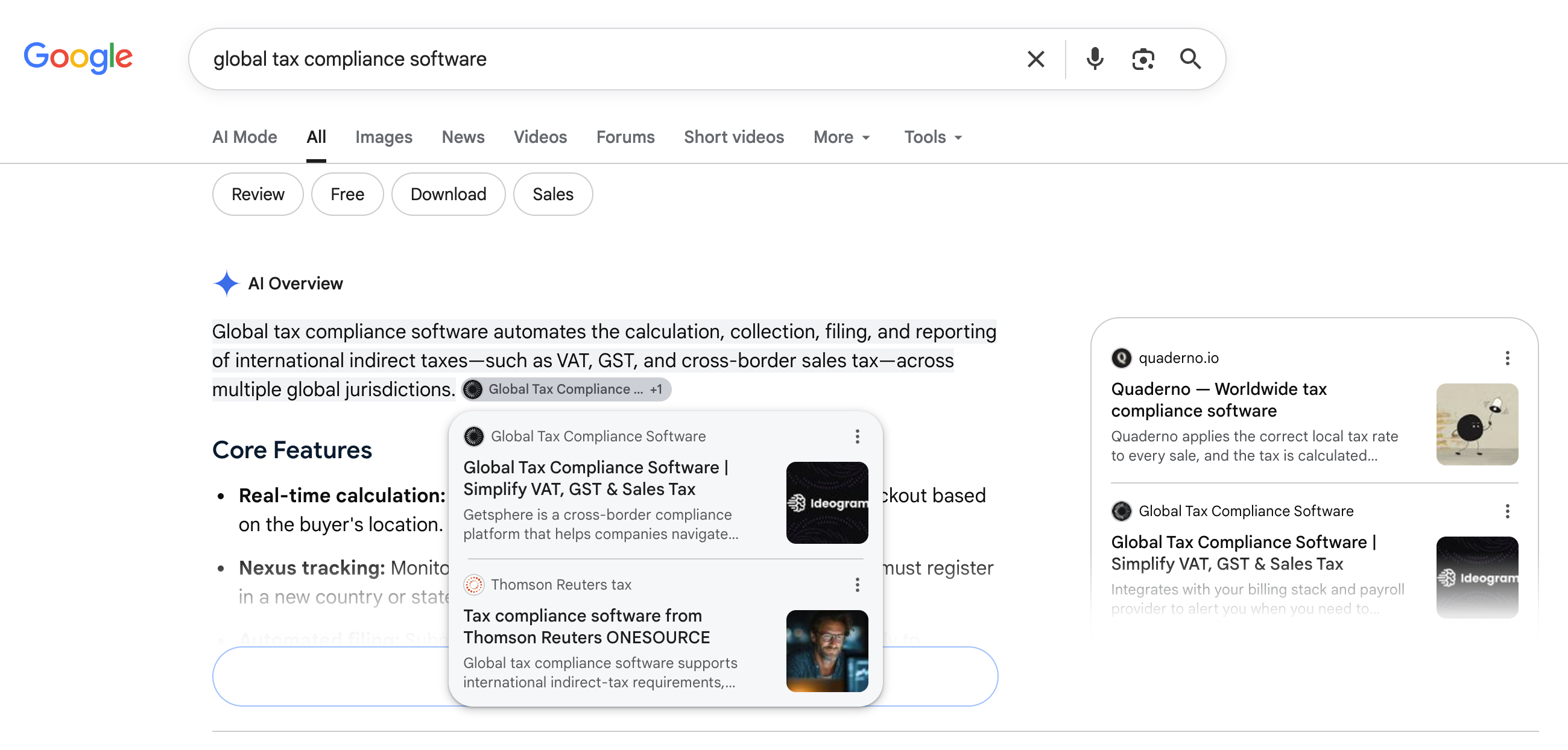
Sphere: 40% of SQLs from organic in 1.5 years. Sphere, a YC- and a16z-backed tax compliance platform, launched with about five organic clicks a day. Seen targeted the long-tail problems bigger competitors ignored and built 1.1K referring domains from nearly zero. Sphere now ranks #1 on Google for "global tax compliance software" and gets 40% of its SQLs from Google and LLMs.
What they say
"Seen has been a true asset to our team. Their depth of marketing expertise, consistency, organization, and proactive ownership made every project run smoother and perform better."Francois Grante, Co-Founder at Hunter
"Highly recommend Seen for all things search. Their expertise spans both traditional SEO and the new world of LLM-based search, which has been incredibly valuable for us as a fast-growing global business."Nicholas Rudder, CEO at Sphere
Is Seen the right fit?
Best for: B2B SaaS companies of different stages, from early-stage to established ones that don't have deep SEO or AI search expertise in-house and want organic tied to signups and pipeline.
Not the right fit: consumer apps, companies that want paid media and web builds under the same contract, and teams that need results in 30 days. SEO that compounds takes months, and Seen won't promise otherwise.
Pricing: one tailored retainer covers the full SEO, GEO, and AEO cycle, weighted toward your biggest gaps. Seen scopes it after an intro call rather than selling fixed packages.
[cta]
Want SEO that shows up in signups, not just traffic reports?
Book a free call with Seen. We will look at where your buyers are searching, where your competitors are winning, and which pages would move pipeline first.
[/cta]
2. Foundation
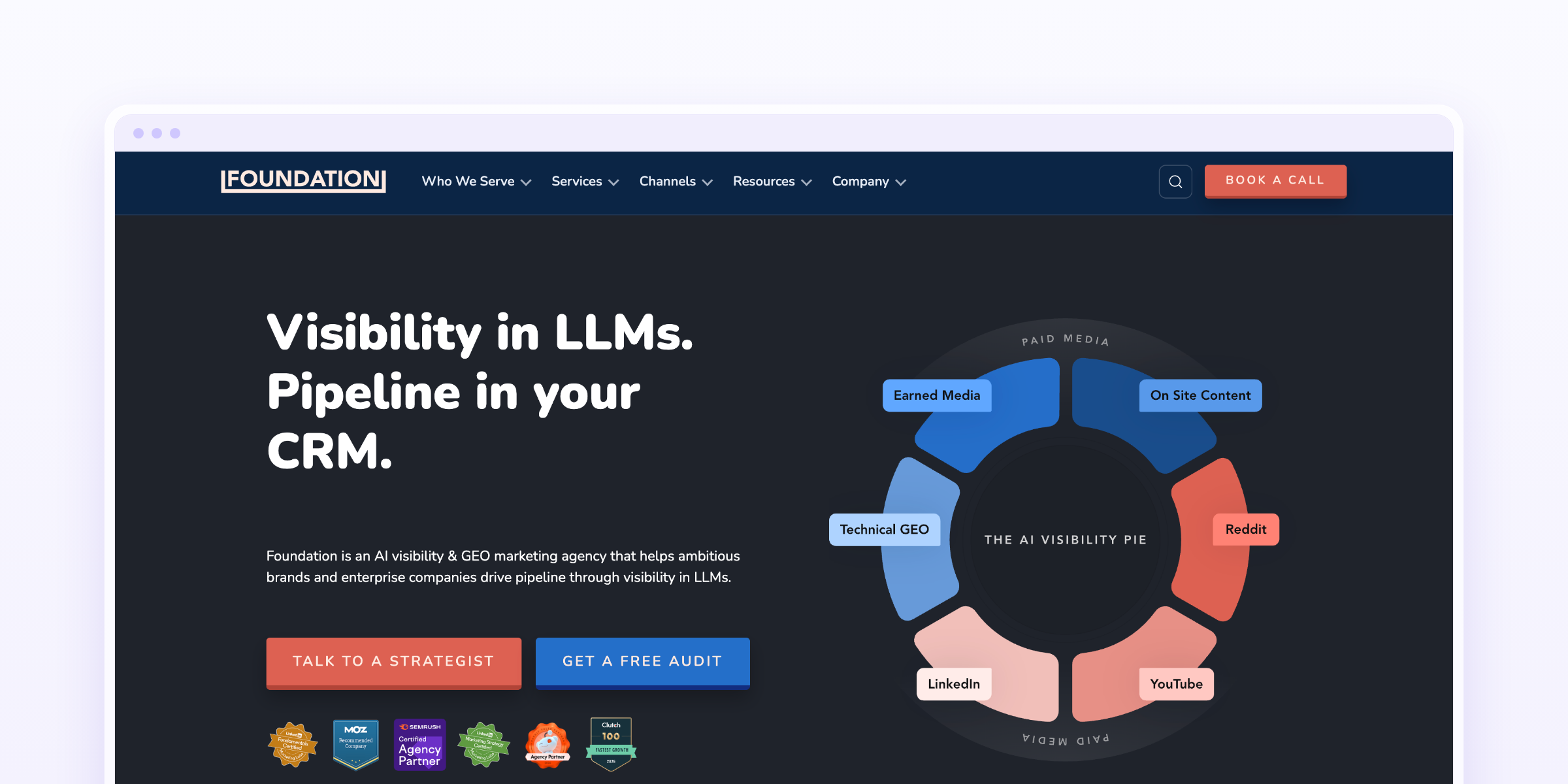
Foundation is a B2B content marketing agency for SaaS and tech brands, with clients like Webex, Mailchimp, Canva, and Snowflake. Its approach is "create once, distribute forever": every piece of content gets repurposed and pushed across channels, not just published and left to rank.
Ross Simmonds founded the agency in 2014, and it has since added AI visibility and GEO work.
What Foundation does
- Content strategy and creation: SEO-led strategy, articles, and content audits for B2B SaaS.
- Content distribution: repurposing content across social, newsletters, Reddit, and YouTube.
- AI visibility and GEO: work aimed at citations in ChatGPT, Gemini, Claude, Perplexity, and AI Overviews.
Result: for an event management SaaS, Foundation reports organic traffic growing from 22,500 to 58,000 monthly sessions (+156%) over 18 months.
Is Foundation the right fit?
Best for: B2B SaaS brands with an existing content library that need more reach and distribution.
Not the right fit if: your real problem is missing commercial pages or technical issues. SEO is also one of many offerings next to paid media, demand gen, and social, so confirm how much of the retainer goes to BOFU pages.
Pricing: Not published. You request a proposal after an intro call.
3. LinkGraph
LinkGraph is a New York-based SEO agency that approaches SaaS SEO from the technical side. It runs client work on its own Search Atlas software, so audits, tracking, and on-page fixes lean heavily on automation and data.
Manick Bhan founded LinkGraph in 2018 and built Search Atlas alongside it.
What LinkGraph does
- Technical audits: diagnosis that combines AI tooling with an expert audit.
- Implementation: code and structure fixes, including JavaScript, hreflang, internal linking, and caching.
- Intent mapping: keyword and topic mapping alongside the technical work.
Result: LinkGraph reports a 25,382% increase in organic sessions for Altify in six months, starting from near zero.
Is LinkGraph the right fit?
Best for: SaaS sites with rendering, indexing, or migration problems.
Not the right fit if: you mainly need buyer-intent content. Its homepage also guarantees "results in thirty days or less," so have the proposal define the result, the remedy, and any content deliverables.
Pricing: Not published. Ask whether the audit is a one-off project and implementation is recurring, with separate fees and minimum commitments.
4. uSERP
uSERP is a link building and digital PR agency for SaaS and tech brands like monday.com, Freshworks, and ActiveCampaign. It also sells content plans and AI SEO, but earned links and mentions remain its core.
Jeremy Moser and Brad Smith founded uSERP in 2019, and its client list also includes Robinhood and CrowdStrike.
What uSERP does
- Earned placements: links and mentions on recognized software and business platforms.
- Content and on-page work: paired with link-building campaigns.
- Authority building: for brands whose pages are already competitive.
Result: uSERP reports a 77.84% increase in organic traffic for monday.com since October 2020, with no end date given.
Is uSERP the right fit?
Best for: SaaS brands with solid content that can't outrank competitors with stronger domains.
Not the right fit if: you need technical fixes or new commercial pages. Links are the center of gravity, so spell out any other deliverables in the scope.
Pricing: Six-month engagements with a 60-day opt-out. Ask whether fees are per link, per campaign, or a monthly retainer.
5. Single Grain
Single Grain is a full-service digital marketing agency covering SEO, content, AI SEO and GEO, paid media, and CRO. That breadth is the point: you can run organic, paid, and conversion work through one vendor.
The agency was founded in 2009 and is led by CEO Eric Siu, co-host of the Marketing School podcast.
What Single Grain does
- SEO and content: including dedicated SaaS and B2B SaaS offers.
- AI SEO, AEO, and LLM SEO: offered as named services.
- Paid media and CRO: run alongside organic work, from one vendor.
Result: Single Grain's case studies page features SmartRent with 10 monthly SQLs from LLMs, with no timeframe given.
Is Single Grain the right fit?
Best for: SaaS companies that want SEO, paid, and CRO handled by one vendor.
Not the right fit if: you want a SaaS-only specialist. It also serves e-commerce, local, and other industries, so SaaS depth depends on the team assigned to your account.
Pricing: Not published. The contact form asks for your monthly marketing budget, so expect a custom proposal.
How to choose a SaaS SEO agency
No agency on this list is the right hire for every SaaS company. Match its scope to the problem blocking your organic growth and to your growth stage, then use the sales call to test how it would handle both.
Match the agency type to your bottleneck
Start from the symptom, not the agency's pitch. Most SaaS organic problems fall into one of four buckets, and each one points to a different type of agency.
[table]
Bottleneck | How it shows up | Agency type built for it | Tradeoff
Findability | No pages for the comparison, alternative, or use-case searches buyers run | Content-led | Deep production; technical scope needs checking
Crawlability | Published pages not indexed, traffic lost after a replatform, JavaScript rendering gaps | Technical or data-led | Fixes the foundation; you may still need writers
Authority | Good pages stuck behind stronger domains | Link building and digital PR | Placement depth; content and technical work may need another owner
Conversion | Traffic grows but trials and demos don't | SaaS-only specialist or full-service B2B shop | Coordinates levers; depth in your weak spot varies
[/table]
A narrow specialist goes deep on one lever but may leave you coordinating writers, developers, and RevOps yourself. A broader partner cuts those handoffs, but you have to check that its bench is strong in the exact area that's failing.
Sequence matters too. If your priority pages aren't indexed, content and link spend may go to pages that can't appear in search yet. In my experience, urgent technical blockers come first, even when a different bottleneck looks bigger.
Match the engagement to your growth stage
- Before product-market fit: A founder or a consultant can often do more than an agency retainer. The job is to validate positioning with a small set of comparison, alternative, use-case, and integration pages, not to publish blog volume. Paying an agency to scale content around messaging that may change next quarter wastes the retainer.
- Growth stage: Once a handful of commercial pages convert, expand into topic clusters around them and build authority so they can compete with larger domains.
- Enterprise: Add technical governance (templates, internal linking rules, release checks) and migration planning, where one bad replatform can undo years of rankings.
- Product-led motion: Measure organic signups through to activation, not signups alone. Prioritize self-serve product pages, integration pages, and use-case journeys that end in a trial.
- Sales-led motion: Measure demo requests through sales acceptance and pipeline. Prioritize comparison pages, solution pages, and proof such as case studies, because buyers on these pages are building a shortlist for a sales conversation.
Questions to ask before you sign
Ask each of these on the sales call. The weak answer is the one that should worry you.
- "Show me trials, demos, or pipeline from a similar SaaS engagement." Weak answer: "Here's our traffic chart." Traffic proves activity, not revenue impact.
- "Who executes the work day to day, and what SaaS work have they done?" Weak answer: "Our experts handle it." Google Search Central suggests asking any prospective SEO about their experience in your industry. Push further and ask for the names of the people on your account.
- "On our site, how would you split the first months between technical fixes, buyer-intent pages, and authority?" Weak answer: "Every client gets the same publishing package." A good answer refers to problems the agency has already found on your domain.
- "What are the minimum term, notice period, and exit ownership terms?" Weak answer: "We'll sort that out later." Get written answers on who controls the CMS, analytics, Search Console, CRM integrations, content files, and any third-party tool accounts when the engagement ends. For earned placements, ask how they're managed and what replacement obligations apply, since independent publishers control their links.
How much SaaS SEO services cost
Separate the charges in a proposal before you compare quotes:
- Monthly retainers pay for ongoing strategy and execution.
- Fixed-scope projects cover work such as audits and migrations.
- Production packages allocate a budget to content or links.
Use these scope examples to judge whether a proposal fits your stage:
[table]
Stage | Scope example
Startup | Keyword research, a few commercial pages, basic technical hygiene
Growth | Topic clusters, ongoing link acquisition, conversion tracking into the CRM
Enterprise | Full technical program, content at volume, digital PR, migration support
[/table]
Content volume, link acquisition, technical complexity, and AI search work drive the fee. For AI search, look for crawlability checks, commercially useful expert content, accurate brand and product information, credible earned mentions, and a defined set of monitoring prompts.
Here's a worked example. Assume $5,000 in total monthly SEO costs, 20 incremental customers per month, $500 MRR per customer, and an 80% gross margin. Each new monthly cohort adds $8,000 in monthly gross profit before churn and other costs.
That steady-state figure doesn't tell you when you break even. Measure the realized return by subtracting cumulative SEO costs from cumulative incremental gross profit. Payback is the first month when cumulative incremental gross profit covers cumulative SEO spend.
Treat CRM pipeline as a leading indicator, not realized revenue, and keep organic-sourced deals separate from organic-influenced ones.
Judge progress by milestones rather than promised dates:
- Baseline and tracking in place
- Priority fixes shipped and commercial pages live
- Pages indexed and search signals moving
- Qualified conversion cohorts you can attribute
Red flags in a SaaS SEO pitch
Watch for proposal lines like these.
- "20 articles every month." A publishing quota needs a keyword-to-intent map that connects topics to buyer actions. Without one, the agency may keep publishing after the useful topics run out.
- "Guaranteed #1 rankings and AI citations." Google Search Central says no one can guarantee a #1 ranking on Google. Its generative-search guidance also says that following its requirements doesn't guarantee indexing or serving.
- "Organic visibility up 200%." An undefined percentage and a dashboard with no connection to signups or demos leave you no way to judge commercial progress.
- "Technical audit: titles and meta descriptions." A titles-and-descriptions checklist is too narrow for a technical audit. The scope should also cover rendering, indexing, and site structure.
So, which SaaS SEO company should you hire?
The best SaaS SEO company for you isn't the one with the prettiest traffic chart. It's the one that understands how your buyers search, fixes the bottleneck that's actually holding you back, and reports on signups and pipeline instead of sessions.
If you need one specific lever, a specialist on this list can go deep on it. Foundation for content and distribution, LinkGraph for technical problems, uSERP for authority, and Single Grain if you want paid and organic under one roof.
If you're a B2B SaaS company that wants Google and AI search working together as a real acquisition channel, that's exactly what we built Seen to do. We start with bottom-of-funnel pages, back them with third-party authority, and judge every experiment by whether it moves signups. That's how organic became 90% of Hunter's leads and 40% of Sphere's SQLs.
[cta]
Ready to turn organic search into signups?
We'll show you where your buyers are searching, which competitor pages are taking your deals, and the first pages we'd build to grow pipeline.
[/cta]
FAQs
Can ChatGPT do SEO for a SaaS product?
It can assist, but it can't own the work. ChatGPT is useful for drafting briefs, organizing keyword lists, and turning your own product material into first drafts. Product facts, statistics, and citations still need human verification. Keep prioritization with someone who understands the product and funnel.
Can a beginner handle SaaS SEO without hiring a company?
Yes, at the early stage. Start with Search Console, map buyer searches to useful pages, and track whether readers take the next product step. Bring in help when technical problems or the volume of pages outgrow the time you have.
Should a SaaS startup hire an SEO company or build an in-house team?
An agency suits a backlog that needs several disciplines at once. An in-house hire suits sustained work that depends on daily product and sales access. Many teams combine an in-house owner with outside SaaS SEO services.
Do SaaS SEO companies work with B2C SaaS or only B2B?
It depends on the agency. Many, including Seen, focus on B2B buying journeys, so a consumer app should ask for case studies with self-serve products, where success is measured in signups and activation rather than demos.
What is the difference between SaaS SEO and generative engine optimization?
SaaS SEO targets rankings and clicks in search engines, while GEO aims to get your product cited or recommended in AI-generated answers. Google says established SEO best practices still apply to its generative AI features and that Google Search ignores llms.txt files. In practice, the strongest results come from running both as one strategy.