- A link building service does the outreach to get other sites linking to yours. Irrelevant links waste the budget, and links bought to manipulate rankings can be ignored or penalized by Google.
- Best for B2B SaaS: Seen. It earns links and brand mentions on the pages Google ranks and AI tools cite, and measures the work by signups, not link counts.
- Other options: Page One Power for custom campaigns, The HOTH for fixed-menu ordering, Outreach Monks for manual outreach on a small budget.
- Compare scope, not price per link. Quotes run from $99 a placement to $3,700+ a month, and they rarely cover the same work.
If you've ever paid for links, you probably know this feeling. The report lands with 20 new URLs, you click through, and half of them sit on a "lifestyle" blog that covers crypto on Monday and roofing on Tuesday. You paid for links. You didn't get anything that helps you rank, let alone get recommended in ChatGPT.
I've spent 10+ years in SEO, and a good part of that on the buying side, hiring and managing link building vendors for in-house teams before I founded Seen. Some were genuinely great. Others sold links that did nothing, and that's the best case. Google says links bought to manipulate rankings may be ignored or attract algorithmic or manual action.
So which service should you hire?
Honestly, it depends on your niche, your budget, and how much of the strategy you want to keep. Below, I compare 4 services and break down what each quote actually covers, including the work that would still land on your team.
Best link building services by buyer type
[table]
Service | Best for | Service model | Pricing model | Main link types
Seen | B2B SaaS teams that want links tied to rankings, AI visibility, and signups | Founder-led SEO, GEO and AEO agency; links and mentions built into a custom strategy | Custom package after a discovery call | Editorial links, listicle placements, and brand mentions
Page One Power | Brands needing custom, relationship-based campaigns | Custom managed campaign | Monthly fee | Resource and content links
The HOTH | Buyers wanting packaged, predictable ordering | Productized ordering; managed option | Per link by site authority tier | Outreach links, link insertions, media and PR placements
Outreach Monks | Small teams buying manual outreach on a budget | Manual outreach with strategy support | Per placement | Outreach placements
[/table]
How we evaluated these link building services
Quick disclosure first: I'm Irina Maltseva, founder of Seen, and Seen is on this list. You should know that going in.
I've worked in SEO for more than 10 years. Before Seen, I led marketing in-house at Hunter, where I hired, briefed, and managed link-building vendors, and ran our own outreach too. One of those campaigns earned 96 links from 54 domains and 33 new listicle mentions in under three months, and Ahrefs later published it as a case study. So I've judged these services from the buyer's side, with my own budget on the line.
We looked at each provider the same way:
- Relevance of the placements. Do sample links sit on sites that cover your topic and point at pages like yours?
- Transparency about method. Does the provider explain how sites are chosen and whether publishers are paid?
- Scope. What's included, and what's left for your team to do?
- Pricing and commitment. Is the price public or clearly scoped, and how long are you locked in?
- Buyer controls. Approval rights, reporting and replacement terms for lost links.
- Connection to outcomes. Can the provider tie its work to rankings, AI visibility and pipeline, not just delivered URLs?
4 link building services compared by buying model
A B2B SaaS search program, a custom outreach campaign, a fixed product menu and per-placement orders are different ways to buy the work. Here's what each one looks like in practice.
1. Seen
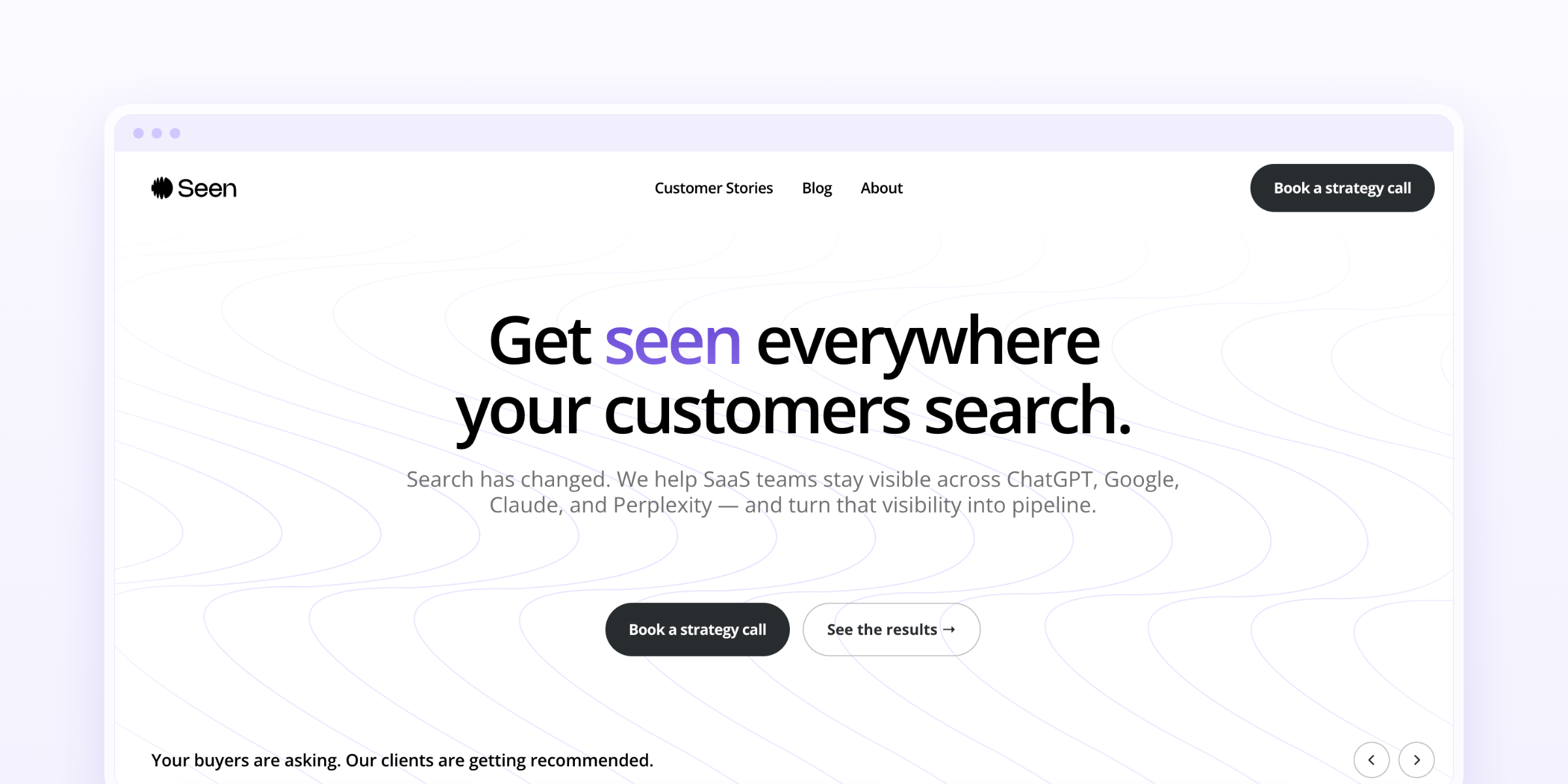
Seen is a founder-led AI SEO agency built only for B2B SaaS. Link building is one part of a wider program that combines SaaS SEO, generative engine optimization (GEO), and answer engine optimization (AEO). That means every link and mention Seen earns is aimed at one thing: getting you found and chosen on Google and in ChatGPT, Claude, Gemini, and Google AI Overviews.
Most link building services start with a list of sites they can get you on. Seen starts from the other end. It asks which of your pages need more authority to rank, and which third-party pages LLMs actually cite when your buyers ask for a recommendation. Then it runs tailored outreach to earn relevant editorial links and brand mentions on exactly those sources.
What Seen does:
- Maps your priority product, comparison, and bottom-of-funnel pages to relevant, authoritative publications in your category.
- Finds the listicles, reviews, and guides that LLMs cite for your buyers' prompts, then runs outreach to get you included wherever you're missing or underrepresented.
- Builds product-led content worth linking to, so links point at pages that convert.
- Prioritizes relevance over volume. Some placements take months of outreach and negotiation, because one page ChatGPT cites is worth more than fifty it ignores.
- Reports each placement against its target page, and ties results to signups and qualified conversions rather than raw link counts.
- Irina Maltseva, Seen's founder, works on the strategy for every account day to day (LinkedIn), and the team handles execution.
Why B2B SaaS teams choose Seen
A link is only worth paying for if it helps a page that brings in customers. That's why Seen focuses on bottom-of-funnel pages and keywords, and why its main KPI is signups, not traffic or referring domains.
It also doesn't run the same playbook for every client. Search and AI answers change too fast for that, so Seen tests what actually moves rankings and recommendations in your category, and puts more effort behind what works. Irina brings 10+ years in search and the in-house view of what a SaaS team needs from an agency. She knows the numbers your board looks at, because she used to report them.
Here are two link building results from Seen's customer stories.
How Nextiva became #1 on Google and ChatGPT
Nextiva had a strong content team but lacked the off-page authority to compete in a crowded market. Over four years, Seen earned editorial links to its priority pages and got it mentioned in the listicles LLMs cite.
- #1 on Google for 4.4K high-intent keywords
- #1 recommendation on ChatGPT for "best business VoIP"
- 200K+ monthly organic visits, worth an estimated $1.4M a month
After years of working together, Nextiva's Head of SEO asked Seen to scale up its brand mention work.

How Riverside became the podcasting software AI recommends first
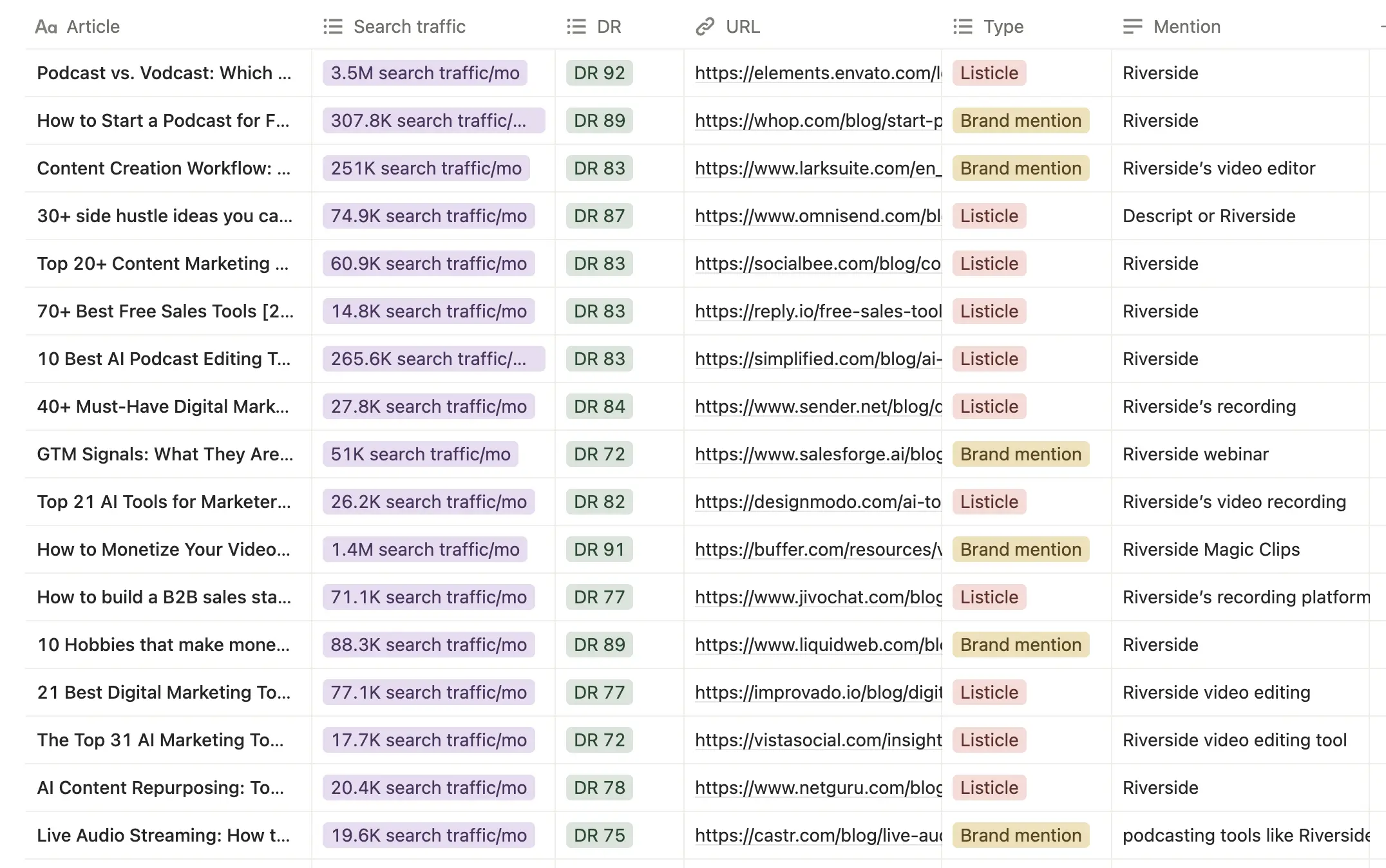
After moving from riverside.fm to riverside.com, Riverside needed to rebuild authority fast. Seen pointed new editorial links at the new domain and got Riverside into the listicles buyers and LLMs rely on.
- #1 recommendation on ChatGPT for "best podcasting software"
- 113K+ monthly organic visits from Google
- 500+ authoritative mentions and links earned
Read the Riverside case study →
Clients include
Sphere · Nextiva · Riverside · Aura · Artisan · Hunter
What clients say about Seen
"Highly recommend Seen for all things search. Their expertise spans both traditional SEO and the new world of LLM-based search, which has been incredibly valuable for us as a fast-growing global business. Also, just an absolute pleasure to work with."
Nicholas Rudder, CEO at Sphere
"Seen helped us go from zero visibility to consistently ranking #1 for our most important keywords, driving hundreds of leads every month. A truly brilliant partner."
Jaspar Carmichael-Jack, Founder & CEO at Artisan
Want the full story? Read how Seen helped these companies grow in our customer stories →
Limitations: Seen works only with B2B SaaS companies. And because links come as part of a wider SEO, GEO and AEO scope, you won't get a like-for-like quote for a set number of links.
Pricing: Custom packages based on your business needs. Seen recommends a scope and gives a price estimate after a discovery call.
Best for: B2B SaaS teams that want links and brand mentions tied to Google rankings, AI recommendations, and pipeline.
[cta]
Want links that get you recommended by ChatGPT, not just more referring domains?
We'll show you where you're missing and what it would take to get you in.
[/cta]
2. Page One Power
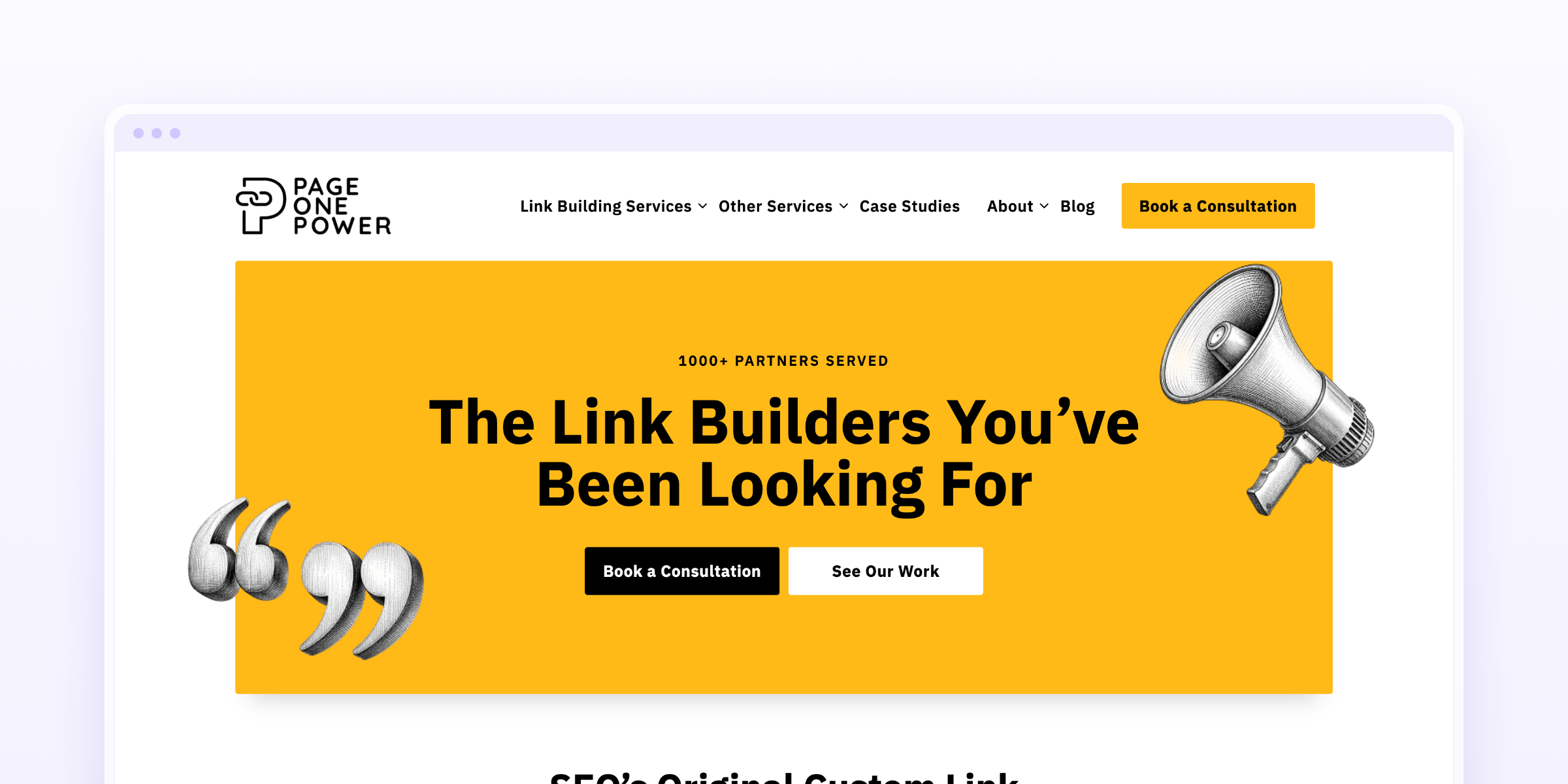
Page One Power is a Boise-based agency that has focused on link building since 2010. Instead of selling links off a menu, it builds a custom campaign around the specific pages you want to rank.
What Page One Power does:
- Scopes each campaign around your target pages, including commercial and money pages.
- Combines resource link building with content link building, creating linkable assets where needed.
- Runs relationship-based manual outreach, backed by a contractual link quota.
- Evaluates progress against agreed campaign goals.
- Offers white-label link building for agencies, plus content and technical SEO support.
In one published case study, a six-month campaign built 34 links for Tipalti and grew clicks to its target pages by 158%.
Clients include: Bostitch · QuickBooks · Healthline · Hyatt · Lucidchart · WorkWave · Atera · YorkTest
Limitations: Custom scoping and the initial contract suit buyers prepared to commit to a campaign rather than test a single placement. The link quota covers delivery, not rankings, and the work focuses on Google rather than AI search visibility.
Pricing: A typical campaign starts at $3,700 per month with an initial six-month contract, after which it can move to month-to-month.
Best for: Established brands that need targeted links to specific money pages and can commit to a six-month campaign.
3. The HOTH
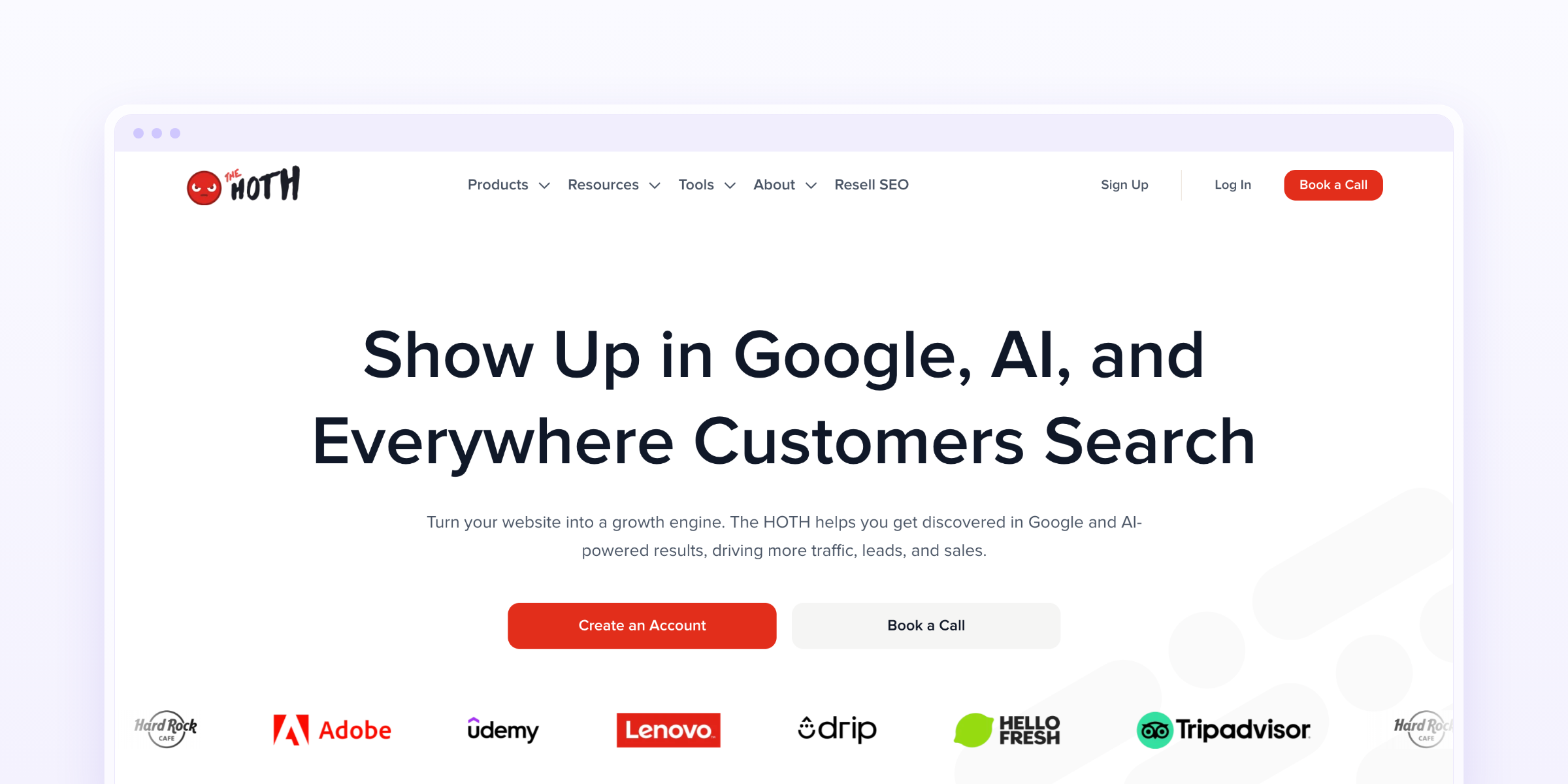
The HOTH is a productized SEO company that sells link building alongside content, local SEO, and a fully managed program called HOTH X. Its Link Outreach product is ordered like an online purchase: pick a site authority tier and an article length from 500 to 2,000 words, then check out.
What The HOTH does:
- Eight a la carte link building products covering manual outreach, link insertions, media placements, and PR.
- Link Outreach placements on existing blogs in your niche, with the article written by its team.
- HOTH X, a fully managed option that bundles links with content and on-site SEO, plus a campaign manager.
- Link Outreach links fixed or replaced for six months if they break, extended to a year for qualifying Discount Tier Contracts or active HOTH X subscriptions.
Its case studies mostly feature local and small-business clients, for example, a law firm that grew from 45 to 500 referring domains.
Clients include: The HOTH doesn't name clients on its homepage. Its published case studies mostly cover law firms, local service businesses, and ecommerce stores.
Limitations: Link Outreach does not include prepublication content approval, which rules it out if your team must approve the article before it goes live. Some Trustpilot reviewers also report placements on irrelevant sites, so review samples before you order in bulk.
Pricing: Per link, by authority tier. The Link Outreach page shows promotional prices of $75 and $100 for its two entry tiers (regularly $150 and $200), plus $315 and $375 for its two higher-authority tiers. The HOTH's link building catalog, however, lists Link Outreach from $175 per link at the entry tier. Confirm the price at checkout, including whether longer word counts change it.
Best for: Small businesses and startups that want predictable ordering without scoping a custom campaign.
4. Outreach Monks

Outreach Monks is a link building agency that has focused on manual outreach since 2017. You can order one placement at a time with no retainer or lock-in, or move to a managed monthly plan.
What Outreach Monks does:
- Sends personalized manual pitches, with no bulk-send tools.
- Places guest posts, link insertions (niche edits), and brand mentions.
- Screens sites for PBN footprints during vetting.
- Handles anchor planning, content creation, and a monthly strategy review.
- Replaces lost links under a six-month guarantee.
- Offers white-label fulfillment for SEO agencies.
It doesn't publish detailed case studies, so ask for sample placements in your niche before you order.
Clients include: Outreach Monks doesn't name clients on its site. Its Clutch reviews come mainly from SEO and digital marketing agencies, plus software, CBD, and e-commerce companies.
Limitations: Lower price tiers buy placements on lower-authority sites, and authority on its own doesn't show whether a site is relevant to your buyers. Its cheapest entry tier also sits below the minimum authority threshold listed elsewhere in its homepage vetting criteria.
Pricing: Per placement, in US dollars, from $99 at the entry tier and rising with site authority, niche difficulty, and traffic. Managed plans start at $599 a month.
Best for: Small businesses and lean marketing teams that want manual outreach at a low entry price and are prepared to judge relevance for themselves.
Managed campaigns, white-label fulfillment, or per-link ordering?
In a fully managed campaign, you hand over goals and target pages, and the provider returns strategy, content, placements, and reporting. Your job becomes approving and reviewing.
White-label fulfillment is delivered unbranded to an agency, which presents it to its client as its own work and keeps the client relationship. It can cover individual services or a managed campaign, with per-link or monthly billing. White-label describes whose name is on the work, not the price structure.
With buyer-directed per-link or packaged orders, you purchase a defined deliverable, such as a guest post in a given authority band, and retain responsibility for the campaign plan. Some services add a marketplace where you browse inventory and pick sites. Others choose for you.
Guest posts, niche edits, and digital PR are acquisition tactics, not buying models. A guest post publishes a new article on another site; a niche edit adds a link to an existing article. Digital PR pitches stories or research to journalists, who decide whether to cover them.
Editorial independence affects what you are buying: an editor chooses whether a contribution merits coverage, while a paid-placement agreement purchases publication. Ask who controls publication, whether the publisher is paid, and how any paid links are qualified. A managed contract, manual outreach, or a high-authority site metric does not establish compliance with Google's link spam policies.
How much link building services cost
A quote needs to show both the billing basis and the included work:
[table]
Model | What you pay for | Usually included | Usually left to you
Per link | Each placement | Prospecting, content and outreach for one link | Target pages, overall strategy, cross-order reporting
Fixed package | A set number of links or a tier | Placements, sometimes account management | Planning beyond the package
Monthly retainer | An ongoing fee, often with a minimum term | Strategy, content assets, outreach, reporting | Approvals and making target pages link-worthy
[/table]
Outreach Monks advertises placements from US$99 at its entry tier. Page One Power says its typical custom campaign starts at $3,700 per month with an initial six-month contract.
Per-link prices vary with site authority and traffic, niche difficulty, content creation and outreach labor. More writing or a harder prospect search can raise the cost of each placement. Those metrics help set prices, but they don't establish relevance. For example, a high-authority site about pet supplies can still be the wrong home for a payroll software link.
Consider a buyer weighing 20 entry-tier Outreach Monks placements, which would start at about $1,980, against a Page One Power campaign at $3,700 a month. The per-placement order fixes the deliverable and leaves target pages and strategy with you; the campaign scopes outreach around target pages and evaluates progress against campaign goals, with a six-month commitment. Compare those responsibilities and the commitment before treating the quotes as different prices for the same work.
The cheapest quote can also end up costing more. Links that search engines ignore waste the spend outright, and problematic placements can create cleanup work.
Four questions to choose a link building service
Run these four questions against every provider on your shortlist before signing:
- Can they show relevant work in your niche? Ask for representative placements in your industry that point at pages like the ones you want to support. Google's own hiring guidance recommends asking for examples of previous work and about the provider's experience in your industry. Relevance you can see in examples beats any authority threshold.
- Which budget model can you sustain? If you need a capped, predictable spend, per-link or packaged ordering fits. If you can commit to a retainer or a minimum term, a managed campaign becomes an option. Compare the total commitment and what it includes, not the rate per link.
- Which link types will you accept? Decide whether you want guest posts, niche edits, or digital PR, then ask how the provider obtains each one, including whether publishers are paid. Judge the answer, not the tactic's name.
- How much do you want to delegate? Decide whether you want strategy, content, and outreach handled end to end, fulfillment under your own brand, or orders you direct yourself. Then get the terms in writing: site-approval rights, reporting cadence and contents, and how lost or removed links are replaced.
If you're delegating both strategy and execution, shortlist managed campaigns, and if you're a B2B SaaS team that also wants AI search visibility, look for a provider that plans links around the pages LLMs cite. Agencies keeping the client relationship belong with white-label fulfillment, and buyers ready to own strategy can use per-link or packaged ordering. Niche, budget, and link type then narrow the field within whichever model you chose.
Audit sample placements for link building red flags
Request representative placements, the written proposal, and a sample report before signing, then use the following examples as prompts for investigation:
- Network patterns in the sample list. Picture a "lifestyle" blog with almost no organic traffic that publishes about crypto, roofing, and dental implants in the same week, with each post linking out to two or three unrelated businesses. Treat the combination as a reason to investigate a possible private blog network or link farm, not as proof. Google treats low-value content created mainly to manipulate linking signals as link spam.
- Outcome guarantees in the proposal. Phrases like "guaranteed top three in 30 days" or "double your organic traffic in 90 days" promise SEO outcomes rather than delivery. Google warns that no one can guarantee a #1 ranking. A guaranteed link quota or replacement policy is different, because it commits the provider to work, not to search results.
- Secrecy about method or results. Google flags secrecy, and any failure to explain proposed work, as a warning sign when hiring. In practice, watch for a provider that won't share sample placements, won't explain how sites are chosen, or ignores approval rights you negotiated. A report that's a bare list of URLs, with no target page, anchor, or site context, fails the same test. Lacking a ready inventory is not itself secrecy, and delegating selection can be deliberate.
- Paid ranking credit. Be wary of a proposal offering "do-follow links on our paid partner sites that pass full authority." Google's spam policies count buying or selling links for ranking purposes as link spam. Advertising and sponsorship links are permitted when appropriately qualified with nofollow or sponsored attributes.
Paying an agency for outreach labor is separate from paying a publisher for a link; manual pitches and no-PBN claims do not settle the policy question. Google's link-spam guidance says it can nullify link schemes and may apply algorithmic or manual action to excessive sponsored or guest-post acquisition without appropriate tags. Those links can waste the spend, and a pattern of unqualified paid placements can put the site at risk.
Key takeaways
When I was hiring link building vendors in-house, the expensive mistakes never came from the price per link. They came from links on the wrong sites, pointing at the wrong pages.
- Pay for relevance, not authority scores. A link only helps if the site covers your topic and points at a page that converts.
- Compare what's included, not the rate. A $99 placement and a $3,700/month campaign aren't different prices for the same work.
- Ask how publishers are paid. Manual outreach and "no PBN" claims don't tell you whether a link complies with Google's policies.
- Plan links for AI search too. If buyers ask ChatGPT for recommendations, the pages it cites are where your mentions need to be. Seen builds link programs around exactly that for B2B SaaS teams.
Before your first provider call, list the five pages you most want to rank and the 10 buyer prompts you most want to win in ChatGPT. A good partner will tell you exactly where they'd earn links and mentions first, and why.
[cta]
Want links and mentions that turn into signups?
Seen helps B2B SaaS teams earn the links and brand mentions that move Google rankings and AI recommendations, and measures it all by pipeline.
[/cta]
FAQs
Does link building still work?
Yes. Google says PageRank, its link-based signal, continues to be part of its core ranking systems. Links are one signal among many.
What is external link building?
External link building is getting other websites to link to yours. Internal linking connects pages on your own site, and you control it completely.
What is a HARO link builder?
A HARO link builder monitors journalist requests on Help a Reporter Out and pitches your expertise to win quotes, mentions and links. HARO connects journalists with expert sources, and it continues to operate after its 2025 acquisition by Featured.com. Because the publication decides whether to quote and link you, these links are earned editorial coverage.
Should you build links in-house or hire a link building service?
Build in-house if you have time and content worth linking to, and hire when outreach capacity or expertise is the bottleneck. Google's hiring guidance notes that small local businesses can probably do much SEO work themselves. Compare the service's cost with the time and expertise you would otherwise need in-house. And if you'd rather hand over SEO as a whole, not just links, our guides to B2B SEO agencies and AI SEO companies compare broader options.
Are link building services worth it for small businesses?
They can be, provided your target pages are ready to convert traffic and you can sustain spending until the first review point. If your service pages are thin, fix them first, because links rarely rescue a page that doesn't answer the search.
How many backlinks do you need each month?
There's no universal number. Look at how many relevant referring domains point to the pages outranking yours for your target terms, then set a monthly pace you can afford and that relevant opportunities can actually support.