- Every agency sells LLM SEO now, so the label tells you nothing. What matters is whether they ship the content and third-party mentions that change the AI's answer, and whether they measure it in pipeline.
- Best for B2B SaaS: Seen. It runs SEO, GEO, and AEO as one strategy and measures it in signups and pipeline. Sphere now gets 40% of its SQLs from Google and LLMs.
- Other options: Siege Media for content-led programs at large brands, Algomizer for performance-linked fees, Embarque for fast page volume, and iPullRank for enterprise technical depth.
- Pay for shipped work, not dashboards. Most published agency retainers land between about $4,000 and $10,000 a month, and tracking on its own changes nothing.
If you're reading this, you've probably already run the test. You asked ChatGPT for the best tools in your category, and it named three of your competitors and not you. Then you went looking for someone to fix it and found that every SEO agency on the internet now sells LLM SEO.
That's the real problem. The label is everywhere, but the work behind it varies wildly. Some agencies hand you a visibility dashboard and a list of prompts you're losing. Some rename their old SEO retainer and add "AI" to the proposal. A few actually change what the AI says, by shipping the pages and earning the third-party mentions those answers are built from, then tying it back to signups.
I've been on both sides of that conversation: I hired agencies in-house for years, and now I run one. So this guide is about telling them apart. You'll find 5 agencies worth a look, what LLM SEO really costs, how to measure it, and the questions that expose a weak pitch on a sales call.
How I evaluated these LLM SEO services
I've spent 10+ years in SaaS growth, including as CMO at Hunter, where I hired and managed agencies from the in-house side long before I started Seen. That taught me how differently two agencies can deliver under the same label. So I didn't score anyone on what their service pages promise. I looked at:
- Who ships the work. Do they implement content, technical fixes, and outreach, or hand over an audit and a dashboard login?
- How they learn the product. Is the strategy built on the client's buyers, positioning, and competitors, or on a keyword export?
- Proof inside AI answers. Are there named, specific results on real buyer prompts, across more than one engine?
- Off-site authority. Do they earn mentions on the third-party pages that AI answers already cite?
- Measurement. Do they connect visibility to signups, demos, and pipeline, not just mention counts?
- Fit. Which company stage and type is each engagement model actually built for?
Each write-up draws on the agency's own service pages and case studies, plus directory listings where they add detail. I left out agencies that only sell tracking, because any AI visibility tool can do that for a fraction of the price.
Quick disclosure: Seen is my agency, and it's #1 on this list. I've held it to the same standard as the others, and the rest of the guide should be useful even if you never talk to us.
5 Best LLM SEO services at a glance
[table]
Agency | Best for | Core focus | Published pricing
Seen | B2B SaaS teams that want LLM recommendations to drive signups and pipeline | One SEO, GEO, and AEO strategy: product-led BOFU content plus third-party mentions on the sources LLMs cite | Custom packages, scoped after a strategy call
Siege Media | Large brands that want a content-led program with digital PR | Content marketing, SEO, digital PR, and GEO | Not published; Clutch reviewers report projects from about $60,000
Algomizer | Buyers who want fees tied to AI visibility outcomes | Measured visibility across major AI models | Performance-linked, rate by agreement
Embarque | Early-stage SaaS that needs page volume | High-volume page production | Published tiers that differ between pages
iPullRank | Enterprise brands that want a technically deep, research-led AI search program | Relevance Engineering: technical SEO, content strategy, and digital PR for AI search | Not published; partner listing mentions a $150K program tier
[/table]
The 5 best LLM SEO services for B2B SaaS
1. Seen
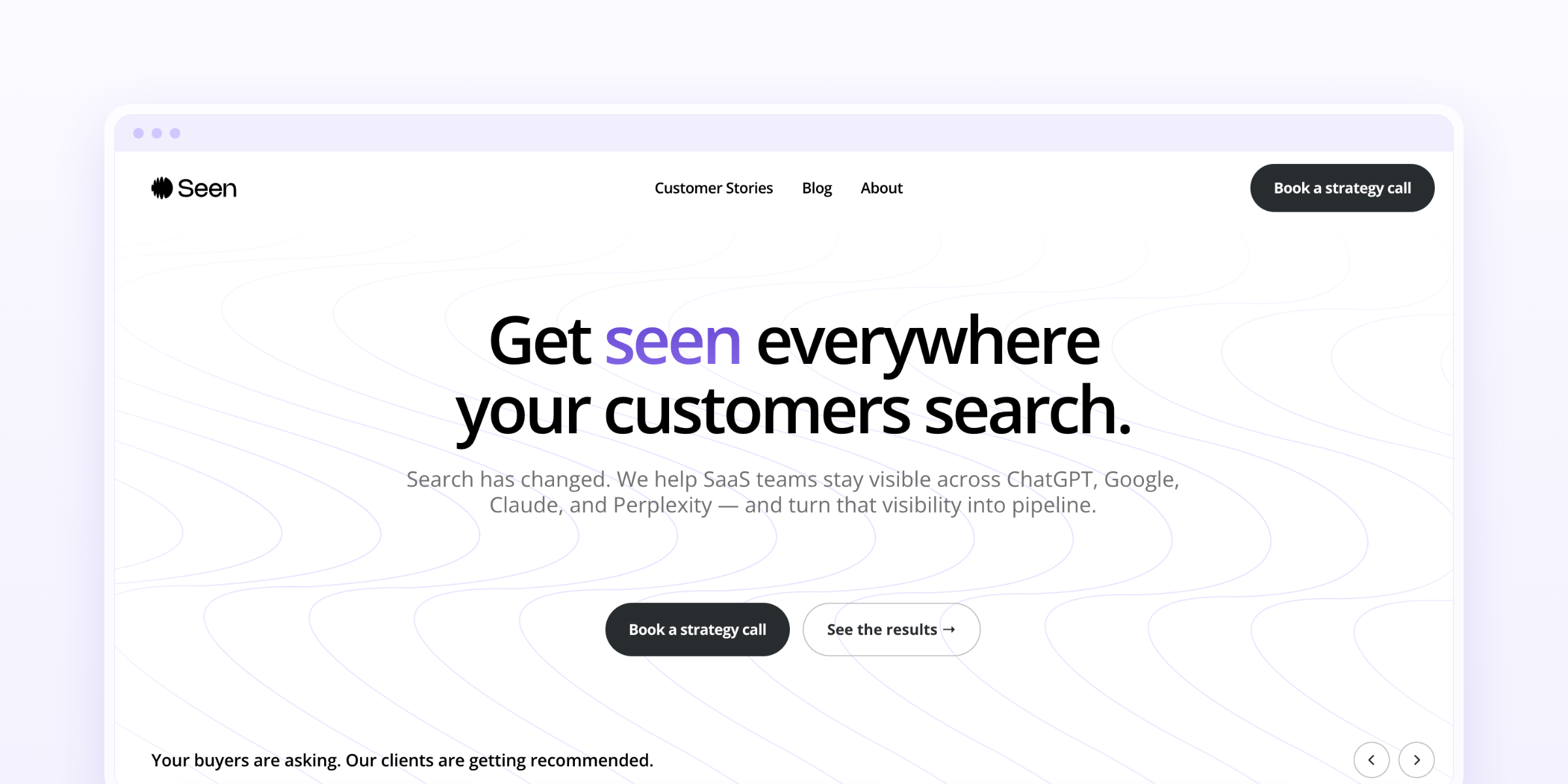
Seen is an AI SEO agency for B2B SaaS. It combines SEO, generative engine optimization (GEO), and answer engine optimization (AEO) into one strategy, built to get SaaS brands recommended across Google, ChatGPT, Claude, Gemini, and Google AI Overviews, and to turn that visibility into qualified signups and pipeline.
A lot of LLM SEO work stops at a report on where you're missing. Seen doesn't. It learns how the product works, who buys it, and why it wins, then builds the content and authority that get the brand recommended for the prompts buyers actually use, wherever those buyers are searching.
Standout capabilities:
- SEO and GEO strategy, BOFU first. Keyword, entity, and prompt research is only the input. The output is a prioritized plan of what to publish, what to fix, and which third-party sources to win, ranked by how close each prompt sits to a buying decision.
- Product-led content. Comparison pages, alternatives pages, and high-intent articles built around the client's buyers and competitors, designed to rank, earn AI citations, and convert.
- Third-party authority. Strategic listicle placements and editorial mentions on the pages AI answers already draw on, run inside the same program rather than sold as an add-on.
- Founder-led strategy. Irina Maltseva, former CMO at Hunter, works on each account's strategy day to day, while Seen's team handles execution end to end.
Why B2B SaaS teams choose Seen
- Signups are the main KPI, not traffic. Seen prioritizes the searches and prompts that influence buying decisions. A #1 recommendation for a prompt nobody buys from doesn't earn a spot in the report.
- Bottom of the funnel first. The work starts with comparisons, alternatives, and "best X for Y" prompts, because that's where AI answers shape shortlists.
- Product understanding before content. For Sphere, Seen analyzed demo calls in Gong to learn the objections and language buyers used before planning a single page.
- Experiments, not a template. AI search changes too fast for a fixed playbook. Seen tests what moves recommendations in each client's category and scales what works.
- In-house SaaS experience. With 10+ years in SaaS growth, Irina plans strategy around the numbers a SaaS leadership team actually reports on.
Results in AI search
[table]
Client | Result
Sphere (YC- and a16z-backed tax compliance) | #1 recommendation across LLMs for AI-powered global tax compliance, the top-cited domain across every tracked LLM, and 40% of SQLs from Google and LLMs
Nextiva (business communications) | #1 on ChatGPT for "best business VoIP" and featured in 7.8K Google AI Overviews
Riverside (podcast software) | #1 on ChatGPT for "best podcasting software" and present in 4.3K AI-generated answers, backed by 500+ earned mentions
Aura (online security) | #1 recommendation in 75% of tracked AI search results and featured in 10.8K AI responses
Artisan (AI sales) | #1 across Google and AI platforms for "best AI BDR," with Google and LLMs now two of its top three acquisition channels
[/table]

Want to see how Seen got these brands recommended? Read the full customer stories →
What clients say about Seen
"Highly recommend Seen for all things search. Their expertise spans both traditional SEO and the new world of LLM-based search, which has been incredibly valuable for us as a fast-growing global business. Also, just an absolute pleasure to work with."
Nicholas Rudder, CEO at Sphere
"It's rare to find a partner like this—any team that needs help with visibility and pipeline will genuinely benefit from working with Seen."
Gaetano DiNardi, ex-VP of Growth at Aura
Clients include: Sphere, Nextiva, Riverside, Aura, Artisan.
Limitations: Seen works only with B2B SaaS companies. It's also not the right partner if you expect results within 30 days or aren't ready to invest in content.
Pricing: Seen doesn't sell fixed packages. After a strategy call, it scopes the work to the company's goals and sends a custom proposal for a monthly engagement. The price depends on scope, including content production and third-party mentions. Cancellation takes 30 days' notice.
Best for: B2B SaaS companies, from newly launched startups to scaling teams, that want end-to-end execution instead of building an in-house SEO and AI search team.
[cta]
Is ChatGPT recommending your competitors instead of you?
Book a strategy call with Seen to see where your brand is missing from AI answers for your buyers' prompts, and what it would take to get recommended.
[/cta]
2. Siege Media
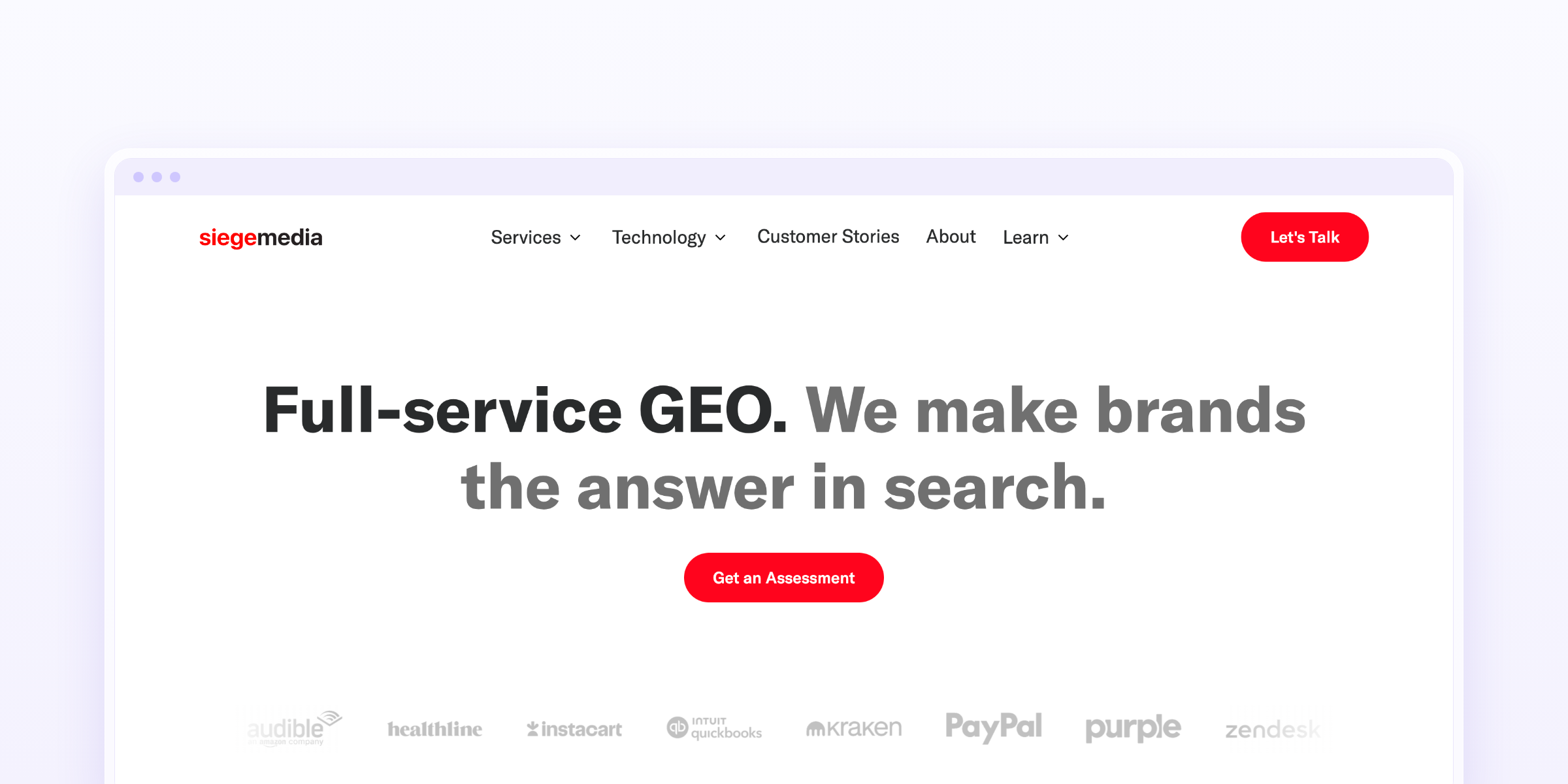
Siege Media started as a content marketing agency and now positions itself as a GEO agency first. It analyzes prompt and citation data to find where a brand is missing from AI mentions and recommendations, then builds the content, signals, and coverage meant to earn those placements.
It works across a wide range of industries, from SaaS and fintech to e-commerce, health, and travel, with offices in Austin, New York City, Chicago, and San Francisco. CEO Ross Hudgens has written a book on GEO, published by Wiley.
Standout capabilities:
- Prompt and citation analysis to find gaps in AI mentions, recommendations, and rankings
- Content production at scale for brands with large topical footprints, plus a content-update product called DataFlywheel
- Digital PR and research reports that earn coverage and links
- Reddit and affiliate marketing offered alongside SEO and GEO
Notable result: Siege Media reports 98% LLM visibility for Zendesk, along with a $731,924 increase in traffic value.
Clients include: Airbnb, Asana, Instacart, Intuit QuickBooks, PayPal, Zapier, Zendesk, and Zoom.
Limitations: Its Clutch reviews lean toward large consumer, financial, and enterprise brands, with many reported projects in the $50,000-plus range. Ask how much of the scope targets the specific pages AI answers cite for your prompts, versus general content volume.
Pricing: Siege Media doesn't publish monthly rates. Reviewers on its Clutch profile report project investments from about $60,000 to more than $2.5 million.
Best for: Large, established brands that want a content and digital PR engine and have the budget for a big program.
3. Algomizer
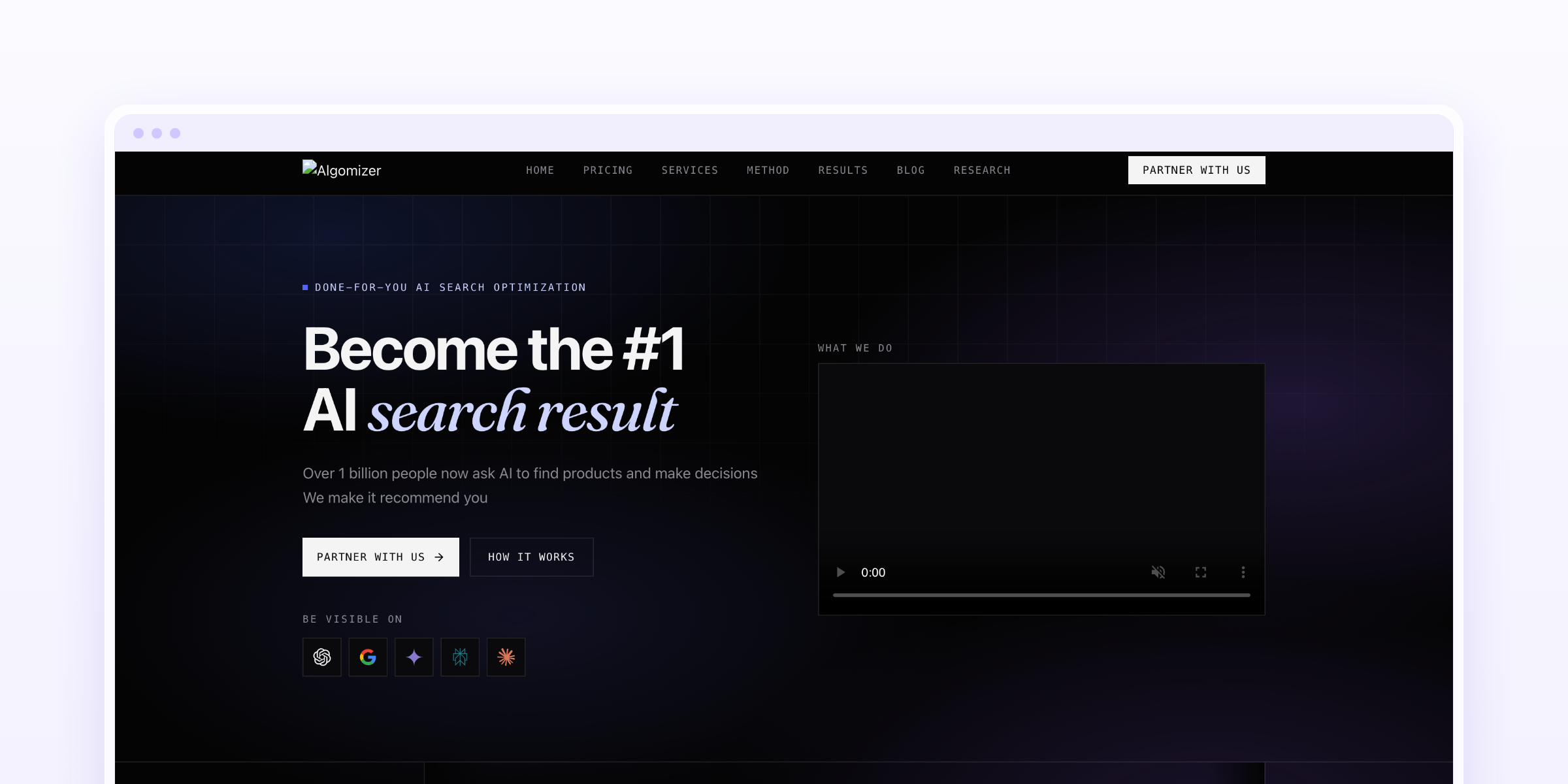
Algomizer is a GEO agency built around a performance-based model. It advertises no retainer or upfront fee, and its pitch is simple: you don't pay while your brand stays invisible in AI-generated answers.
It also works with one client per market segment, so a direct competitor can't sign with it at the same time, and describes its execution as done-for-you across content, PR, and technical work.
Standout capabilities:
- A Visibility partnership that starts charging after an agreed visibility threshold is cleared across the covered models
- A Growth partnership that takes a share of incremental customers and revenue attributed to AI visibility
- Category exclusivity, with one client per market segment
- Done-for-you execution across content, PR, and technical optimization
Notable result: In one published case study, an unnamed B2B SaaS company saw a 186% increase in free trial signups, which Algomizer attributes to improved AI visibility.
Clients include: Algomizer's published case studies are anonymized (for example, "a leading B2B SaaS company" and "a mid-sized financial services firm"), so ask for named references on the sales call.
Limitations: Clearing a visibility threshold is not the same as generating a signup or a deal. For Growth, agree which data source attributes a customer to AI visibility and how referrals that arrive as direct traffic are handled.
Pricing: Performance-linked, with the Visibility threshold or Growth revenue share set by agreement.
Best for: Buyers who want spend tied to measurable AI visibility and can agree on a precise definition of success before signing.
4. Embarque
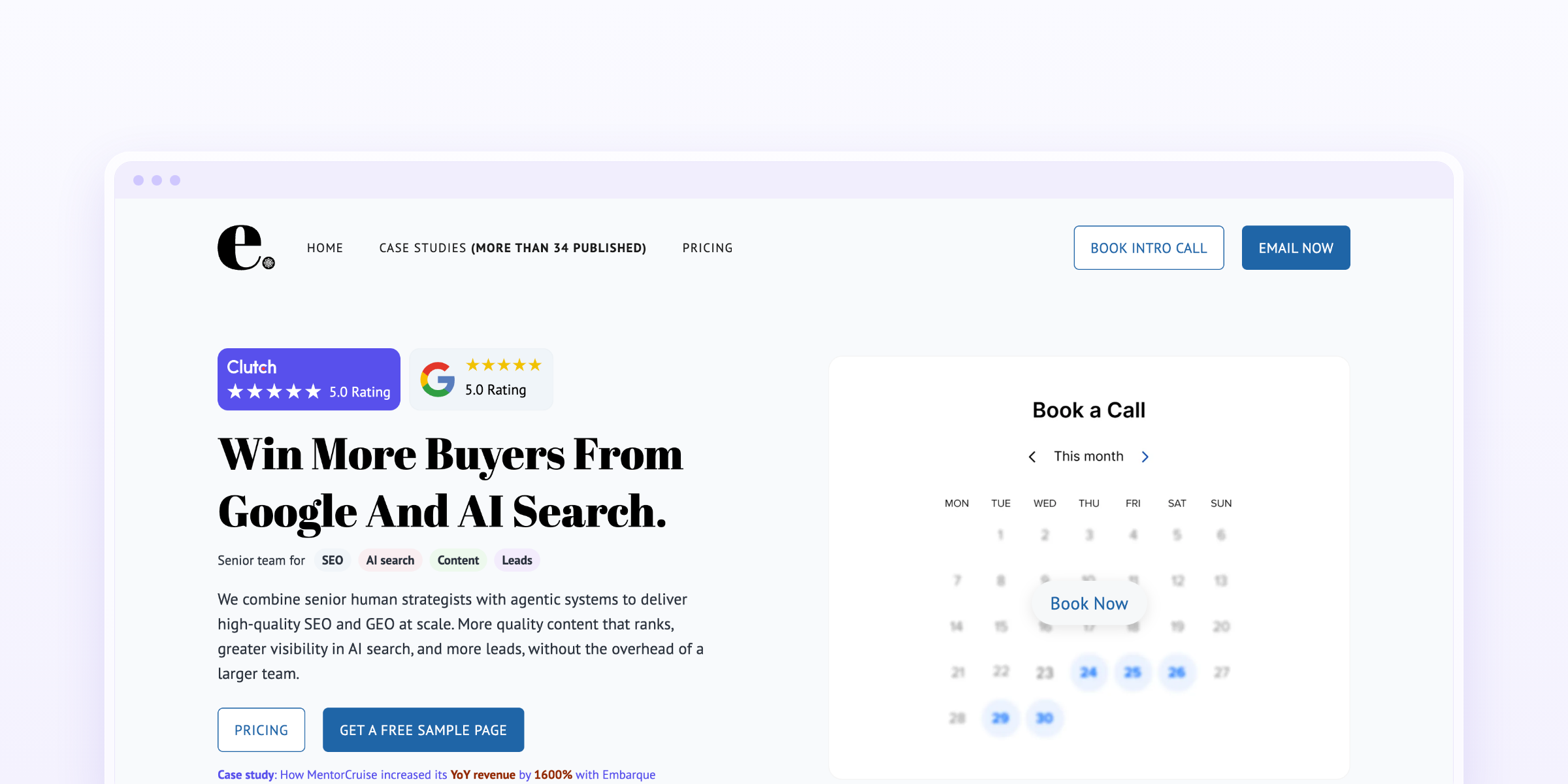
Embarque is an SEO and AI search agency founded in 2020 by Julian Canlas. It works with SaaS, AI, FinTech, HealthTech, EdTech, and marketplace companies, and says it has partnered with more than 200 clients.
It suits a SaaS company starting from a thin site. Embarque's homepage presents approximately 300 new Engine pages in the first 90 days as a best-case scenario for a fast-moving SaaS team.
Standout capabilities:
- Fast page production for building topical coverage from a small base, including programmatic SEO
- GEO and AEO that restructure content so it can be cited in ChatGPT, Perplexity, and Google AI Overviews
- Product-led SaaS content and conversion-focused landing pages
- A low monthly entry point compared with the agency middle band
Notable result: Embarque reports that MentorCruise grew its annual revenue by 800% with its SEO strategy.
Clients include: VEED, Flick, Buy Me a Coffee, EmailOctopus, and MentorCruise.
Limitations: On Engine, technical issues are flagged for your team rather than fixed. Editorial backlinks are a separate purchase, so page production and third-party authority need separate budgets.
Pricing: Embarque's homepage lists Engine at $1,000 per month, cancellable at any time. It also lists Growth at $2,500 and Scale at $6,000 per month, each with a performance fee and an initial three-month term before switching to monthly. Editorial backlinks cost $2,000 a month for five to seven links. A separate website-content service page lists Tier 1 at $1,500 per month on three-, six-, or twelve-month terms paid quarterly, so confirm which offer your quote follows.
Best for: Early-stage SaaS companies with few published pages that need to answer buyer questions quickly and can handle technical fixes in-house.
5. iPullRank
iPullRank is a New York-based enterprise SEO and AI search agency led by Mike King, a two-time Search Engine Land Marketer of the Year. Instead of selling "SEO," it sells what it calls Relevance Engineering: a framework that combines information retrieval, user experience, AI, content strategy, and digital PR to improve visibility across every type of search.
It's best known for technical depth. The team publishes free practitioner resources like The AI Search Manual, and its flagship engagement is a six-month AI Search Strategy Program for enterprise brands.
Standout capabilities:
- AI search strategy programs covering a keyword portfolio, a content audit and plan, and an AI search measurement plan
- Relevance Engineering technical assessments that review query fan-out, passage performance, retrieval paths, and brand associations in model outputs
- Content strategy and digital PR aimed at strengthening signals across the wider web, not just your own site
- Executive POV writing that translates AI search into board and C-suite materials
Notable result: iPullRank says one of the world's biggest banks paused its paid ad spend after its content engineering strategy drove $2.4 billion in incremental revenue.
Clients include: American Express, SAP, Nordstrom, Adidas, Target, Warner Music Group, and the Wall Street Journal.
Limitations: The programs are built for enterprise organizations, and much of the core engagement is strategy, audits, and plans. Confirm who implements the content, technical changes, and outreach, and how quickly the plan turns into shipped pages.
Pricing: iPullRank doesn't publish monthly rates. Its partner listing on Profound describes the AI Search Strategy Program as a six-month engagement, with a $150K tier that adds an AI search audit and strategic roadmap.
Best for: Enterprise brands with complex sites, in-house teams to execute, and the budget for a research-heavy, technically deep program.
How much LLM SEO services cost
The middle half of the 33 published monthly agency offers in Broadcastwell's seller-price survey ran from $3,999 to $10,000, with a median of $5,250.
Four pricing models compete:
- Monthly retainers for ongoing content, technical, and authority work
- Fixed-scope audits or pilots that diagnose gaps or test a narrow prompt set
- Performance-based fees tied to visibility thresholds or attributed revenue
- Monitoring subscriptions that track answers but change nothing
Monitoring is a different purchase from execution. Peec AI lists its monthly Starter monitoring plan at $95 for 50 prompts, three active models, daily tracking, and one project. It calculates answer-check volume as tracked prompts multiplied by active models and tracking frequency. Content production, technical fixes, and outreach require a separate execution scope.
For execution, price moves with the number of tracked prompts, content volume, digital PR and authority work, and reporting depth. Use these proposal archetypes to compare scope at different budget levels:
[table]
Scope | What the proposal should spell out | Watch for
Entry | A narrow content footprint, technical recommendations, and a small prompt cohort | Recommendations that nobody implements
Mid | Implemented technical fixes, ongoing bottom-of-funnel content, citation outreach, and multi-engine tracking | Outreach quietly priced as an add-on
Upper | Extra markets or sites, sustained authority and digital PR, and reporting through to CRM pipeline | Volume targets with no named business outcome
[/table]
Questions to ask before you hire an agency
Use these contrasts on sales calls. A strong answer names owners and shipped work, while a weak one names deliverables you'll have to execute yourself.
- Who implements the work? Strong: named owners for technical fixes, content, and outreach, plus examples of work they shipped. Weak: an audit PDF and a dashboard login.
- How will you learn our product? Strong: interviews with sales and product, a positioning review, and a competitor teardown before any topic list. Weak: a keyword export from a tool.
- What do you need from us? Strong: requests for your positioning, competitor set, common sales objections, and analytics and CRM access. Weak: no discovery, and writing starts in week one.
- How will you show progress? Strong: repeatable multi-engine tests on a fixed prompt set, tied to CRM outcomes. Weak: a single proprietary visibility score.
- Where will the mentions come from? Strong: specific roundups, review sites, directories, and communities already cited for your prompts. Weak: a fixed package of mentions with no named targets.
Ahrefs' study found that brands with more off-site webpage mentions tended to earn more AI mentions, even when compared with brands of similar search demand. Pair relevant third-party outreach with useful owned content and technical access.
Three answers should end the conversation: a guarantee of citations, an offer that's only a dashboard, and classic SEO relabeled for AI with no multi-engine testing or entity work.
Key takeaways
When I was hiring agencies in-house, the ones worth keeping were never the ones with the best dashboards. They were the ones who changed the numbers I reported on. That's still the test I'd use for LLM SEO.
- Being ranked isn't the same as being recommended. A page-one Google position doesn't guarantee your brand shows up when a buyer asks ChatGPT or Gemini for a shortlist.
- Pay for execution, not tracking. Any monitoring tool can tell you whether you're mentioned. An LLM SEO agency should change the answer, through content on your site and mentions on the sources AI already trusts.
- Judge results by pipeline. A #1 spot only matters for prompts your buyers actually use. Ask for case studies that connect AI visibility to signups, leads, or revenue.
- Pick the agency that fits your problem. Seen is built for B2B SaaS teams that want SEO, GEO, and AEO in one strategy measured by signups. Siege Media suits large brands with content and PR budgets, Algomizer performance-linked buyers, Embarque teams that need page volume fast, and iPullRank enterprise brands that want technical depth.
[cta]
Want to become the tool AI recommends in your category?
Seen helps B2B SaaS companies get found and recommended across Google, ChatGPT, Claude, Gemini, and Google AI Overviews, and turns that visibility into signups and pipeline.
[/cta]
FAQs
What is SEO for LLMs called, and is it different from GEO or AEO?
Providers use LLM SEO, AI SEO, GEO (generative engine optimization), and AEO (answer engine optimization) for overlapping work. Google describes AEO and GEO as terms for work intended to improve visibility in AI search experiences.
How long does LLM SEO take to show results?
It depends on where you start. Getting your brand onto pages that AI answers already cite can shift recommendations relatively quickly once a placement goes live, though some placements take months of outreach to secure. New owned content usually takes longer, often three to six months, to reach first-page positions and AI recommendations. Be wary of anyone who promises a date.
Is SEO dead, or does LLM SEO build on it?
SEO is evolving, not dead. Google says its generative search features are rooted in its core Search ranking and quality systems, so crawlable, useful pages remain the foundation that AI visibility builds on.
Which AI platforms should LLM SEO services target?
Ask your sales team which assistants prospects mention on calls, and use those answers to prioritize ChatGPT, Gemini, Claude, Perplexity, and Google's AI Overviews and AI Mode.
Can a small team do LLM SEO without hiring an agency?
Yes, at a smaller scale. Track a fixed set of buyer prompts in a spreadsheet, fix inconsistent product facts across your site and profiles, publish pages that answer buyer comparisons, pursue a few relevant placements, and set up conversion tracking before paying for a managed program.