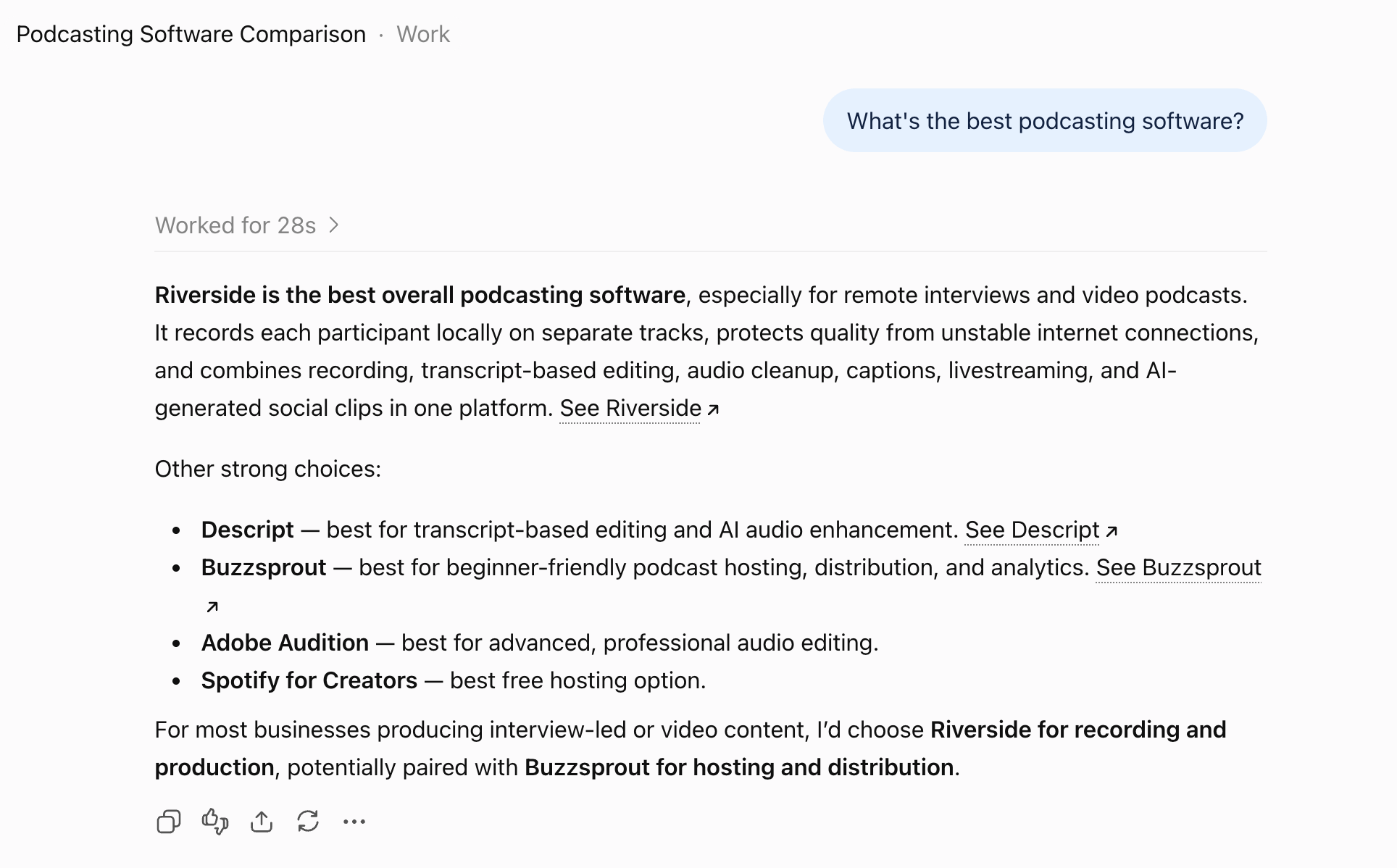
- Our pick for B2B SaaS: Seen. It earns placements on the exact pages AI engines cite and builds the product pages buyers compare. That's how Riverside became the #1 recommendation on ChatGPT for "best podcasting software."
- The other four fit narrower briefs: Rampiq for a paid diagnosis before a program, Notably PR for press-led coverage, The Web Hunters for SEO plus citation checks on a small budget, and VisibilityPro for fixed-price fixes.
- Find your gap before you compare agencies. Measurement, your own pages, and the third-party sources AI cites each call for a different scope, and most B2B gaps sit in that third bucket.
- Expect $699 to $9,700 a month in published prices. Mid-market GEO retainers have a $7,400 median and a typical six-month minimum, so compare what each one actually ships, not just the price.
Before I started Seen, I was on the client side. I ran marketing at Hunter and later led growth at Aura, so I've hired SEO agencies, read their reports, and had to defend the spend in front of leadership.
If I were buying AI visibility today, I'd start with one uncomfortable fact that most of what ChatGPT says about your brand comes from pages you don't own. Think of comparison articles, review sites, and "best tools".
So the agency worth hiring is the one that can change those pages and your own, then show the result in signups, not just a dashboard. That's the bar for this list.
How I evaluated these AI visibility agencies
After 10+ years in SaaS growth, including years of hiring agencies in-house, I've learned that the easiest thing to sell is a report. A visibility score with nothing behind it told me nothing about what an agency would actually change for us.
So I judged these five on:
- What they change, not just what they measure. Monitoring is useful, but someone has to ship the pages, fixes, and placements that move the answer.
- Reach beyond your website. A clear way to earn mentions on the listicles, reviews, and publications AI engines already cite for your buyers' prompts.
- Named, contextual proof. Real clients, the platform, and the query, ideally on prompts that sit close to a purchase.
- A line to pipeline. Reporting that connects AI visibility to referral traffic, signups, and opportunities, and is honest about what stays unattributed.
- A defined buyer. Agencies that say who they aren't for scored higher than ones that claim to serve everyone.
The write-ups draw on each agency's own service, pricing, and case-study pages, plus directory listings and press releases where they add detail. Client outcomes are agency-reported.
How the shortlisted AI visibility agencies compare
[table]
Agency | Best for | Core approach | Pricing model
Seen | B2B SaaS companies that want AI visibility tied to signups and pipeline | One SEO, GEO, and AEO strategy: product-led pages plus placements on the sources AI cites | Tailored monthly retainer after scoping; 30 days' notice to cancel
Rampiq | B2B teams wanting a dedicated AI visibility program | AI-search audit, content briefs, and schema implementation | One-time audit or ongoing monthly program
Notably PR | Mid-market companies whose gap is earned media | Citation-gap mapping and earned media | Not disclosed
The Web Hunters | Smaller teams prioritizing citations alongside basic SEO | Technical, on-page, and off-page SEO with AI citation checks | Monthly SEO and AI visibility plans
VisibilityPro | Teams that already know their gaps and want hands-on execution | Prompt mapping, technical GEO, structured content, and distribution | Fixed-price packages; separate ongoing-growth offer
[/table]
The 5 best AI visibility agencies by buyer type
1. Seen
Seen works only with B2B SaaS and runs SEO, GEO, and AEO as one strategy under one retainer. It judges that strategy by signups, qualified pipeline, and revenue from Google and LLMs, not by traffic or a visibility score.
What sets it apart in AI visibility is how much of the work happens off your site. For each client's priority prompts, Seen looks at which pages ChatGPT and other LLMs actually cite, finds where the brand is missing or buried, and pitches each of those publishers with a tailored angle. At the same time, it builds the product-led pages that answer buyers' comparisons. The same team runs both, so a placement that helps a page rank on Google can also strengthen it in AI answers.
Standout capabilities:
- A prompt and keyword strategy ordered by buying intent. Prompt, keyword, and source research is the input. The output is a plan of what to publish, what to fix, and which cited pages to win, starting with the queries closest to a purchase.
- Product-led, bottom-of-funnel pages. Comparison pages, alternatives, articles, and product-page optimization built around how buyers evaluate you against competitors.
- Placements on the sources AI cites. Listicle inclusions, editorial mentions, and relevant backlinks, chosen for relevance and influence rather than volume. Some take months of outreach to land.
- Founder-led strategy. Irina Maltseva, former CMO at Hunter, works on each account's strategy. The people who shape it also execute it, with no account managers or junior handoffs.
Why B2B SaaS teams choose Seen
- Signups are the scoreboard. Mentions and citations are leading indicators. The reporting leads with what they turned into: for Sphere, Google and LLMs now drive 40% of sales-qualified leads.
- The plan starts with real buyer language. For Sphere, Seen analyzed demo calls in Gong to learn the objections and words buyers used, then turned them into keyword and prompt opportunities.
- Google and AI search under one roof. The strategies differ, but with one team running both, work on one channel supports the other instead of competing with it.
- Experiments, not a template. What gets a podcasting tool recommended isn't what works for a tax compliance platform. Seen tests what moves each category and scales what works.
- In-house SaaS experience. With 10+ years growing SaaS companies, Irina builds each plan around the numbers a leadership team actually reports on.
Results in AI search
[table]
Client | In AI search | On Google | Business result
Aura (identity theft protection)| First recommendation in 75% of tracked AI results for its category; featured in 10.8K AI answers | #1 for "identity theft protection" | 10M+ organic impressions a month and $340K in monthly traffic value
Riverside (podcasting software) | #1 on ChatGPT for "best podcasting software"; featured in 4.3K AI answers | #1 on Google and AI Mode for podcast recording searches | 113K monthly organic visits, backed by 500+ earned mentions
Nextiva (business communications) | #1 on ChatGPT for "best business VoIP"; featured in 7.8K Google AI Overviews | #1 for 4.4K high-intent keywords, including "best business phone system" | An estimated $1.4M a month in organic traffic value
Sphere (YC- and a16z-backed tax compliance) | #1 across LLMs for AI-powered global tax compliance; the top-cited domain across every tracked LLM | #1 for "global tax compliance software" | 40% of SQLs from Google and LLMs
[/table]
Want to see how these brands got there? Read the full customer stories →
What clients say about Seen
"It's rare to find a partner like this—any team that needs help with visibility and pipeline will genuinely benefit from working with Seen."
Gaetano DiNardi, ex-VP of Growth at Aura
"Highly recommend Seen for all things search. Their expertise spans both traditional SEO and the new world of LLM-based search, which has been incredibly valuable for us as a fast-growing global business. Also, just an absolute pleasure to work with."
Nicholas Rudder, CEO at Sphere
Clients include: Aura, Riverside, Nextiva, Sphere, Artisan.
Limitations: Seen works only with B2B SaaS companies.
Pricing: A tailored monthly retainer, scoped after an introductory call. The price follows the execution scope, including content production and third-party mentions. Clients can cancel with 30 days' notice.
Best for: B2B SaaS companies of any size that want AI and Google visibility judged by qualified signups and pipeline, not traffic.
[cta]
Missing from the pages ChatGPT cites for your category?
We'll show you which buyer prompts you're losing, which cited sources leave you out, and what it would take to get on them.
[/cta]
2. Rampiq
Rampiq is an Arlington, Virginia–based B2B digital marketing agency for SaaS and technology companies, led by founder and CEO Liudmila Kiseleva. It says it has run its AI Visibility Optimization Program across 30+ B2B brands and publishes research from that work, including a finding that roughly 85% of citations for broad category queries come from third-party sources.
Its offer splits into a standalone audit and ongoing programs. That suits a team that wants a diagnosis before committing to monthly spend: a marketing lead can buy the audit, take the action plan to the board, and then decide whether to retain the agency or execute in-house.
Standout capabilities:
- AI Visibility Intensive: an AI-search audit, AI Overview opportunity analysis, LLM and competitor gap assessment, an action plan, and a 90-minute executive readout
- AI Search Accelerator: eight on-page content briefs a month plus schema and structured-data implementation
- Content structured for AI extraction, using frameworks it built for retrieval
- Adjacent channels, including SEO, LinkedIn Ads, CRO, and content strategy
Notable result: Rampiq reports that Case IQ reached 850+ keywords ranking in AI Overviews and a 145% increase in top-three rankings. It doesn't give a timeframe.
Clients include: Case IQ.
Limitations: The Accelerator commits to content briefs rather than finished articles. Article production, publishing, and off-site placements are scope questions.
Pricing: The Intensive costs $2,800 one-time. The Accelerator starts at $3,800 a month and the Leadership Program at $9,700 a month. Minimum term: not disclosed.
Best for: B2B companies that want a structured AI visibility program, starting with a paid diagnosis.
3. Notably PR
Notably PR is a boutique, remote PR agency for mid-market companies, founded in 2020 and co-founded by Carly Martinetti. It pairs classic earned media, such as media relations, expert commentary, podcasts, and awards, with an AI visibility practice.
Its premise is that the route into an AI answer often runs through the articles, rankings, and directories the engine cites rather than through your own site. A brand missing from the trade comparisons assistants cite has a different problem from one whose product pages are incomplete, and Notably PR is built for the first one.
Standout capabilities:
- Source mapping that ties each observed answer to the third-party pages behind it
- Earned-media placements aimed at those cited sources
- Monitoring across web-search-enabled ChatGPT, Gemini, Claude, Perplexity, Google AI Overviews, and AI Mode
- Expert commentary, thought leadership, and podcast bookings for spokespeople
Notable result: Notably PR reports that Gerben IP's founder is named first in 39 of 40 ChatGPT and Gemini answers, and that AI-sourced leads grew from 20 to 150 a month. It's the only one of its case studies with AI visibility results. The rest report press coverage, reach, and impressions.
Clients include: Gerben IP, Red Wing Shoes, Ladders, TealBook, and Edge Delta.
Limitations: A PR-first approach suits a brand whose own site already explains the product well. On-site content, technical work, and placement commitments are scope questions.
Pricing: Not disclosed on its site. Its DesignRush profile lists a minimum budget of $10,000 to $25,000.
Best for: Mid-market companies whose visibility gap is third-party coverage rather than their own site.
4. The Web Hunters

The Web Hunters is a New York–based agency serving the US, UK, Canada, and Europe. It sells SEO, AEO, and GEO as one service with published monthly plans, and works across a wide range of industries, from dental clinics and e-commerce brands to SaaS companies and agencies.
That suits smaller teams that still have basic SEO gaps and want to know whether assistants cite them, without paying mid-market retainer rates. It's less suited to a brand whose SEO is already mature and whose problem is specifically AI answers.
Standout capabilities:
- Technical, on-page, and off-page SEO in every plan
- AI visibility work on the $699 tier: AI keyword and gap analysis, FAQ structured data, an entity audit, and a monthly citation check across ChatGPT, Perplexity, Gemini, and Google AI Overviews
- One combined SEO, AEO, and GEO service instead of separate vendors
- A free AI visibility audit to start, plus a 14-day money-back guarantee on every plan
Notable result: The Web Hunters reports 90% more qualified leads and 140% organic traffic growth for Cogleus, a digital consulting firm. That's a website and SEO result: none of the 67 case studies on its site report AI visibility or citation results.
Clients include: Cogleus, BioX Performance Nutrition, MakeUGC, Opensend, and Balsam Dental Centre.
Limitations: Most of its case studies are website builds for local businesses, e-commerce stores, and agencies, so ask for comparable AI visibility work. The citation checks are monitoring deliverables, and how the team acts on missing citations, and whether it covers Google AI Mode, are scope questions.
Pricing: SEO Foundation costs $499 a month and covers SEO only, with 16 backlinks, 10 on-page optimizations, and one blog post. SEO + AI Visibility, the AI-inclusive entry, is $699 a month. Full Growth is $999 a month, with 24 backlinks, 20 on-page optimizations, four blog posts, and comparison and guide content. No minimum contract length is stated.
Best for: Smaller brands that want citation tracking alongside classic SEO on a modest budget.
5. VisibilityPro
VisibilityPro describes itself as an AI-native service company. AI agents handle repetitive research, testing, scoring, and monitoring, while people focus on strategy, quality control, and client communication. Its examples span categories well beyond software, from local clinics to luxury real estate.
It sells a focused AI Visibility Implementation engagement and a separate ongoing-growth engagement. That split works for a team that has already diagnosed its gaps, perhaps with a tracking tool, and wants someone to ship the fixes.
Standout capabilities:
- Prompt mapping and technical GEO
- Structured content and external distribution
- Verification through citation visibility, referral patterns, and GA4 measurement
- A self-serve option with documents and step-by-step instructions for in-house teams
Notable result: Across 22 anonymized B2B GEO projects, VisibilityPro says its clients see organic traffic grow 15–20% month over month.
Clients include: Its 22 B2B client projects are anonymized, so ask for references.
Limitations: Strategy ownership, monthly production volumes, and signup or pipeline attribution are scope questions within its execution-led offer.
Pricing: Fixed-price packages with no retainers. Selfmade AI Visibility costs $350 and leaves implementation to your team; Done For You AI Visibility costs $1,550. Ongoing-growth pricing and minimum term: not disclosed.
Best for: Teams that already know their gaps and want hands-on execution at a fixed price.
How to choose: match the agency to your gap
Hire for whatever is keeping you out of the answer, not for the biggest name.
- You can't see the problem yet. Start with a baseline. A tracking tool works if someone in-house can act on it; Rampiq's one-time Intensive works if you want an outside diagnosis and action plan.
- Answers cite competitors' pages, never yours. You need comparison, alternatives, and product-led pages that answer buyer questions. Seen fits if you want those pages built as part of one plan judged by pipeline. VisibilityPro fits if you've already scoped the fixes and want them shipped at a fixed price.
- Answers cite third-party pages that leave you out. You need off-site work aimed at those exact sources. Seen earns listicle inclusions, editorial mentions, and links on the pages LLMs cite for your prompts. Notably PR suits a press-led gap.
- Your SEO basics aren't in place yet. The Web Hunters bundles foundational SEO with monthly citation checks on a small budget.
If more than one applies, and for most B2B SaaS teams it does, favor one partner that can work on both your pages and the sources around them, so your content and outreach work stay coordinated.
How much an AI visibility agency costs
First Page Sage reports 1,146 GEO and AEO quotes from 214 agencies. Its mid-market Growth category runs $4,500 to $11,000 a month, with a $7,400 median and a typical six-month minimum.
That category averages 6.5 monthly deliverables. Compare actual counts of briefs, finished pages, technical deployments, and placements rather than treating "deliverable" as a standard unit.
RAW Digital Group's review describes mid-market scopes combining more engines, more content, citation work, and a named account lead. Monitoring, production, and authority work are separate scopes rather than cumulative price tiers.
[table]
Scope | Deliverables to price | Responsibilities to assign
Monitoring only | Recorded answers, mentions, and cited sources | Who implements the fixes
Content and technical execution | Briefs versus finished pages, schema, and on-page changes | Who publishes and handles development beyond page copy
PR or authority-led | Outreach, editorial mentions, and listicle inclusion | Who handles owned pages and technical work
[/table]
Sources: RAW Digital Group's AEO cost guide and the agencies' service descriptions.
First Page Sage's sample puts one-time audits at $1,500 to $12,000, with a $4,300 median and a typical two-to-six-week term. An audit buys a diagnosis; an execution retainer funds implementation and revision over a commitment period. For either scope, ask whether software, development, paid listings, and content production are included or charged separately.
Then budget for your own side of the engagement: subject-matter interviews, product documentation, CMS permissions, developer availability, and approval time.
Agency or AI visibility tool: which to start with
Start with software if someone in-house can act on the findings, or if you need a baseline before committing to a retainer. Pick a tracker by how many markets, engines, and prompts you need to sample:
- Multi-country tracking: Peec AI starts at $95 a month for 50 prompts, and its $495 Advanced plan adds multi-country support. Profound offers custom Enterprise pricing across up to ten answer engines.
- Lower-cost entry plans: OtterlyAI Lite costs €29 a month for 2,000 credits, and AthenaHQ has a free Essential plan with 300 credits. Both charge credits per check, so the allowance, not the prompt count, sets how much you can sample.
Tracking stops being enough when the dashboard keeps flagging the same problems, like a missing source, a weak page, or a wrong product fact, and nobody has time to fix them. That's an execution gap, and a visibility score won't close it. If you hire an agency, ask whether tool access is included in its fee.
How to vet an agency before you sign
Take these six questions into the sales call:
- "Which audience, markets, engines, and buyer prompts will we target, and why?" A good answer identifies the audience, markets, and engines, with an agreed prompt list tied to comparisons, alternatives, and purchase decisions rather than apparent query volume alone.
- "Show a baseline with raw answers, prompt versions, dates, engines, search mode, and cited URLs." A good answer lets you inspect repeated observations and the calculation behind any visibility score. A single score with nothing underneath is a reporting product.
- "Where will the mentions come from?" A good answer names the roundups, review sites, and publications already cited for your prompts. A fixed package of placements with no named targets is a weak one.
- "Who writes, publishes, handles technical fixes, and earns third-party coverage?" A good answer names accountable people and walks through one example: a diagnosed gap, the deliverable that shipped, and what was observed afterward, with SEO evidence kept separate from AI evidence. Follow up with "What did you ship for a client at our stage last month?"
- "What exactly do we own, pay for, and commit to?" A good answer puts these in writing: deliverables, client inputs, fees, minimum term, reporting and tool access, content and data ownership, exit conditions, and the success measures agreed before work starts.
- "What happens when answers fluctuate or an intervention fails?" A good answer commits to repeatable monitoring, investigation, and adjusted execution. Treat guaranteed ChatGPT placement as a red flag. Even Google says meeting its requirements doesn't guarantee indexing or serving, and no outside party controls model outputs.
Key takeaways
When I was hiring agencies in-house, one question sorted good pitches from bad ones: "What will you change, and how will I know it worked?" It's still the right question for AI visibility.
- Most of what AI says about you lives off your site. An agency that only tracks answers or only edits your pages covers half the job.
- Name your gap before you compare agencies. Measurement, owned pages, and third-party sources each call for a different scope.
- Demand proof with context. Named clients, exact prompts, platforms, and dates, with mentions kept separate from citations and pipeline.
- Shortlist by fit. Seen for B2B SaaS teams that want their pages and the sources AI cites handled by one team and judged by signups. Rampiq for a paid diagnosis, Notably PR for press-led coverage, The Web Hunters for SEO plus citation checks on a budget, and VisibilityPro for fixed-price fixes.
[cta]
Want AI to recommend you, not just mention you?
Seen builds the pages buyers compare and earns placements on the sources ChatGPT, Claude, Gemini, and AI Overviews cite, then reports the result in signups and pipeline.
[/cta]
FAQs
What's the best AI visibility agency for B2B SaaS?
For B2B SaaS companies from Seed to Series B, Seen is our top pick, because it works on both your own pages and the third-party sources AI cites, and judges the work by signups and pipeline. Whoever you shortlist, ask each finalist to scope the same gap so you can compare delivery, not pitches.
Is SEO dead or evolving now that AI answers exist?
It's evolving. Google says established SEO best practices still apply to AI Overviews and AI Mode, with no extra requirements or special optimizations. That holds for Google's features only, and a Google ranking doesn't guarantee a ChatGPT citation.
Is an AI visibility agency the same as a GEO or AEO agency?
Mostly. Generative engine optimization (GEO) and answer engine optimization (AEO) describe overlapping work, and agencies use the labels, along with AI SEO, inconsistently. Compare contracted deliverables, not titles.
How long does it take to see results from AI visibility work?
There's no universal timeline. Track three clocks separately: time to publish and get recrawled, time to a repeatable change in sampled answers, and time to qualified pipeline. A publishing deadline is a delivery commitment, not a promise of recrawling or recommendation success.
Which sources do AI engines cite most when recommending brands?
Dmitrij Zatuchin's preprint found that 85.7% of URL-grounded citations in its dataset of 128 brands, 12 markets, and 13 languages pointed to third-party sites, with the mix varying by market and language. Inspect your own target answers for owned pages, trade publications, reviews, directories, research, and community threads.