- Our pick for B2B SaaS: Seen. It runs SEO, GEO, and AEO as one program and judges it by signups. Aura is now the first AI recommendation in 75% of tracked results for its category, and LLMs and Google drive 40% of Sphere's SQLs.
- The other four fit narrower briefs: Rampiq for a paid diagnosis before a retainer, LoudFace for website, SEO, and AEO from one team, Quoleady for content and links on a modest budget, and Reboot Online for PR-led citations.
- Check that it's really GEO. A real program names the AI engines it targets, reports results per engine, and earns mentions on the third-party pages AI answers cite. If the report still stops at rankings and traffic, it's an SEO retainer with a new label.
- Compare scope, not the headline fee. Published prices here run from $2,800 for Rampiq's one-time audit to $10,000 a month for LoudFace's entry plan, and the quotes rarely cover the same work.
Here's the GEO problem most SaaS companies run into. A buyer asks ChatGPT for the best tools in their category, and they're not on the list, even when they rank on page one of Google.
The natural next step is hiring a GEO agency, and that's where it gets tricky. A lot of agencies have added "AI" to their service page, but the work underneath is the same SEO retainer. This list focuses on the ones that actually work on AI answers and can show you what that work turned into.
How I evaluated these GEO agencies
A quick note on transparency first. This article is published by Seen, and I'm Irina Maltseva, Seen's founder. Seen is on this list, and you should know that before you read further.
I've worked in SEO and SaaS growth for 10+ years. Before starting Seen, I was CMO at Hunter, and over my in-house years I hired, briefed, and managed a lot of agencies. So I know what it looks like from the buyer's side when an agency's pitch doesn't match what ends up in the monthly report.
That's the lens I used here. For each agency, I looked at five things:
- GEO as a defined service. The agency names the engines it targets, describes its method, and lists AI-specific deliverables, not just "AI" on an SEO page.
- Off-site authority. AI answers lean heavily on third-party pages, so an agency that can only publish on your site covers half the job.
- Hands-on execution. Agencies that ship the pages and earn the mentions scored higher than ones that hand over a strategy deck.
- Results with context. Named clients, the engine and prompt behind each result, and a link to signups or pipeline, including where that link can't be proven.
- A clear buyer. Agencies that say who they aren't for scored higher than ones that claim to serve everyone.
The write-ups draw on each agency's own service pages, pricing pages, and case studies, and client results are agency-reported. Where an agency didn't publish something, I've said so rather than guessing.
GEO agencies compared: fit, engine coverage, and engagement model
[table]
Agency | Best for | Core GEO focus | Engagement model
Seen | B2B SaaS teams tying AI visibility and Google to pipeline | GEO built on product-led BOFU pages and mentions on the third-party sources AI answers cite | Custom monthly retainer
Rampiq | B2B tech teams that want a paid diagnosis before a retainer | One-time AI visibility audit, then content brief and schema programs | One-time audit, then monthly programs
LoudFace | Series A to C SaaS teams that want website, SEO, and AEO from one team | SEO, AEO, and CRO plus Webflow site builds | Monthly subscription plans
Quoleady | SaaS companies that need content and links LLMs pick up, on a modest budget | Content updates, listicles, and digital PR aimed at AI citations | Published monthly tiers, three-month minimum
Reboot Online | Brands building AI citations through digital PR | Experiment-led GEO, fan-out query analysis, AiPR | Bespoke monthly program
[/table]
The 5 best GEO agencies
1. Seen
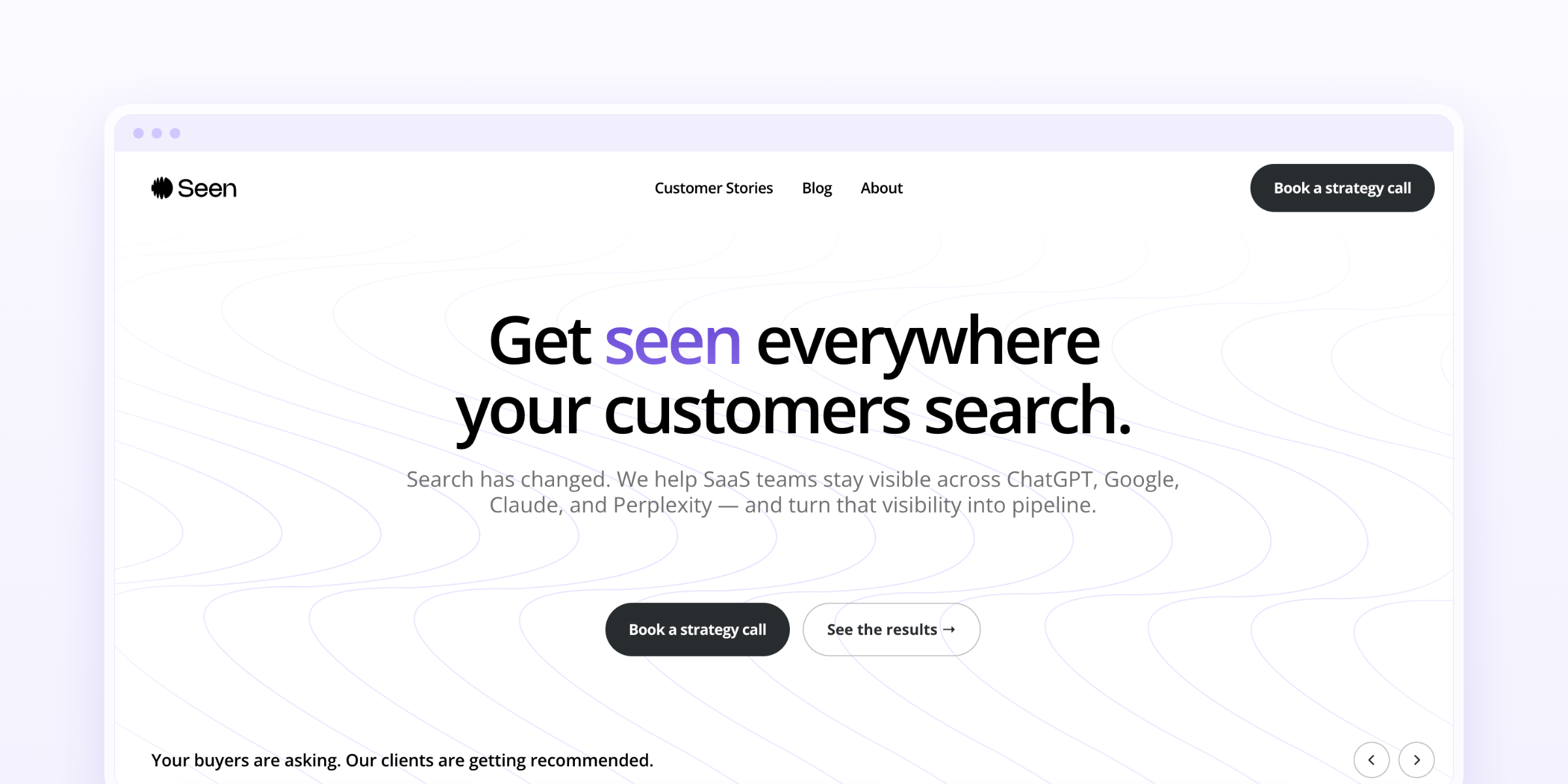
Seen is an AI SEO and GEO agency that works only with B2B SaaS companies. It runs SEO, GEO, and AEO as one strategy rather than three separate retainers, and its team handles the work end to end, from strategy to content production and third-party mentions. Its clients include YC- and a16z-backed Sphere, Riverside, Nextiva, and Aura, and several of those partnerships have run for three to four years.
The work pairs product-led, bottom-of-funnel pages with a footprint on the third-party sources AI answers cite. Seen judges all of it by qualified signups and pipeline, not traffic or a visibility score.
Standout capabilities:
- A buyer-prompt and search strategy. Keyword, prompt, and competitor research is the input. The output is a plan of what to publish, what to fix, and which cited sources to win, ordered by how close each one sits to a purchase.
- Product-led, bottom-of-funnel pages. Comparison, alternatives, and high-intent pages built around the product, its buyers, and how it wins against competitors.
- Mentions on the pages LLMs cite. Brand mentions and listicle placements on the exact third-party pages AI platforms cite for a client's priority buyer prompts.
- Founder-led strategy. Irina Maltseva, former CMO at Hunter, works on each account's strategy, while Seen's team handles execution.
Why B2B SaaS teams choose Seen
- Signups are the scoreboard. Recommendations and citations are leading indicators. The report leads with what they turned into, like the 40% of Sphere's SQLs that now come from LLMs and Google.
- The plan starts with sales conversations. For Sphere, Seen analyzed demo calls in Gong to learn the objections and language buyers used, then turned them into keyword and prompt opportunities.
- Experiments, not a template. What gets a tax compliance platform recommended isn't what works for podcasting software. Seen tests what moves each category and scales what works.
- It starts where a client can win. For Sphere, that meant skipping high-volume head terms at first and going after the specific problems buyers searched for, then moving up to bigger terms as authority grew.
- In-house SaaS experience. With 10+ years growing SaaS companies, Irina builds each plan around the numbers a leadership team actually reports on.
Seen's results in AI search
[table]
Client | In AI search | Business result
Aura (online safety) | First recommendation in 75% of tracked AI results for its category; featured in 10.8K AI responses | 10M+ organic impressions a month
Sphere (YC- and a16z-backed tax compliance) | #1 recommendation across LLMs for AI-powered global tax compliance, and the top-cited domain across every tracked LLM | 40% of SQLs from LLMs and Google
Riverside (podcast and video software) | #1 on ChatGPT for "best podcasting software"; featured in 4.3K AI answers | 113K monthly organic visits, backed by 500+ earned mentions
Nextiva (business communications) | #1 on ChatGPT for "best business VoIP"; featured in 7.8K Google AI Overviews | An estimated $1.4M a month in organic traffic value
[/table]

Want to see how these companies got there? Read the full customer stories →
What clients say about Seen
"It's rare to find a partner like this—any team that needs help with visibility and pipeline will genuinely benefit from working with Seen."
Gaetano DiNardi, ex-VP of Growth at Aura
"Highly recommend Seen for all things search. Their expertise spans both traditional SEO and the new world of LLM-based search, which has been incredibly valuable for us as a fast-growing global business. Also, just an absolute pleasure to work with."
Nicholas Rudder, CEO at Sphere
Clients include: Aura, Sphere, Riverside, Nextiva, Artisan.
Limitations: Seen works only with B2B SaaS companies.
Pricing: Custom. After an introductory call, Seen scopes a monthly retainer around the execution required, including content production and third-party mentions, and sends a tailored proposal.
Best for: B2B SaaS companies that want AI and Google visibility judged by qualified signups and pipeline.
[cta]
Paying for GEO but still missing from ChatGPT's shortlist?
We'll show you which buyer prompts you're missing from, which pages AI engines cite instead, and what it would take to get on them.
[/cta]
2. Rampiq
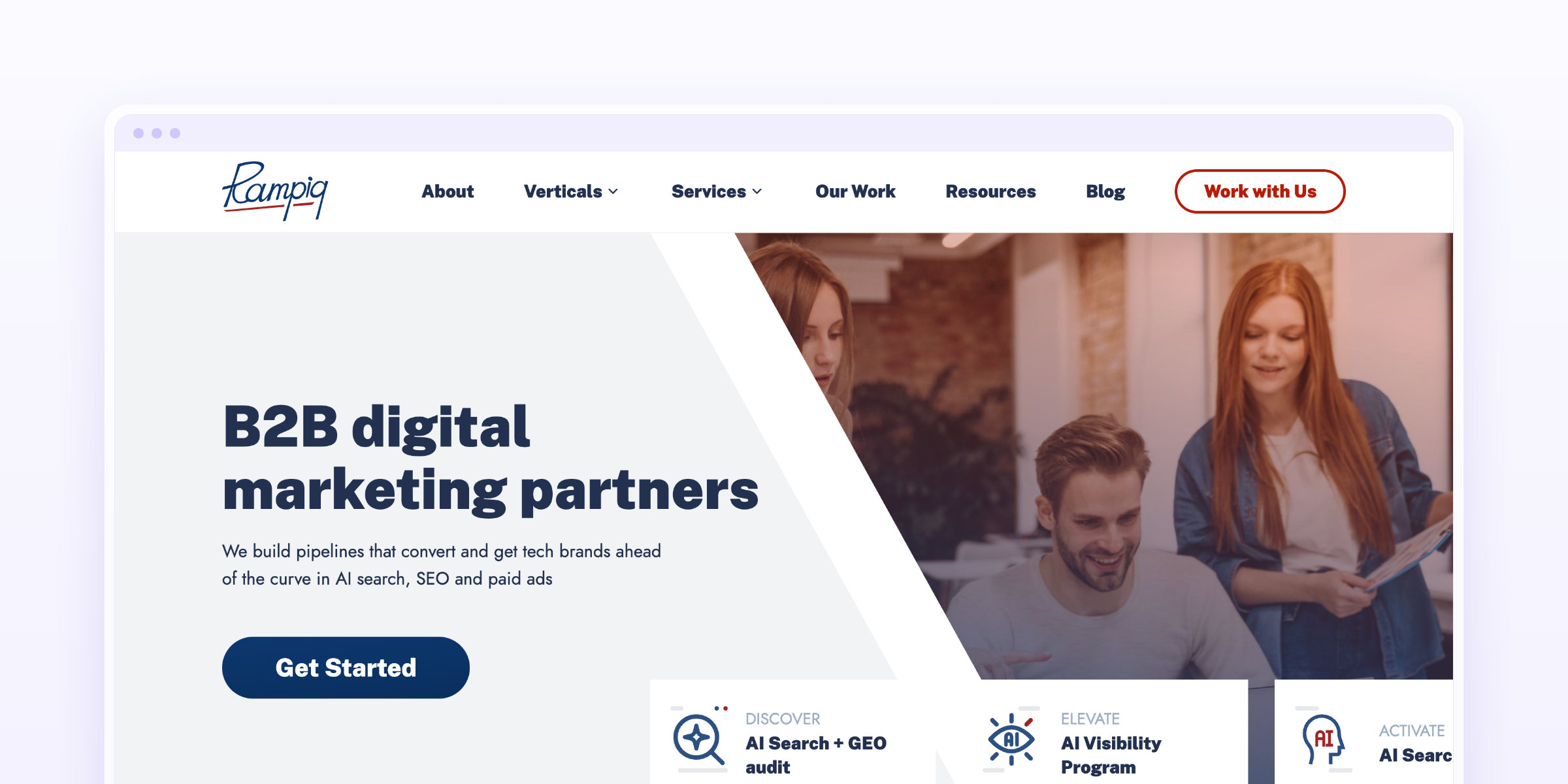
Rampiq is an Arlington, Virginia–based B2B digital marketing agency for SaaS and technology companies, led by founder and CEO Liudmila Kiseleva. It says it has run its AI Visibility Optimization Program across 30+ B2B brands, and it publishes research from that work, including a finding that roughly 85% of citations for broad category queries come from third-party sources.
Its offer splits into a one-time diagnosis and ongoing programs. That suits a team that wants to see the gaps before committing to monthly spend: a marketing lead can buy the audit, take the action plan to leadership, and then decide whether to retain the agency or execute in-house.
Standout capabilities:
- AI Visibility Intensive: an AI search audit, AI Overview opportunity analysis, LLM and competitor gap assessment, an action plan, and a 90-minute executive readout
- AI Search Accelerator: eight on-page content briefs a month plus schema and structured-data implementation
- Coverage of ChatGPT, Perplexity, Gemini, and Google AI Overviews
- Adjacent channels, including SEO, CRO, and a LinkedIn pipeline program
Notable result: Rampiq reports that Case IQ reached 850+ keywords ranking in AI Overviews and a 145% increase in top-three rankings. It doesn't give a timeframe.
Clients include: Case IQ.
Limitations: The Accelerator commits to content briefs rather than finished articles, so article production, publishing, and off-site placements are scope questions.
Pricing: The Intensive costs $2,800 one-time. The Accelerator starts at $3,800 a month and the Leadership Program at $9,700 a month. Minimum term: not disclosed.
Best for: B2B tech teams that want a paid AI visibility diagnosis before a retainer.
3. LoudFace
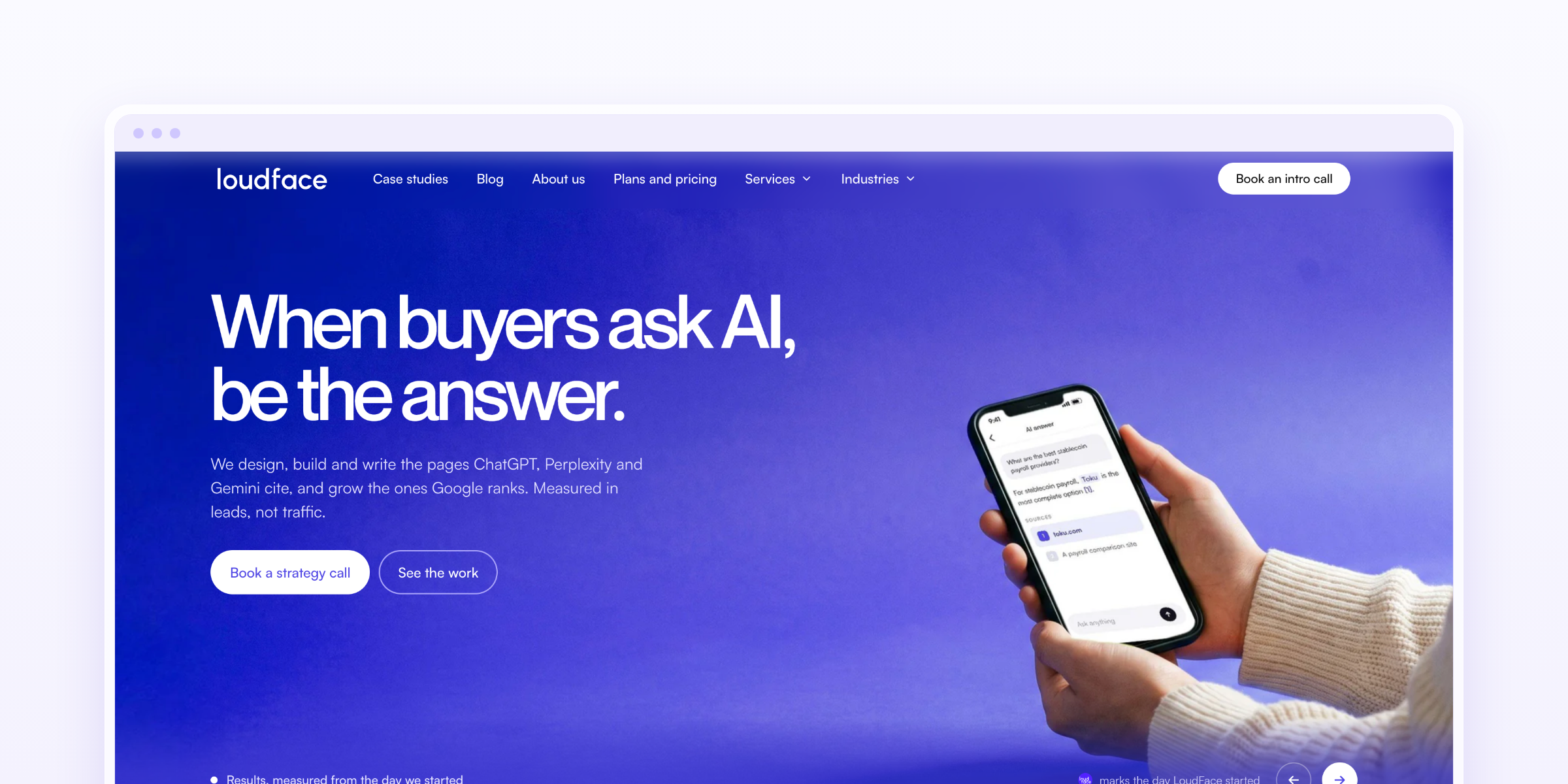
LoudFace is a San Francisco–based B2B SaaS web design and growth agency, founded in 2019 and a Webflow Enterprise Partner. It says it has built 200+ SaaS websites, and its model is to build the site and then grow it, with SEO, AEO, and CRO run by the same team.
That makes it a fit for Series A to C teams whose website is part of the problem. The AEO work lands on pages the same team can redesign and test for conversion, instead of being handed to a separate web vendor.
Standout capabilities:
- AEO for ChatGPT, Perplexity, Claude, and Google AI Overviews
- SEO, AEO, and CRO run together, aimed at turning traffic into pipeline
- Website builds and redesigns on Webflow
- Subscription-style plans that run one track (Build or Growth) or both in parallel
Notable result: LoudFace reports taking Toku from 0 to 86% AI visibility. For Dimer Health, it reports a 288% conversion lift.
Clients include: Toku, Hoxhunt, Eraser, Montblanc, and Radisson Hotels Group.
Limitations: Listicle placements and editorial mentions aren't a headline part of its offer, so ask how it builds third-party authority. Much of its portfolio is web design, so check which case studies include AEO work.
Pricing: Its Clutch profile lists the Small plan, one focused track, at $10,000 a month, with a $5,000+ minimum project size.
Best for: Series A to C SaaS teams that want their website, SEO, and AEO handled by one team.
4. Quoleady
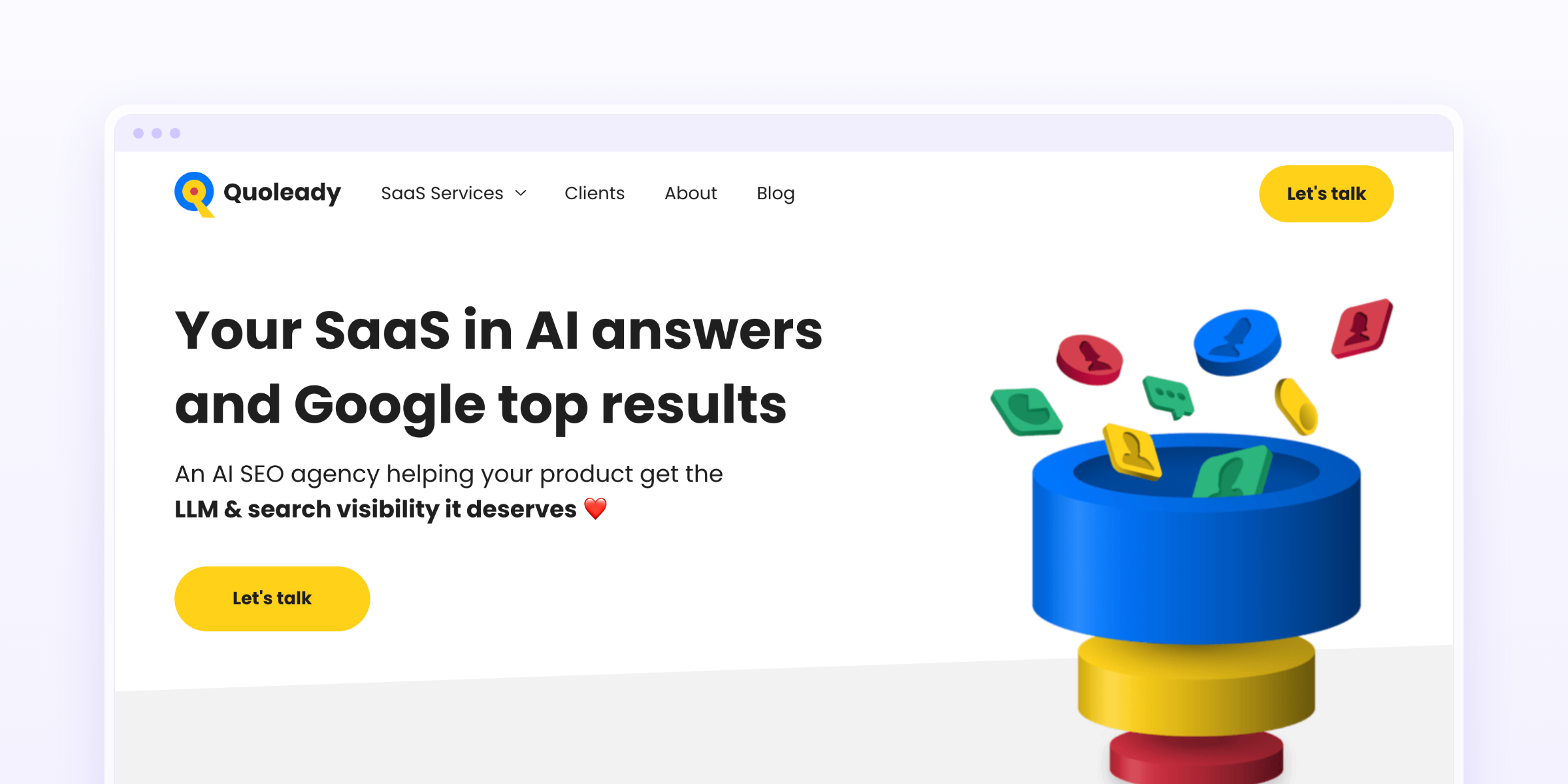
Quoleady is a remote content marketing agency for B2B SaaS, founded by Olga Mykhoparkina. It combines SEO, AI search visibility, digital PR, and content marketing, and its clients on Clutch note that leadership stays personally involved.
Its LLM optimization work is built on content updates, listicles, and digital PR aimed at earning AI citations. Unusually, its pricing page spells out content volumes and estimated placements for each tier, so you know what a month buys before the first call.
Standout capabilities:
- AI citation work built on content updates, listicles, and digital PR
- High content volume, from 10,000 to 20,000 words a month on the integrated plans
- Estimated placements listed for every tier
- Standalone link building for teams that only need authority
Notable result: Quoleady reports that Legal Nodes got 47.5% more booked meetings and top-five AEO and SEO rankings within three months.
Clients include: Expandi, airfocus, PassKit, Fuelfinance, Effy AI, and Legal Nodes.
Limitations: The packages are built around content and links, so an engineering-heavy brief with complex technical changes is a looser fit. Ask for comparable implementation work.
Pricing: The integrated SEO + AI Visibility plans are Launch at $3,500 a month, Growth at $5,000, and Scale at $7,000, each with a three-month minimum. They include 10,000, 15,000, and 20,000 words of content a month and an estimated 3–5, 4–6, and 6–9 placements respectively.
Best for: SaaS companies building AI visibility through content and links on a modest budget.
5. Reboot Online
Reboot Online is a UK search and digital PR agency that runs its GEO practice on controlled experiments. Part of that work is live fan-out query analysis: seeing the background searches an assistant runs before it writes an answer, which shows which pages actually feed the response and where an earned citation would count.
Authority work runs through AiPR, Reboot's offering for securing backlinks and citations from trusted third-party sources. Its GEO service also covers content and technical work, but earned coverage is what sets it apart.
Standout capabilities:
- Controlled experiments as the basis for recommendations
- Fan-out query analysis to find the sources AI answers draw on
- Named coverage of ChatGPT, Bing Chat, Gemini, Perplexity, and Claude
- AiPR for backlinks and citations from trusted publications
Notable result: Reboot Online reports that Alan Boswell grew LLM referral traffic by 194.72% and ChatGPT referral traffic by 382.5%, with a 233% increase in key events from LLM referrals.
Clients include: Alan Boswell.
Limitations: The model is PR-led, so teams that need a large on-site program, like a steady run of comparison and category pages, are a looser fit.
Pricing: Bespoke GEO starts at £2,500 a month (about $3,300).
Best for: Brands building AI citations through digital PR.
How to vet a GEO agency before you sign
The deciding test is simple: can the agency show a brand being recommended on prompts buyers use to choose a vendor, and explain what happened next without overclaiming? A rising visibility score is a diagnostic, not a result.
Which buyer prompts will you track, and how often? Look for a documented prompt set built from your category, competitors, and sales-call language, rerun on a fixed schedule.
Can you show results per engine? Expect separate numbers for ChatGPT, Perplexity, Gemini, Claude, and AI Overviews, with citations kept apart from recommendations. One blended score hides the engine where your buyers actually shortlist.
Where will the mentions come from? A strong agency names the listicles, review sites, and publications already cited for your prompts and explains how it would get you on them.
Who implements what? Get named owners for content, technical fixes, outreach, and reporting in writing, including whose developers ship changes and who publishes.
Can you walk us through a sample report? It should go from prompt visibility to AI referral traffic, signups, and pipeline, and say plainly where attribution stops.
What a credible report looks like
Take a hypothetical report for one engine: 20 fixed buying prompts, each run three times, gives you 60 answers. The report should state the prompt set, locale, run date, and model version, and keep the raw answers archived.
[table]
Layer | Example measure | What it can support
Visibility | 18 of 60 answers recommend the brand (30%) | Buyers' prompts surface the brand as an option
Visibility | 12 of 60 answers cite the brand's domain (20%) | Engines use the brand's pages as a source
Traffic | Identifiable AI referral sessions | People clicked through from AI answers
Business | Signups, demos, and CRM opportunities from those sessions | An observable contribution to pipeline
[/table]
Recommendations and citations are separate events. An answer can cite your pricing page without recommending you, or recommend you while citing a review site. Keep self-reported discovery apart from observed conversions, too.
The first 90 days to hold them to
- Days 1 to 30: a baseline prompt panel per engine, a technical, content, and third-party source audit, analytics and CRM setup, and a roadmap with an owner on every item.
- Days 31 to 60: prioritized technical fixes and product-led buying pages, like comparison and category pages.
- Days 61 to 90: outreach on the pages engines cite, plus the first per-engine report you can compare to the baseline.
These are delivery milestones, not promised recommendation dates. Your side of the deal is product access, subject-matter experts, accurate claims, analytics and CRM permissions, and fast approvals.
Red flags that signal relabeled SEO
Shared SEO foundations aren't a warning sign. Google says SEO best practices still apply because its generative features run on core Search ranking systems. The problem is a retainer with no AI-specific targeting, measurement, or delivery.
- Reports that only show rankings, traffic, or an unexplained visibility score. If nobody can tell you which prompts were run, on which engine, and how often you were recommended, nothing AI-specific is being measured.
- Guarantees of a top spot in AI answers. No agency controls model outputs.
- A plan that's only blog publishing. Real GEO includes off-site work: listicle placements, editorial mentions, and presence in the directories, communities, and reviews your buyers check.
- Schema sold as the GEO fix. Google states structured data isn't required for generative AI search, so it's housekeeping, not a strategy.
- Advice-only decks. If the answer to "who implements this?" is "your team," you're paying for recommendations.
Hiring a GEO agency vs. building it in-house
- Hire an agency if you need the capability quickly. An agency arrives with a method, tooling, and the editorial and outreach relationships that take a long time to build.
- Build in-house once GEO is a permanent function with its own budget, and you can hire content, technical SEO, outreach, and analytics skills.
- Go hybrid if you have one person who can own priorities but not a full team. That internal owner supplies positioning, product access, subject-matter experts, and approvals, while the agency owns the audits, content, outreach, and reporting.
How much a GEO agency costs
Budget from scope, not a headline monthly number. Published prices on this list come in several shapes: a one-time audit fee, monthly entry prices, a starting fee in pounds, and custom proposals. They don't add up to a market rate.
[table]
Cost driver | Pushes the quote up | Keeps it down
Scope mix | Content, technical work, and off-site authority together | One workstream, like content only
AI engines tracked | Per-engine reporting across five or more engines | The two or three engines your buyers use
Markets | Several countries and languages | One market, one language
Implementation | Agency ships technical changes and publishes | Your team implements
Reporting depth | Conversion and CRM integration | Visibility diagnostics only
[/table]
Contract structure matters as much as price. A longer retainer suits programs where content and off-site authority compound over months, as long as it comes with milestones and exit terms. Month-to-month terms suit teams testing whether GEO fits their funnel.
When you compare quotes, line them up on deliverables, implementation, reporting, and commitment. Four articles and a visibility dashboard is a different purchase from content, outreach, and per-engine reporting tied to your CRM, whatever the monthly fee.
Key takeaways
When I was hiring agencies in-house, one question sorted the good pitches from the bad ones: "What will you change, and how will I know it worked?" It works just as well for GEO.
- Pick by growth model, not by label. Seen for B2B SaaS teams that want AI search and Google in one program judged by signups. Rampiq for a paid diagnosis first, LoudFace for website and AEO from one team, Quoleady for content and links on a modest budget, and Reboot Online for PR-led citations.
- Make sure it's real GEO. Named engines, prompt-level reporting per engine, and off-site work on the pages AI answers cite.
- Ask for proof with context. Named clients, the exact prompts and engines, and a link to signups or pipeline.
- Compare scope, not price. The same monthly fee can buy very different work.
[cta]
Want GEO that shows up in your signups, not just a dashboard?
Seen builds the pages and earns the mentions that get B2B SaaS brands recommended in ChatGPT, Claude, Gemini, and AI Overviews, then reports the result in pipeline.
[/cta]
FAQs
What's the best GEO agency for B2B SaaS?
For B2B SaaS companies, Seen is our top pick, because it runs SEO, GEO, and AEO as one program and measures it by signups and pipeline. Whoever you shortlist, ask for named results on unbranded buyer prompts, reported per engine.
Is a GEO agency the same as a local SEO agency?
No. GEO stands for generative engine optimization, which means getting a brand cited and recommended in AI answers. Local or geographic SEO targets map results and location-based searches, which is a separate discipline.
Do I need a GEO agency if I already have an SEO agency?
Only if your current SEO agency can't show per-engine prompt tracking, recommendation rates, and off-site authority work. If its reports stop at rankings and traffic, add a GEO specialist or move the work.
Can a PR agency handle GEO?
Partly. Third-party coverage is a major input to AI answers, but PR alone misses technical fixes, product-led buying pages, and prompt measurement.
Which AI engines should a GEO agency optimize for?
The ones your buyers actually use. Ask recent customers where they researched vendors, then have the agency report on each of those engines separately.
How long does it take a GEO agency to show results?
It depends on your starting authority and how quickly you ship fixes and content. Be wary of anyone who promises a recommendation by a fixed date, and hold the agency to delivery milestones instead, with a first comparable per-engine report by around day 90.